





The recently concluded Assembly elections in Kerala, Tamil Nadu, Assam, and West Bengal reaffirm a well-established feature: women form a large, active, and electorally consequential segment of the electorate. In these elections, too, women’s turnout remained high, and in several cases, slightly higher than that of men, making their participation central to the outcomes.
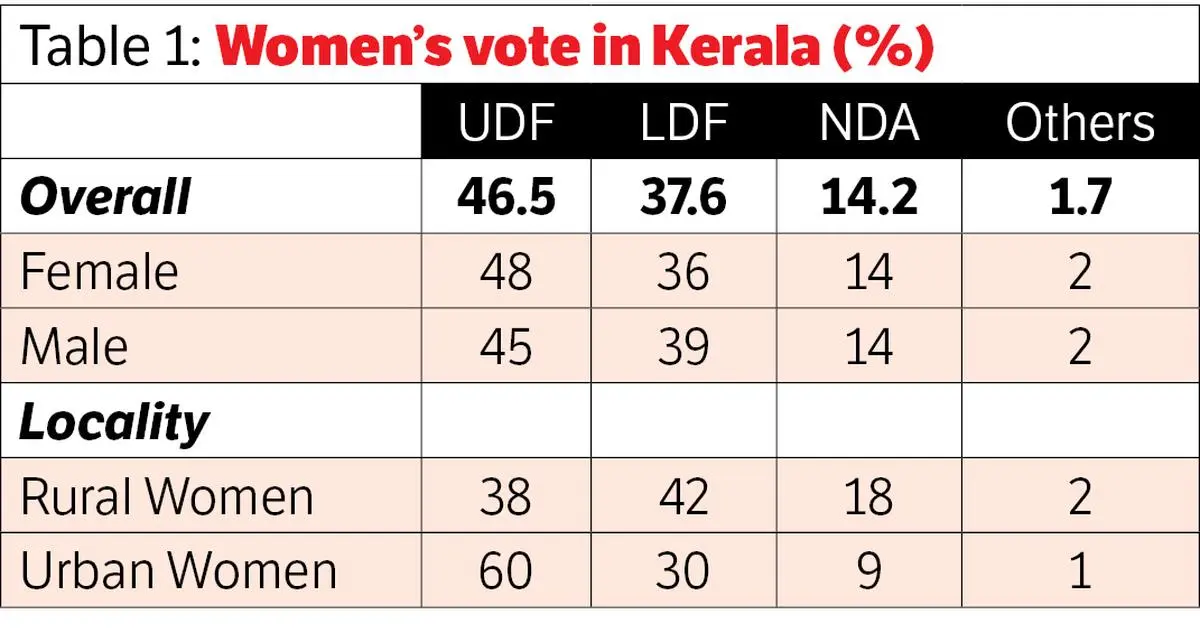
In Kerala, women leaned more decisively towards the United Democratic Front (UDF), with roughly 48 per cent backing it as compared to 36 per cent backing the Left Democractic Front (LDF) and 14 per cent the National Democratic Alliance (NDA). Men also favoured the UDF, though less decisively (about 45 per cent for the UDF and 39 per cent for the LDF). The difference, however, was one of degree rather than direction, as both men and women favoured the UDF as the leading choice (Table 1).
These aggregate patterns were further differentiated by location, age, and class among women voters in Kerala. A rural–urban divide was evident: rural women were more inclined towards the LDF (42 per cent) than the UDF (38 per cent), while urban women showed a strong and decisive preference for the UDF (60 per cent) over the LDF (about 30 per cent), indicating a sharp spatial divergence in voting behaviour (Table 1).
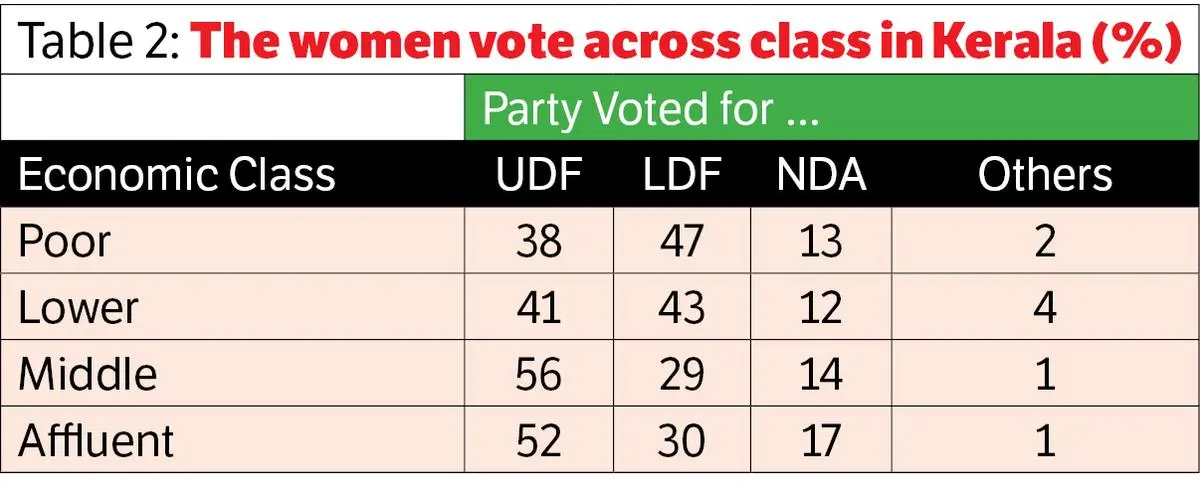
Younger women (up to 45 years) supported the UDF at levels above 50 per cent, while support for the party declined among older women, who showed a stronger inclination towards the LDF. Class divisions were equally significant. Women from poor and lower-income households were more supportive of the LDF (around 47 per cent and 43 per cent respectively), whereas those from the middle and affluent classes showed a clear preference for the UDF, with support ranging from about 52 per cent to 56 per cent (Table 2).
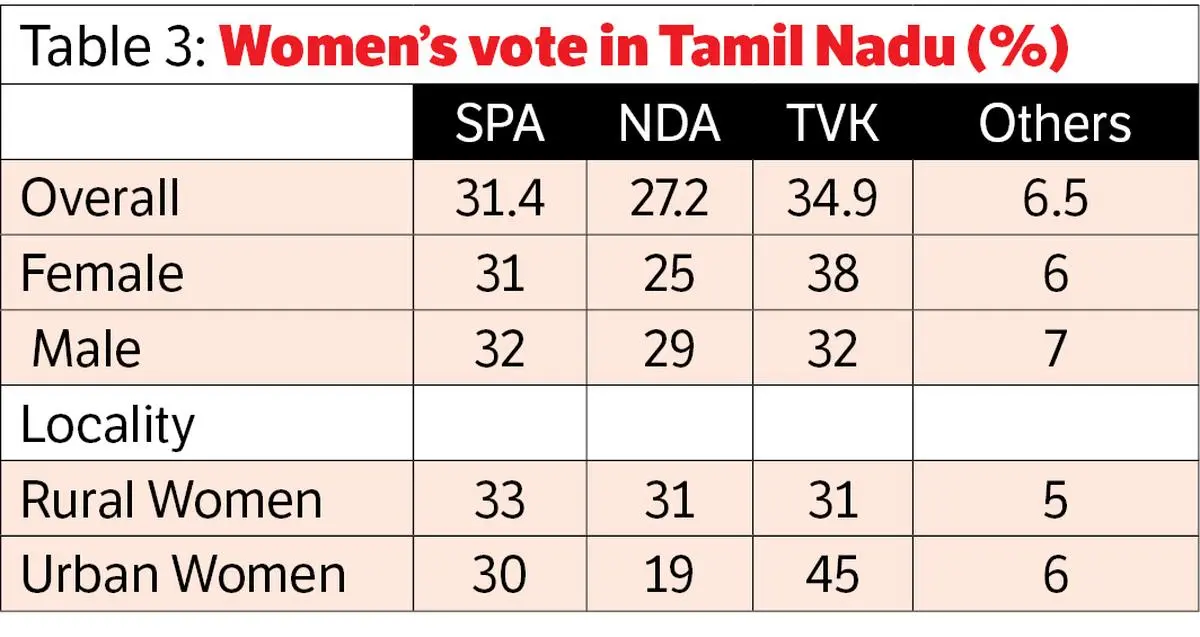
In Tamil Nadu, women voters showed a relatively fragmented but clearly structured pattern of electoral choice. Overall, women were most inclined towards the Tamilaga Vetri Kazhagam (TVK) (38 per cent), followed by the Dravida Munnetra Kazhagam (DMK)-led Secular Progressive Alliance (SPA) (31 per cent) and the AIADMK-led NDA alliance (25 per cent), indicating that the TVK emerged as the single largest preference among women. Compared to men, women showed a stronger preference for TVK and a relatively lower inclination towards the NDA alliance, while the DMK’s support remained broadly similar across genders (Table 3).
The rural-urban divide was pronounced. Rural women showed a fairly even distribution of preferences across the SPA (33 per cent), NDA (31 per cent), and TVK (31 per cent), suggesting a closely contested three-way split. Urban women, by contrast, showed a strong tilt towards the TVK, which received 45 per cent support, compared to 30 per cent for the SPA and 19 per cent for the NDA (Table 3).
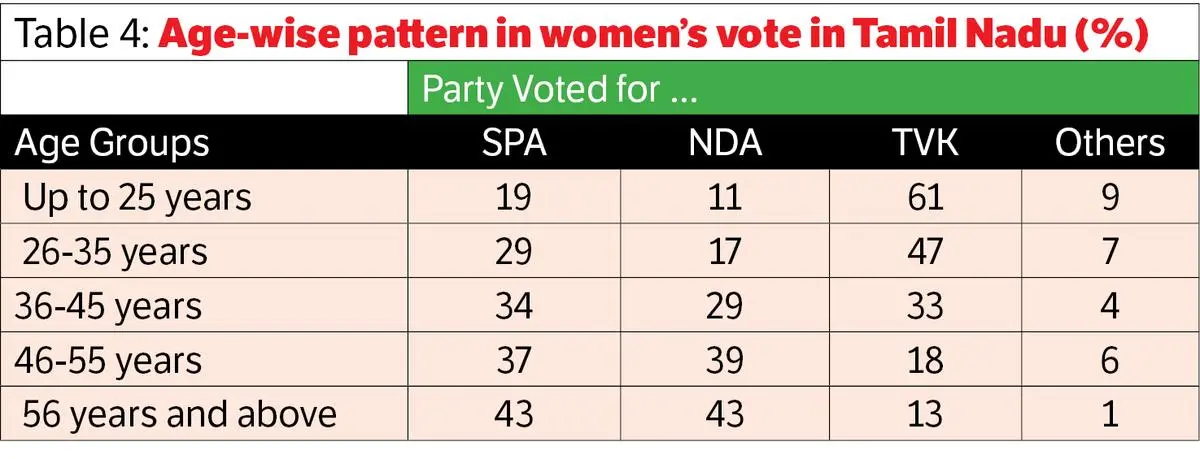
The age-wise variation was particularly sharp and indicated a clear generational shift. Younger women strongly favoured the TVK, and support declined steadily with rising age, while the other two alliances gained relatively greater support among older women (Table 4).
Class differences followed a similar pattern. Among poorer women, voting was relatively divided, with the NDA (36 per cent) and TVK (34 per cent) ahead of the Secular Progressive Alliance (27 per cent). As economic status increased, support for TVK rose, reaching 41 and 42 per cent among women from middle and affluent classes.
The data point to a significant concentration of TVK support among younger and economically well-off women, while older and poorer women remained more divided across the two Dravidian parties.
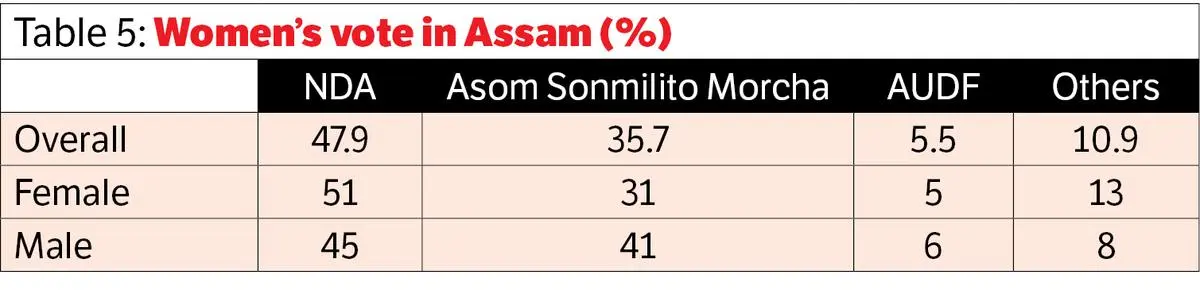
In Assam, women voters showed a clear and consolidated preference for the NDA, with 51 per cent supporting it compared with 31 per cent backing the Congress-led coalition Asom Sonmilito Morcha (ASM), 5 per cent the All India United Democratic Front (AUDF), and 14 per cent others. Compared to men, women were more strongly aligned with the NDA and less supportive of ASM, indicating a modest but clear gender tilt in favour of the NDA (Table 5).
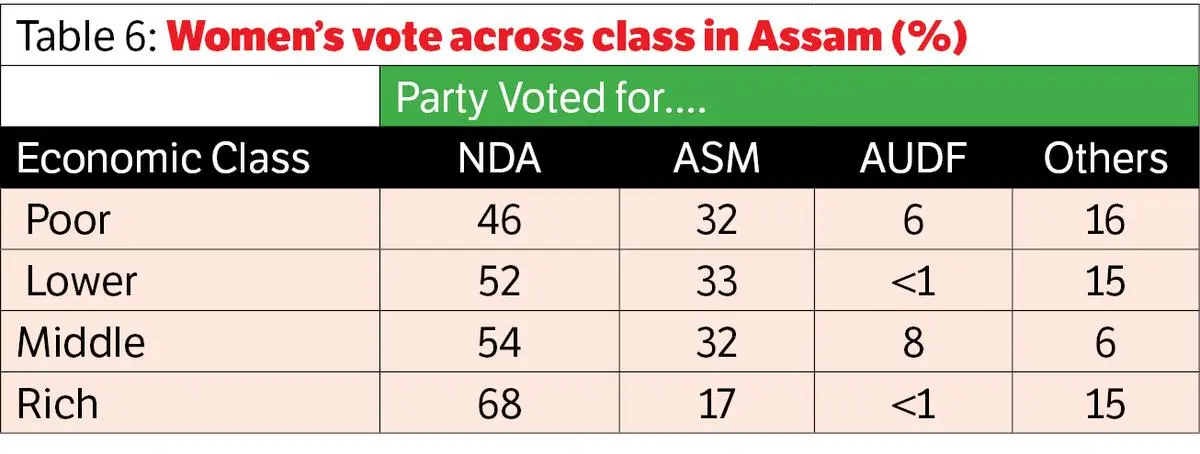
The NDA drew strong support from both younger and older women, with support dipping slightly in the 36-45 age group, though it remained around 45 per cent . Class differences reinforced the dominance of the NDA among economically better-off groups, with support rising in direct proportion to economic status (Table 6).
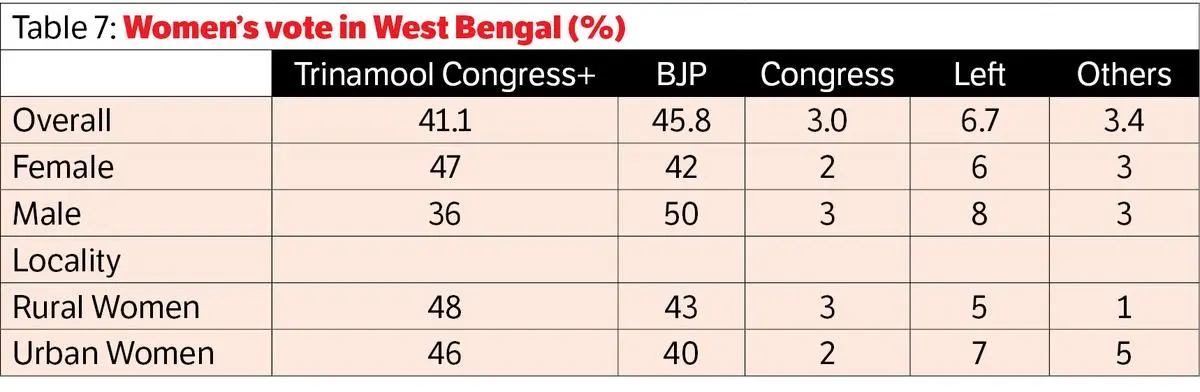
In West Bengal, women voters were closely divided between the All India Trinamool Congress (AITC)-led alliance (47 per cent) and the BJP (42 per cent), with only a small gap. Men, by contrast, showed a clearer preference for the BJP (50 per cent) over the Trinamool (36 per cent), indicating a pronounced gender difference in voting. While the Trinamool retained a narrow lead among women, the BJP took a substantial share, suggesting that the BJP had made significant inroads into this segment (Table 7). In 2021, the women vote went far more sharply for the Trinamool. Rural-urban differences were limited, with the Trinamool holding only a narrow lead, while the BJP trailed closely in both spaces, but showing growing inroads (Table 7).
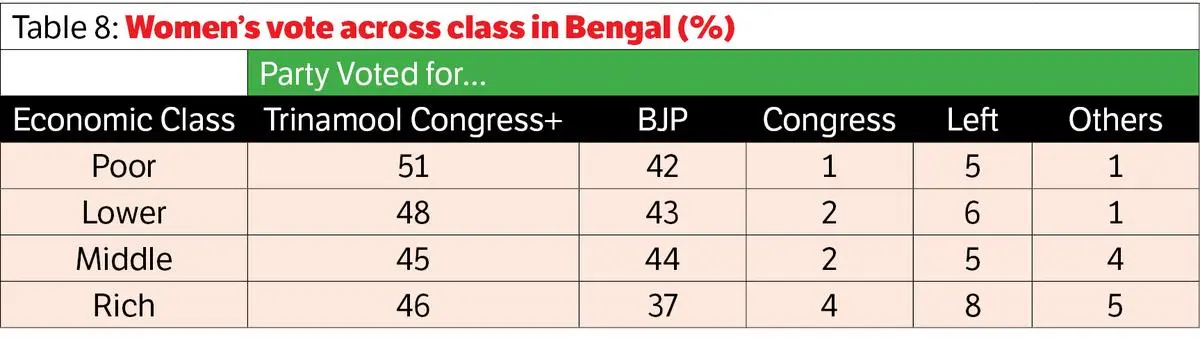
Across age groups, the women’s vote in West Bengal showed a close contest between the Trinamool and the BJP, with variation across cohorts but no single trend. Class-wise differences were visible among women, with those from poor backgrounds showing stronger support for the Trinamool (51 per cent) compared to the BJP (42 per cent). Among lower-income and middle-class women, the gap was smaller, with near parity in the middle group (45 per cent for the Trinamool and 44 per cent for the BJP). Among affluent women, the Trinamool again had a clear lead (46 per cent versus 37 per cent for the BJP) (Table 8).
While there have been variations, there is no doubt that women’s participation has been on the rise and they are a constituency that no political party can ignore.
Sanjay Kumar is an election analyst and a psephologist. Vibha Attri and Arindam Kabir are researchers with Lokniti-CSDS.
The views expressed by the authors are their individual views. They do not reflect the views of any institution.
Also Read | Did women-centric welfare schemes influence voting in Bengal, Kerala, and Tamil Nadu?
Also Read | How Vijay achieved a breakthrough in Tamil Nadu