













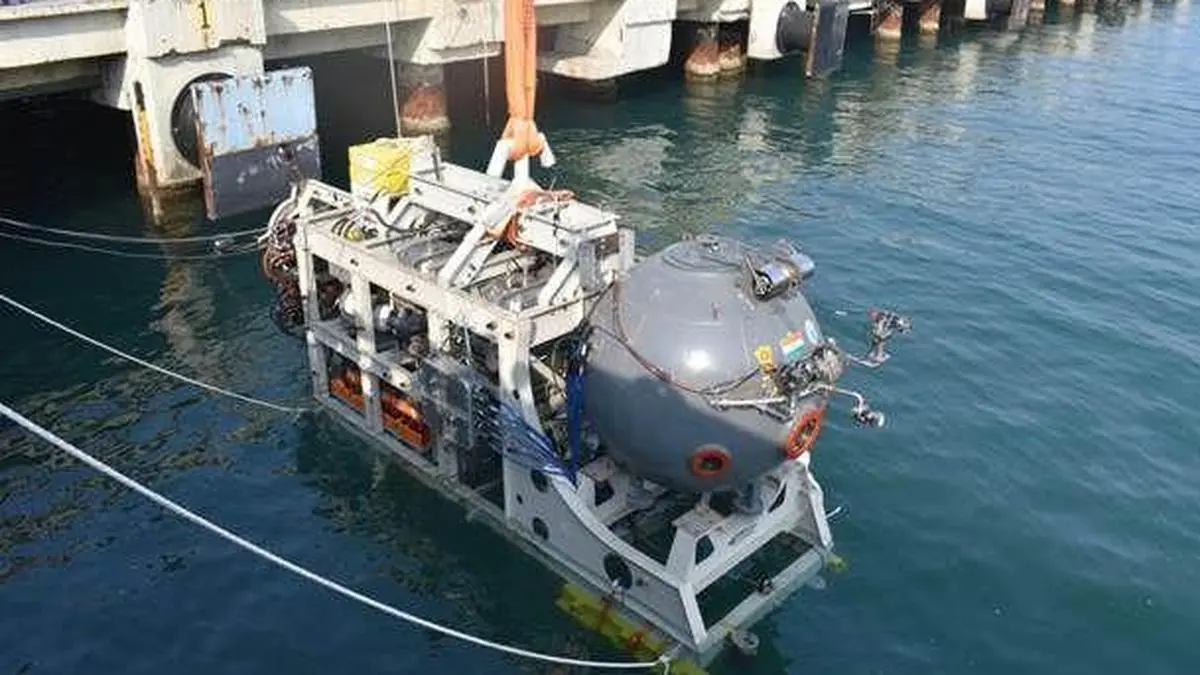
The National Institute of Ocean Technology has developed MATYSA 6000
The ₹4,077-crore Deep Ocean Mission, launched in 2021 to explore and eventually mine critical minerals from polymetallic nodules on the Indian Ocean bed, has made limited progress. With the current year marking the end of the programme, only about 35 per cent of the allocated budget has been spent by the Ministry of Earth Sciences.
A Parliamentary Standing Committee on Science and Technology Environment Forests and Climate Change, which examined the ministry’s demands for grants, noted “with concern” that progress “does not appear to be commensurate with the objectives and timelines originally envisaged.”
In a recent report, the committee said that “the pace of progress under certain critical verticals of the Mission needs to be significantly accelerated” to achieve intended outcomes within a reasonable timeframe.
Polymetallic nodules—potato-shaped mineral-rich concretions—are found scattered across parts of the ocean floor. The International Seabed Authority has allotted India an area of 75,000 sq km in the Indian Ocean for exploratory work. In December, the ministry told Parliament that this area is estimated to hold 366 million tonnes of nodules, containing 0.14 per cent cobalt, 1.14 per cent nickel, 1.09 per cent copper and 25.2 per cent manganese.
The National Institute of Ocean Technology, under the ministry, has designed a deep-sea mining system capable of operating at depths of up to 5.5 km. It has also developed MATYSA 6000, a human submersible for deep-sea exploration.
However, a fully-integrated mining system is yet to be realised.
The ministry attributed the underutilisation of funds to lower spending in the initial phase, citing the “preparatory nature of activities.” Expenditure stood at 40 per cent and 32 per cent of allocations in 2021-22 and 2022-23, respectively, before rising to 48 per cent and 98 per cent in the subsequent two years.
The committee has recommended clearly defined and measurable milestones across the Mission’s six verticals, along with fixed timelines and a structured monitoring mechanism to track progress and address bottlenecks.
Commercial deep-sea mining is not yet feasible, as the International Seabed Authority is still finalising the ‘Exploitation Code’.
Mining polymetallic nodules is only one objective of the Mission. Others include ocean climate advisory services, technologies for exploring and conserving deep-sea biodiversity, harnessing energy and freshwater from the ocean, and setting up an advanced marine biology station.
The ministry has reported progress in some areas. For instance, 1,845 deep-sea microbes, including previously unknown species, have been isolated from samples in India’s exclusive economic zone. The Centre for Marine Living Resources and Ecology has also surveyed 25 seamounts in the Lakshadweep and Andaman and Nicobar regions, documenting 195 deep-sea species.
Published on April 16, 2026
此内容由惯性聚合(RSS阅读器)自动聚合整理,仅供阅读参考。 原文来自 — 版权归原作者所有。