





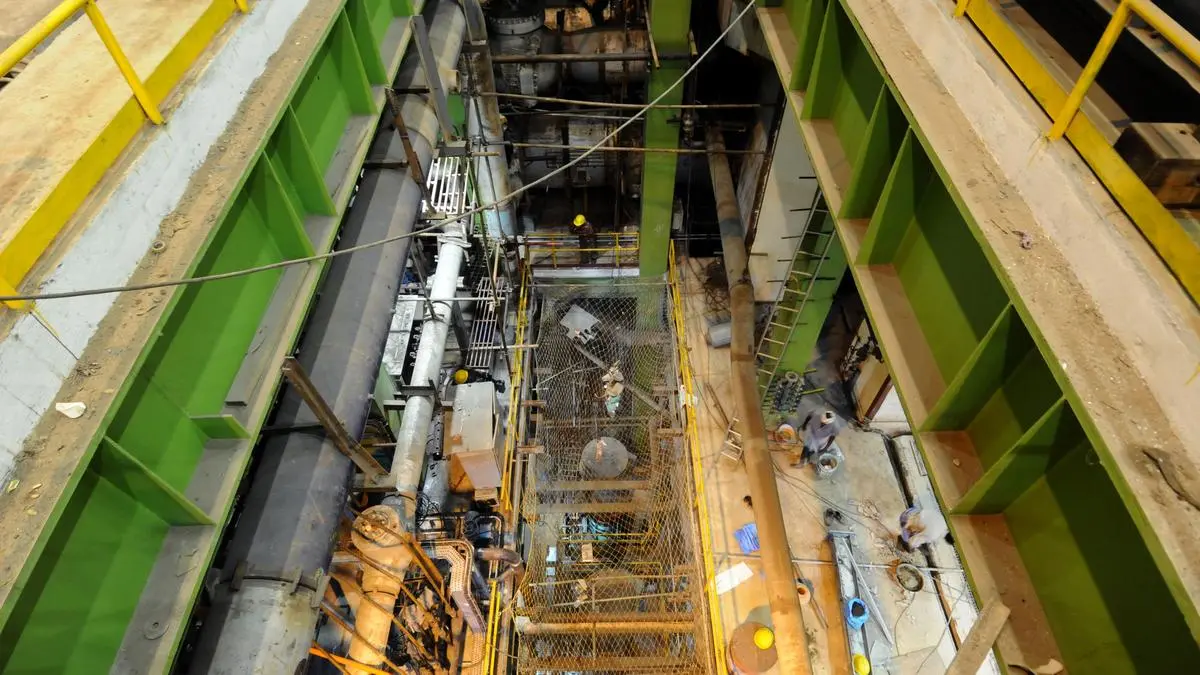
File Photo: A section of the Prototype Fast Breeder Reactor (PFBR) showing the complexity of the equipment that has gone into its making, in Kalpakkam, Tamil Nadu | Photo Credit: RAGU R
A Parliamentary Committee has expressed unhappiness over the delays in—and mounting cost of—executing the 500 MW Prototype Fast Breeder Reactor (PFBR) nuclear power project, whose construction began in 2004.
The cost of the project is today estimated at ₹8,181 crore, compared with its original cost of ₹3,492 crore. For over a decade, the project has been “ready for commissioning next year.”
The Parliamentary Standing Committee on Science and Technology, Environment, Forests and Climate Change, which examined the ‘demands for grants’ of the Department of Atomic Energy (DAE), has noted that the project “remains in the commissioning stage without having commenced power production, and that no operating revenue, profit or dividend has been generated by BHAVINI (the government company set up for the project).”
The PFBR project is of critical national importance, as it would set a template for India’s ambition to set up more fast breeder reactors. Fast breeder reactors use as fuel the plutonium-239 that comes out as waste in the conventional uranium-235 reactors, and generate more plutonium-239 – which is why they are called breeders. More importantly, they pave the way for using thorium as nuclear fuel—India has plenty of thorium. As fast breeder reactors generate energy, they can also convert thorium into uranium-233, which is nuclear fuel.
Thus, the PFBR is the first step in India getting into the second of the planned three-stage programme—the three phases can be broadly understood as relating to the use of uranium, plutonium and thorium as nuclear fuel.
Yet, the project, which was originally slated to be completed by 2011, has already been delayed by 15 years.
The committee has expressed “deep concern” over this delay and has called upon the government to “introduce a milestone-linked budgetary release mechanism for BHAVINI,” so as to align financial flows with actual technical progress. It has also asked BHAVINI to seek international help “to reduce the risk of recurring technical delays.”
The Budget for 2025-26 allocated ₹374 crore to BHAVINI which was later slashed to ₹150 crore when the revised estimates were drawn up. Still, BHAVINI could spend only ₹50 crore till December 2025.
The committee has observed that “BHAVINI’s severe underutilisation is particularly concerning given that approximately 70 per cent of the PFBR core has been loaded as of February 2026.”
Meanwhile, the ₹9,589 crore ‘fast reactor fuel cycle facility’ (FRFCF) project, which is closely related to the PFBR, has also been hugely delayed. The project, meant to reprocess the spent fuel coming out of the PFBR, was originally expected to be ready for operations in 2014. Last week, the Department of Atomic Energy told the Rajya Sabha that it is expected to be commissioned in December 2029.
While the FRFCF project has no relevance until the PFBR is commissioned, it is worth noting that the government has already spent ₹4,904 crore on it.
Published on April 5, 2026
此内容由惯性聚合(RSS阅读器)自动聚合整理,仅供阅读参考。 原文来自 — 版权归原作者所有。