








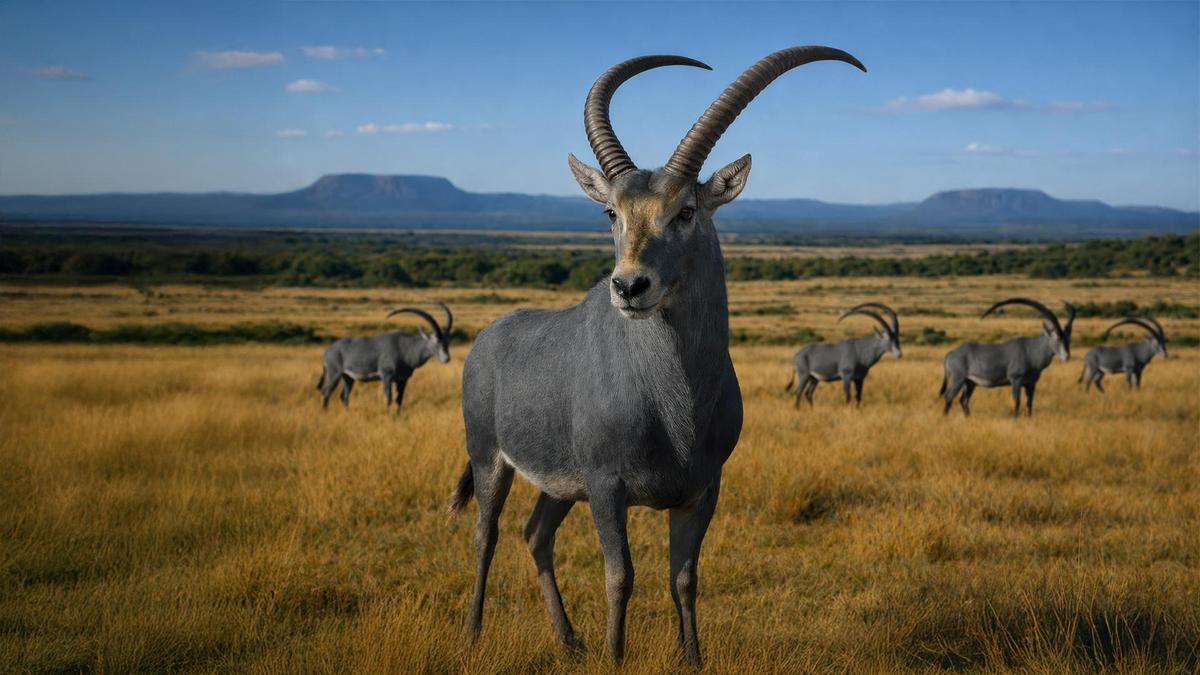
An artist’s rendering of the extinct African antelope, the bluebuck, released on April 30, 2026. Colossal Biosciences is working to revive the species using genetic engineering after it was hunted to extinction around 1800. | Photo Credit: Colossal Biosciences
The bluebuck, an antelope with a silvery slate-blue coat and striking horns, inhabited the coastal grasslands of South Africa’s southwestern Cape region until European settlers hunted it to extinction in around 1800. A U.S. company now plans to resurrect the bluebuck as part of its de-extinction efforts.
Dallas-based Colossal Biosciences announced on Thursday that it has made the bluebuck the sixth species in its de-extinction portfolio based on genetic engineering, alongside three other mammals - the dire wolf, woolly mammoth and thylacine, also called the Tasmanian tiger - and two birds, the dodo and moa.
“We’re two years into the bluebuck project and have already completed several foundational steps,” Colossal CEO and co-founder Ben Lamm told Reuters. “We are equally excited about how our technology can help living antelopes today. About a third of the world’s roughly 90 antelope species are threatened or near-threatened.”
Prized for the unique color of their hides, bluebuck were hunted to extinction just 34 years after the species was first documented scientifically. The animal stood about four feet (1.2 meters) tall at the shoulder, with backward-curving and ringed black horns reaching about 22 inches (56.5 cm) long, and was smaller than the closely related roan and sable antelopes.
“Humans did this. European settlers shot the bluebuck out of the Cape in under 34 years. There’s no ambiguity about the cause and there’s no ambiguity about the responsibility. If we have the capability to right that wrong, I think we have an obligation to,” Lamm said.
The company in April 2025 announced the birth of three genetically engineered wolf pups created with the help of ancient DNA obtained from fossilized remains of dire wolves, an Ice Age predator that went extinct roughly 13,000 years ago. The process used to create them involved editing the genes of the gray wolf, the closest living relative of the extinct species, to add dire wolf traits, and creating an embryo.
In the case of the bluebuck, Colossal is editing the genes of an African antelope called the roan, its closest living relative.
“We are now in the genome-editing phase, where we introduce key bluebuck edits and genes into roan antelope cells,” Lamm said, adding, “After finishing the various edits, the next step will be to use the edited cells to create an embryo and move toward implantation. From there, gestation would take about nine months.”
The plan is for the embryo to be implanted into a surrogate roan mother. Through cloning, embryos were created from edited gray wolf cells in the dire wolf project, and these were implanted in surrogate domesticated dog mothers.
Lamm said the company mainly used a mounted bluebuck skin from a young male specimen at the Swedish Museum of Natural History in Stockholm to obtain bluebuck DNA.
The team compared the bluebuck and roan genomes to understand what made the bluebuck unique, Lamm said, noting that the two species are more than 98% genomically similar. The team has created pluripotent stem cells in roan antelope - “essentially versatile ‘starter cells’ that can become many different cell types,” Lamm said.
“We’ve also made breakthroughs in reproductive methods, including successfully collecting eggs from antelope species using advanced techniques,” Lamm said.
Even as a growing number of species slip into oblivion due to human actions including hunting and habitat destruction, scientists have debated the ethics of attempting to resurrect extinct species.
“Honestly, I think the debate sometimes functions as a way to avoid a harder conversation, which is that conservation as currently practiced is not winning. We are losing species faster than our existing toolkit can address,” Lamm said.
Colossal called the wolves it created dire wolves and referred to the species as the world’s first successfully “de-extincted” animal. Some outside experts described them as genetically modified gray wolves.
“The three dire wolves live on a 2,000-acre (810-hectare) secure, expansive ecological preserve that allows us to monitor and manage them while providing them a semi-wild habitat to thrive in. We hope to have more dire wolf pups by the end of the year. We will also have scientific progress announcements around the mammoth, dodo, thylacine and moa before the end of the year, but the projects are all running on track,” Lamm said.
Published on May 1, 2026
此内容由惯性聚合(RSS阅读器)自动聚合整理,仅供阅读参考。 原文来自 — 版权归原作者所有。