





惯性聚合 高效追踪和阅读你感兴趣的博客、新闻、科技资讯
阅读原文 在惯性聚合中打开

推荐订阅源

U
Unit 42
S
Security Affairs
Engineering at Meta
Engineering at Meta
MongoDB | Blog
MongoDB | Blog
Microsoft Security Blog
让小产品的独立变现更简单 - ezindie.com
美团技术团队
月光博客
月光博客
Cyber Security Advisories - MS-ISAC
有赞技术团队
有赞技术团队
博客园 - 叶小钗
Hugging Face - Blog
Hugging Face - Blog
Microsoft Azure Blog
V
V2EX
Vercel News
Vercel News
阮一峰的网络日志
阮一峰的网络日志
腾讯CDC
C
Cisco Blogs
T
Tor Project blog
The Hacker News
The Hacker News
雷峰网
雷峰网
MyScale Blog
MyScale Blog
博客园 - 司徒正美
AWS News Blog
AWS News Blog
GbyAI
GbyAI
Y
Y Combinator Blog
D
DataBreaches.Net
Simon Willison's Weblog
S
Securelist
The GitHub Blog
The GitHub Blog
S
SegmentFault 最新的问题
T
Tenable Blog
L
LangChain Blog
M
MIT News - Artificial intelligence
N
Netflix TechBlog - Medium
The Cloudflare Blog
A
About on SuperTechFans
IT之家
IT之家
F
Fortinet All Blogs
Security Latest
Security Latest
Threat Intelligence Blog | Flashpoint
NISL@THU
NISL@THU
爱范儿
爱范儿
钛媒体:引领未来商业与生活新知
钛媒体:引领未来商业与生活新知
cs.AI updates on arXiv.org
freeCodeCamp Programming Tutorials: Python, JavaScript, Git & More
W
WeLiveSecurity
A
Arctic Wolf
I
Intezer
Application and Cybersecurity Blog

Science News, Space News, ISRO, NASA News & Updates | The HinduBusinessLine

Ancient marine reptile was a fearsome “T. rex of the sea”, study finds Think it's hot now? The next five years will smash records: UN Climate change fuelling growth of antibiotic-resistant Salmonella: Study Red Balloon launches India’s first stratospheric super-pressure balloon NASA unveils 3-phase $20-billion plan for permanent moon base Space start-up AnduraX to conduct ‘drop test’ for reusable spaceplanes India can boost Ebola vaccine and antibody development: Soumya Swaminathan ICMR launches major biomedical innovation and technology transfer platform China to send astronaut on year-long space mission as it targets 2030 moon landing China's new lunar mission to conduct environment and resource surveys of Moon’s south pole Gujarat, Tamil Nadu to get new technical facilities for space sector manufacturing SpaceX sets Mars vision with 1 million population target for Musk incentives SpaceX invests over $15 billion in Starship rocket development, SEC filing reveals SpaceX targets 10,000 rocket launches per year within five years, FAA says Strand Life Sciences marks a research milestone that aids drug discovery AI Meets Agriculture: Indian scientists creates gene editor for crops Pune scientists develop DME fuel to reduce India’s LPG import dependence With AI, science is borderless Global space-tech major ICEYE to launch satellite production in India Scientists find climate change is reducing oxygen in rivers worldwide WOG Tech sets up research centre IIT Bombay launches indigenous carbon capture and storage pilot facility David Attenborough turns 100 amid global tributes and BBC celebrations Trump releases classified UFO files and Apollo mission records India seeks greater role in global international space norms Newer weight loss drugs may alter brain's reward circuit, impact how one experiences pleasure: Study Skyroot Aerospace becomes unicorn after $60 million funding ahead of Vikram-1 launch India and Japan sign quantum technology and healthcare cooperation agreements FICCI, PSA office join hands to drive deep tech and innovation in India Elon Musk, PM Modi hail GalaxEye’s landmark Mission Drishti space mission Bengaluru start-up’s satellite launched aboard SpaceX rocket: What is Mission Drishti? Extinct bluebuck may return as scientists advance gene-editing project SpaceX sets futuristic pay goals for Musk with Mars colony and valuation targets Skyroot’s rocket sets off for Sriharikota from Hyderabad Cretaceous “Kraken” octopus discovered as apex predator of ancient seas Red Balloon Aerospace to launch its inaugural Super Pressure Balloon soon Blue Origin fails to place AST satellite in correct orbit, FAA orders probe G20 satellite expected to be launched in 2027: ISRO chief Narayanan Poor progress in Deep Ocean Mission Indian spacetech startups shift gears from R&D to scalable manufacturing Artemis II astronauts return to Earth after historic lunar flyby and Pacific splashdown MAHE and Helogen Corporation partner for space-based biomedical research ISRO successfully conducts second integrated air drop test for Gaganyaan mission Artemis II astronauts prepare for reentry after historic moon mission Global agencies praise India’s fast breeder reactor milestone NASA's lunar success sharpens focus on China's 2030 crewed landing goal NASA Artemis II astronauts to speak from lunar orbit after record-setting flyby Artemis II breaks Apollo 13's distance record with daring moon flyby that included solar eclipse Artemis II astronauts break Apollo 13 distance record in historic lunar mission Parliament body unhappy as PFBR cost mounts to ₹8,181 crore ISRO eyes May launch; Artemis-II will be a success, says Chairman V Narayanan ISRO launches Mission MITRA in Ladakh to test astronaut performance for Gaganyaan Artemis II mission: Crew clicks dazzling Earth images 90,000 miles away SpaceX has held talks with Saudi fund for possible $5 billion investment in IPO, sources say Artemis II crew rockets toward the moon after orbiting Earth for a day Artemis II astronauts reach orbit on historic mission to moon and back How Artemis II could decide the future of NASA’s costly SLS rocket Key milestones in NASA’s Artemis program and the path to the moon How NASA’s Artemis II mission will unfold from launch to moon flyby NASA’s Artemis II launches astronauts on historic moon flyby after 50 years American Heart Association calls for shift to plant-based proteins, reduced full-fat dairy intake Eutelsat in talks with ISRO to boost satellite launch options NASA begins countdown for humanity's first launch to the moon in 53 years Swadeshi technologies and a long-term approach to innovation important for India: IIT-M’s Kamakoti CSIR transfers bio-bitumen technology; firms seek buyback assurance NASA’s Artemis II mission: Timeline of the first crewed Moon journey since Apollo CERN scientists achieve first-ever transport of antimatter Silent threat: Hidden liver fibrosis affects 26% of Type-2 diabetics India aims to cut emissions intensity by 47% by 2035 from 2005 levels With satellite navigation system NavIC not fully functional, experts doubt it can be used for security purposes A web of sensors: How the US spots missiles and drones from Iran The past decade has been the hottest on record, says global weather body Ultra-sensitive graphene sensors may detect diseases instantly Abbott launches XIENCE Skypoint drug-eluting stent in India for complex heart blockages What is ‘acid rain’ in wake of US bombings in Iran? Atmospheric scientist explains Scientists grow chickpeas in simulated moon soil for future lunar missions India taps space start-ups for launching ‘bodyguard’ satellites Last total lunar eclipse until 2029 is coming tomorrow – don’t miss it NASA shakes up moon mission with more tests, scrapped upgrade Space cyber security framework launched ISRO traces NVS-02 orbit-raising failure to pyro valve signal glitch NASA delays moon mission to fix rocket, rules out March launch Agnikul Cosmos conducts first simultaneous test of three semi-cryogenic engines NASA eyes March 6 launch of astronaut moon mission after passing key test ISRO plans liquid methane plant at Mahendragiri to fuel next-gen NGLV missions Scientists discover hybrid photoreceptors in deep-sea fish larvae GalaxEye to launch Mission Drishti in 2026, will run AI workloads in orbit Air pollution directly linked with increased Alzheimer's disease risk: Study Nuclear fusion start-up claims major advance in New Zealand trial IIT Madras, Finnish Meteorological Institute set up aerosol–meteorology centre GalaxEye to partner with ISRO’s NewSpace India to sell its satellite imagery solutions NISAR to deliver 100m soil moisture data every 13 days across India: ISRO Space domain awareness, autonomous satellites, data centres in orbit - AI opens new world Elephant trunk whiskers give unique sense of touch, study reveals Musk accelerates SpaceX moon plans as Bezos ramps up Blue Origin in race with China Vast Space signs order with NASA for private astronaut mission to Space Station Agnikul Cosmos to partner with NeevCloud to host data centre in space Shorter oral TB regimen found cost-effective: ICMR study Over 400 private space start-ups in India, over $500 million invested EarthDaily to launch nine satellites this year and early 2027 for agriculture sector
James Webb Telescope reveals barren rocky exoplanet beyond solar system
By Reuters · 2026-05-09 · via Science News, Space News, ISRO, NASA News & Updates | The HinduBusinessLine
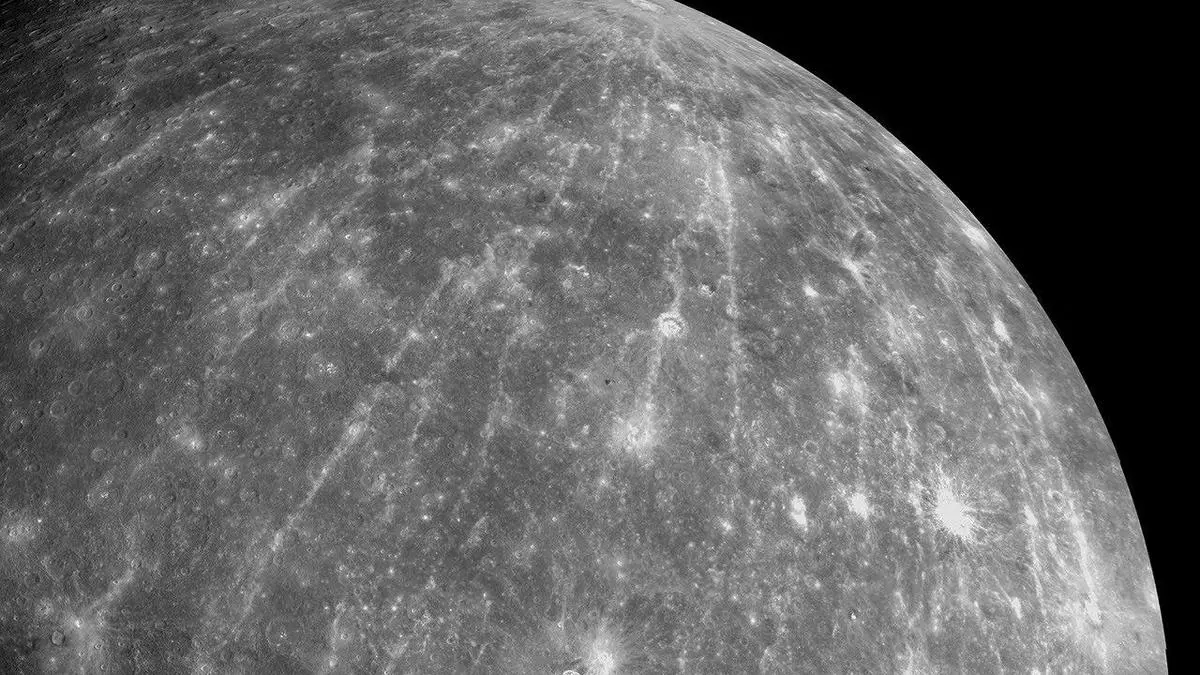
A mosaic of images by NASA's Messenger spacecraft shows an impact crater on the surface of Mercury, named Hokusai, October 6, 2008. New research suggests that the surface of exoplanet LHS 3844 b may resemble that of Mercury.

A mosaic of images by NASA's Messenger spacecraft shows an impact crater on the surface of Mercury, named Hokusai, October 6, 2008. New research suggests that the surface of exoplanet LHS 3844 b may resemble that of Mercury. | Photo Credit: NASA

Astronomers have gotten their clearest look yet at the surface of an exoplanet - a planet beyond our ‌solar system - thanks to NASA’s James Webb Space Telescope.

Webb gathered data on a rocky exoplanet with a diameter about 30% larger than Earth that indicates it is a desolate and airless world whose ⁠surface may resemble that of Mercury, our solar system’s innermost planet. Its lack of a discernible atmosphere and its extreme temperatures - fiercely hot on one side and frigid on the other - seem to render it uninhabitable.

The planet is called LHS 3844 b, or Kua’kua, the ‌word for butterfly in an indigenous language spoken in Costa Rica. It orbits a star smaller and less luminous than the sun, located about 49 light-years from Earth. A light-year is the distance light travels ‌in a year, 5.9 trillion miles (9.5 trillion km).

“This planet is not a nice place,” said astronomer Laura Kreidberg, ‌managing ⁠director of the Max Planck Institute for Astronomy in Germany and senior author of the study ⁠published this week in the journal Nature Astronomy.

“It’s a hellish, barren rock - much more similar to Mercury than it is to the Earth. There is no trace of an atmosphere. Instead we’re seeing a dark surface, likely old. Picture a bare rock hurtling through space for billions of years. You wouldn’t want to go there,” Kreidberg said.

A barren planet with extreme temperatures

The observations suggest ‌an ancient planetary surface covered by darkened regolith - loose, fragmented rocky material that covers solid bedrock, born of eons of continuous bombardment by stellar radiation and micrometeorite impacts.

Webb, which was launched in 2021 and became operational in 2022, has enabled revolutionary advances in the understanding of exoplanets. Its robust infrared observational capabilities have helped discern the chemical composition and ‌internal dynamics of exoplanet atmospheres, even showing what kind of clouds are present.

Webb is now letting astronomers directly study the geology and surface composition of exoplanets, said astronomer and study lead author Sebastian Zieba of the Center for Astrophysics, Harvard & Smithsonian in Massachusetts.

“That was very challenging before the James Webb Space Telescope. ⁠This, therefore, also puts the Earth and the solar system as a whole into greater context, allowing us to check if processes or surface compositions familiar within the solar system are common around other stars, too,” Zieba said.

“It’s like we suddenly ‌cleaned our glasses and can see the planets clearly for the first time,” Kreidberg added.

Tidally locked world orbits red dwarf star

The star that Kua’kua orbits is a common type called a red dwarf. Its mass is about 15% that of the sun and its luminosity about 0.3%. Kua’kua is located extremely close to the star, orbiting it once every 11 hours. It also is “tidally locked,” meaning one side always faces the star and the other side always faces away, as the moon does with Earth.

The planet’s “dayside” surface - perpetually broiled by the star - is about 1,340 degrees Fahrenheit (725 degrees Celsius). There was no detectable heat on the planet’s “nightside.”

Webb enabled ‌the researchers to detect light - specifically the infrared region of the electromagnetic spectrum - coming directly from the planet’s surface.

“Different rocks have different spectral fingerprints, just like atmospheres do. Dark volcanic rocks like basalt matched our observations much better than brighter, silica-rich rocks like granite,” Zieba said.

The surfaces of Mercury and the moon are basalt-dominated.

Scientists search for clues To habitability

“On Earth, widespread granite formation ⁠is linked to water and plate tectonics,” Zieba said, referring to the geological process on our planet involving the gradual movement ⁠of the immense plates that make up Earth’s surface. “So if you ever robustly identified granite-like surfaces on an exoplanet, that would not (automatically) mean life, but it would suggest a much more Earth-like geological history compared to other ‌surfaces.”

Another possibility matching the observations was a solid surface of relatively recent volcanic rock, but the researchers searched for volcanism-related gases like sulphur dioxide and found none.

Without an atmosphere, there is scant protection from stellar radiation or charged particles from the star and no chance for liquid water, considered fundamental for life.

“So overall, this is almost certainly not a habitable world,” Zieba said.

Published on May 9, 2026