



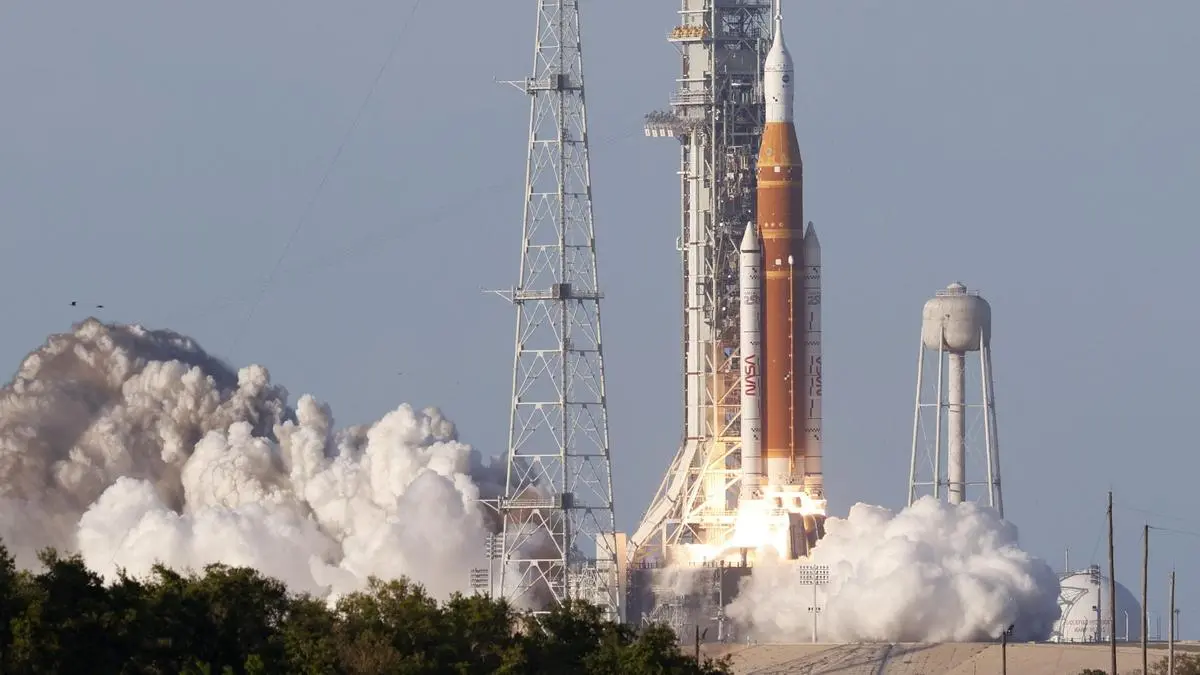
NASA's Artemis II mission to fly by the moon, comprising of the Space Launch System (SLS) rocket with the Orion crew capsule, lifts off from the Kennedy Space Center in Cape Canaveral, Florida, U.S., April 1, 2026. | Photo Credit: REUTERS/Joe Skipper
NASA's Artemis program is the U.S. effort to return astronauts to the moon for the first time since the Apollo era and eventually establish a sustained human presence there, a goal Washington has framed as central to maintaining space leadership amid growing competition from China.
Here are key milestones in the Artemis program:
During President Donald Trump's first administration, NASA was directed to refocus human spaceflight on the moon after years of prioritizing Mars. The lunar effort would be built around the Space Launch System (SLS) rocket and Orion crew capsule, hardware first conceived under the previous, since-canceled Constellation program, with Boeing serving as the prime contractor for the SLS core stage, Northrop Grumman producing the rocket’s solid-fuel boosters and Lockheed Martin building the Orion spacecraft.
In 2019, the White House set a target of landing astronauts on the moon by 2024. Though the "Moon to Mars" program would not get its name Artemis until months later, NASA outlined a three-mission sequence: Artemis I, an uncrewed test flight; Artemis II, a crewed moon flyby; and Artemis III, a landing on the lunar surface.
Technical challenges, cost overruns and COVID-19 pandemic-related disruptions pushed back schedules for the SLS rocket, Orion spacecraft and launch infrastructure at Kennedy Space Center. NASA picked SpaceX's Starship as the program's first lunar lander, keeping the landing target of 2024 but acknowledging it may no longer be achievable.
In November 2022, NASA launched Artemis I, sending an uncrewed Orion spacecraft around the moon and back during a 25-day mission. The flight tested deep-space navigation, communications and Orion's heat shield during a high-speed reentry, a critical step before flying with astronauts.
Jeff Bezos' Blue Origin is tapped as NASA's second lunar lander provider in 2023 after months of legal disputes over the agency's decision to only pick SpaceX's Starship. Later, under President Joe Biden's administration, NASA reset Artemis timelines, pushing the first crewed lunar landing to 2027. The agency continued to defend the program amid budget scrutiny, while highlighting China's parallel lunar ambitions.
NASA announced the four astronauts for Artemis II: Reid Wiseman, Victor Glover, Christina Koch and Canadian astronaut Jeremy Hansen. The mission will be the first crewed voyage toward the Moon since Apollo 17 in 1972.
After taking office, NASA Administrator Jared Isaacman announced a sweeping overhaul of the Artemis program, scrapping plans for the Lunar Gateway — a space station intended to orbit the moon — and redirecting its components toward building a permanent base on the lunar surface. He also added an additional crewed mission ahead of a lunar landing, arguing that the extra flight would help crews and ground teams build operational “muscle memory” in deep space before attempting sustained surface missions.
NASA launched Artemis II, a roughly 10-day mission sending four astronauts on a crewed flyby of the moon, the first such voyage since the Apollo era. The mission will not land on the lunar surface but will push astronauts farther from Earth than any human flight, testing Orion's life-support systems, navigation, communications and heat shield performance in deep space — capabilities NASA says are essential before attempting a lunar landing.
Artemis is intended to return astronauts to the lunar surface using a commercially developed lander, a step NASA says is essential before future missions to Mars. Elon Musk's SpaceX and Jeff Bezos' Blue Origin are competing to provide the lunar lander, part of NASA’s push to enlist private companies in delivering hardware for deep-space exploration. The first moon-walking Artemis crew is expected to take whichever lander completes development first.
Published on April 2, 2026
此内容由惯性聚合(RSS阅读器)自动聚合整理,仅供阅读参考。 原文来自 — 版权归原作者所有。