


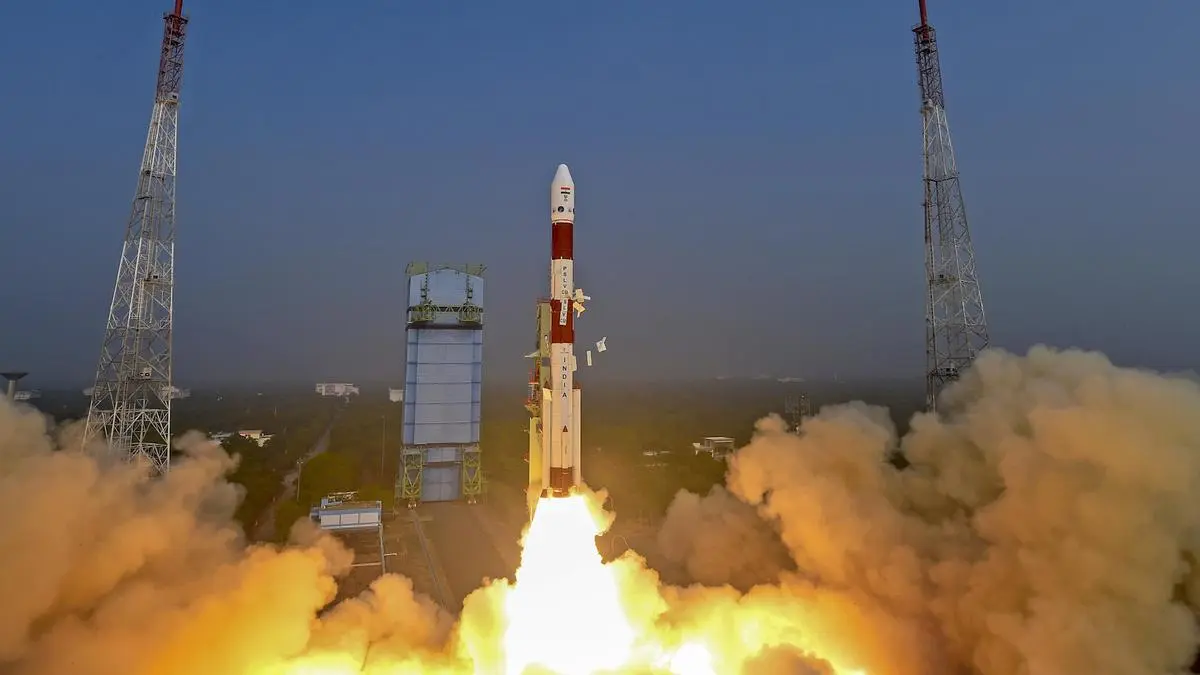
Supply chain dependencies and regulatory coordination remain the biggest hurdles in a still-maturing ecosystem | Photo Credit: PTI
India’s spacetech startups are entering a new phase of growth, moving beyond experimentation to focus on scaled manufacturing, faster turnaround times, and execution reliability as global demand for satellite constellations surges.
Companies across propulsion, launch, and near-space infrastructure say the transition is being driven by the need to deliver consistently at scale rather than simply proving technological capability.
“At Bellatrix, the transition from R&D to scaled manufacturing has been deliberate,” said Yashas Karanam, cofounder and COO of Bellatrix Aerospace. He added that the company has institutionalised the shift from flight-proven products to a “tightly governed manufacturing ecosystem” with rigorous qualification and validation protocols aligned to global standards. Alongside, it is optimising processes and expanding global market access to reduce lead times and improve throughput.
Similarly, Agnikul Cosmos is embedding manufacturing into the core of its design philosophy. “Our focus has shifted from proving that the technology works to proving that it works repeatedly and on schedule,” said Srinath Ravichandran, cofounder and CEO. The company has built an integrated additive manufacturing ecosystem, enabling it to produce rocket engines “in a matter of days, not months,” while reducing supply chain dependencies.
Red Balloon Aerospace, which operates in the near-space segment, is also moving towards assembly-line style production. “The transition… has required a fundamental shift from iterative prototyping to process-driven, modular production systems,” said cofounder and CEO Dr.-Ing. C V S Kiran, noting that standardisation and in-house manufacturing capabilities have helped compress turnaround cycles from months to weeks.
However, scaling execution remains a key challenge. Karanam pointed to infrastructure constraints such as testing capacity and the need for stronger global proximity to win large contracts. Ravichandran highlighted the complexity of ensuring manufacturing consistency and systems integration, while also building teams capable of delivering at launch cadence. Kiran flagged supply chain dependencies and regulatory coordination as ongoing hurdles in a still-maturing ecosystem.
The surge in low Earth orbit (LEO) satellite deployments is further reshaping business strategies. Bellatrix is taking a calibrated approach, building credibility with mid-sized operators before targeting large constellation players. Agnikul, meanwhile, is focusing on modular vehicle design, recoverability, and parallelised production to support sustained launch demand.
For Red Balloon Aerospace, the rise of LEO constellations is complementary. Kiran said near-space platforms can act as “pre-orbital testbeds” and persistent communication layers, supporting high-frequency deployment cycles.
As the global space economy expands, startups say the next phase will hinge not just on innovation, but on their ability to deliver reliably at scale—an area where they will increasingly be benchmarked against established global suppliers.
Published on April 13, 2026
此内容由惯性聚合(RSS阅读器)自动聚合整理,仅供阅读参考。 原文来自 — 版权归原作者所有。