





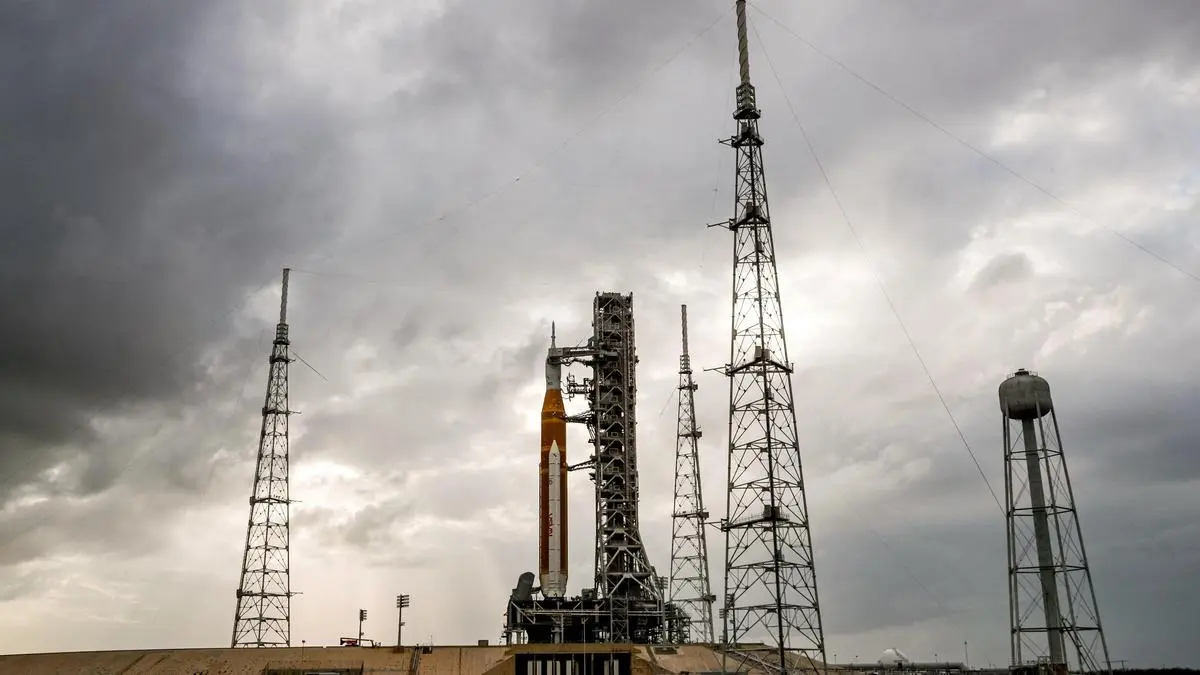
NASA's next-generation moon rocket, the Space Launch System (SLS) rocket with the Orion crew capsule, on Pad 39B ahead of the Artemis II mission launch at the Kennedy Space Center in Cape Canaveral, Florida, US | Photo Credit: REUTERS/STEVE NESIUS
NASA began the countdown Monday for humanity's first launch to the moon in 53 years.
The 32-story Space Launch System rocket is poised to blast off Wednesday evening with four astronauts. After a day in orbit around Earth, their Orion capsule will propel them to the moon and back.
There are no stops, just a quick U-turn around the moon. The nearly 10-day flight will end with a splashdown in the Pacific.
Managers said the rocket is doing well following the latest round of repairs. Forecasters said the weather should cooperate.
NASA's Artemis II mission should have soared in February, but was grounded by hydrogen fuel leaks. The leaks were fixed, but then a helium pressurization line became clogged, forcing a return to the hangar late last month.
The rocket returned to the pad 1 1/2 weeks ago, and its US-Canadian crew arrived at the launch site on Friday.
Unlike Apollo, which sent only men to the moon from 1968 through 1972, Artemis' debut crew includes a woman, person of colour and a non-US citizen.
Artemis II's pilot Victor Glover said over the weekend that he wants young people to see them and think, “Girl power and that's awesome, and that young brown boys and girls can look at me and go Hey, he looks like me and he's doing what???” At the same time, Glover, who is Black, looks forward to when ”one day we don't have to talk about these firsts” and exploring the cosmos becomes an all-encompassing “human history.” NASA has the first six days of April to launch Artemis II before standing down until the end of the month.
Published on March 31, 2026
此内容由惯性聚合(RSS阅读器)自动聚合整理,仅供阅读参考。 原文来自 — 版权归原作者所有。