
惯性聚合 高效追踪和阅读你感兴趣的博客、新闻、科技资讯
阅读原文 在惯性聚合中打开

推荐订阅源

K
Kaspersky official blog
罗磊的独立博客
F
Fortinet All Blogs
人人都是产品经理
人人都是产品经理
量子位
V
Visual Studio Blog
Blog — PlanetScale
Blog — PlanetScale
M
MIT News - Artificial intelligence
B
Blog RSS Feed
腾讯CDC
博客园_首页
aimingoo的专栏
aimingoo的专栏
博客园 - 三生石上(FineUI控件)
博客园 - Franky
S
SegmentFault 最新的问题
N
Netflix TechBlog - Medium
小众软件
小众软件
奇客Solidot–传递最新科技情报
奇客Solidot–传递最新科技情报
K
KPMG report finds enterprise disconnect between AI and its ROI | CIO
Threat Intelligence Blog | Flashpoint
L
LINUX DO - 热门话题
cs.CL updates on arXiv.org
Martin Fowler
Martin Fowler
D
Docker
P
Privacy & Cybersecurity Law Blog
S
Securelist
V
V2EX
Jina AI
Jina AI
阮一峰的网络日志
阮一峰的网络日志
T
Tor Project blog
The Hacker News
The Hacker News
Microsoft Azure Blog
AWS News Blog
AWS News Blog
The GitHub Blog
The GitHub Blog
有赞技术团队
有赞技术团队
T
The Exploit Database - CXSecurity.com
Help Net Security
Help Net Security
酷 壳 – CoolShell
酷 壳 – CoolShell
Application and Cybersecurity Blog
博客园 - 叶小钗
Recent Announcements
Cloudbric
Cloudbric
Y
Y Combinator Blog
钛媒体:引领未来商业与生活新知
钛媒体:引领未来商业与生活新知
freeCodeCamp Programming Tutorials: Python, JavaScript, Git & More
Latest news
Latest news
MongoDB | Blog
MongoDB | Blog
H
Hackread – Cybersecurity News, Data Breaches, AI and More
Recorded Future
Recorded Future
V2EX - 技术
V2EX - 技术

The Hindu: Latest News today from India and the World, Breaking news, Top Headlines and Trending News Videos.

U.K. pauses its plan to cede Chagos Islands after U.S. opposition Driver jailed for 7 days for driving sleeper bus in drunken condition Kim Jong Un supports China’s “multipolar world” vision during talks with Wang Yi Uttar Pradesh boat tragedy: Punjab town mourns deaths Relief for Bengaluru commuters as Silk Board flyover set to open fully, but inspection by BTP reveals likely bottleneck Repolling underway at booth of Karimganj North Assembly seat in Assam PM Modi interacts with Rahul Gandhi as leaders gather to pay tribute to Mahatma Jyotiba Phule Anil Kapoor’s ‘24’ set to release on OTT Vance, Iranian delegation arrives in Islamabad for U.S. talks amid ceasefire hopes Fire at Hyderabad’s Chintal Basti apartment, 17 residents evacuated safely Centre nudges States to view farm solarisation as a route to wiping off ₹2.4 lakh crore subsidy bill Why voter turnout hit record highs in Assam, Kerala & Puducherry Strait of Hormuz to be open “fairly soon”, says Trump ‘Jana Nayagan’ leak tests new legal penalties, torrent downloads under scanner Vijay’s ‘Jana Nayagan’ controversy explained: From legal battles to piracy chaos HYDRAA brings down guest house and other structures at Ameenpur Row erupts over removal of Ambedkar statue at midnight in Secunderabad Cantonment area Nitish may resign as Bihar CM on April 13; son Nishant likely to become one of two JD(U) Dy CMs Police open fire on youth while he was trying to flee Struggling CSK look to snap their losing streak | Vidyut Sivaramakrishnan ED raids former Trinamool Minister Partha Chatterjee’s residence Karnataka’s Gruha Jyothi scheme dimmed the scope of PM’s Surya Ghar Muft Bijli Yojana: KRESMA After Artemis II, NASA looks to SpaceX, Blue Origin for Moon landings Ayush Shetty storms into Badminton Asia Championships final Scholarships: April 11, 2026 Andhra Pradesh’s Socio-Economic Survey missing in recent Budget Session; efforts underway Inside Péro’s fun office Penciljam sessions in Bengaluru help hone artistic talent Watch: The mistake killing high-concept films | Escalation without calibration | FMM 19 Tamil Nadu Assembly election 2026: DMK demands reinstatement of N. Muruganandam as Chief Secretary Kerala Assembly election | Heavy turnout sparks political calculations in Tripunithura’s triangular contest Apple at 50: A loyalist on the brand’s evolution in India Reiterated demand for Hasina extradition with India: Bangladesh Foreign Minister Rahman Phule left a lasting legacy of social reform and inclusion, says President Murmu Trump congratulates returned Artemis astronauts, says ‘next step, Mars!’ Voters' lists in 12 States, Union Territories shrink by over 6 crore post SIR 4.7 magnitude earthquake jolts Maharashtra’s Hingoli district, no casualties Teams led by CSIR women scientists report advances in research on depression mechanisms in females Gap between rich and poor nations growing even wider: U.N. report Russia and Ukraine set to begin Easter truce Minimum temperature continues to rise in Delhi; AQI 'moderate' IPL 2026 | Suryavanshi on tackling Bumrah, Hazlewood: ‘I look at the ball not the bowler’ Iranian delegation reaches Islamabad for peace talks with U.S. as world waits for deal to end conflict Trump shares video of brutal Florida killing allegedly by Haitian immigrant Bihar man sought money from foreign agency for threatening PM Modi’s security, arrested: Police 14 injured as Hyderabad–Eluru bus rams lorry on NH-65 flyover in Kodad Assembly Elections 2026 highlights: BJP tried to invalidate my candidature in Bhabanipur, says Mamata At DEL in Roseate House Aerocity, a robot joins the service team Prince Harry sued for defamation by charity he set up in Africa to honour his mother Princess Diana North Korean leader Kim backs China’s push for multipolar world in talks with Foreign Minister Jio-bp not to raise petrol and diesel prices Ten Indian nationals indicted in U.S. for visa fraud conspiracy In Pictures | Artemis II's voyage to the moon and back The Hindu Morning Digest: April 11, 2026 British Airways ramps up services to India for summer Focus on innovation and entrepreneurship in farm sector through agritech meet in Rajasthan Israel-Iran war updates on April 11, 2026: Iran talks pause after 15-hour negotiation, disagreements remain India in final stages of formulating processing value chain for critical minerals: Mines Secretary ‘A perfect mission’: Artemis II astronauts return to Earth India, U.S. to deepen nuclear ties, explore LPG exports Induction-based cooking to add 13-27 GW of energy requirements: Official In Assam, first evicted, now erased Absorbed uptick in price of ammonium nitrate, diesel to shield prices: Coal India Trump says U.S. will have Strait of Hormuz 'open fairly soon' Political slugfest between Congress-BJP in Haryana over crop procurement World Earth Day 2026: Why India must define its own green factory standards now Tamil Nadu election 2026: In Thiruvaiyaru constituency, all parties sing the same tune during polls BSF jawan killed in unprovoked firing in Manipur’s Ukhrul Discontinue Ladki Bahin if government doesn’t have funds for pension: Bombay HC Tamil Nadu Assembly election 2026: Arun shifted, Modak appointed Chennai Police Commissioner An alternative proposal on Viksit Bharat Shiksha Adhisthan Bill Lebanon says first contact with Israel held ahead of U.S.-brokered talks At ICA conference, CJI Surya Kant underscores arbitration’s role in global economy Students to get textbooks by April 20: Sood 14 lakh tons of silt cleared, half of desilting work complete: Delhi Minister Parvesh JNU considers 5% admission quota for employees’ children Bolstering deterrence through submarine dominance Braving heat, leaders hit the streets in Chennai city as poll battle intensifies Turning up: The Hindu Editorial on high turnout in Kerala, Assam, Puducherry polls Beyond the marks: How II PU toppers overcame challenges Rebuilding ties: The Hindu Editorial on India engaging with Turkiye and Azerbaijan Fake call centre duping buyers of weight-loss products busted, 11 arrested Artemis II: how NASA scientist, senior official Amit Kshatriya helped U.S. moon mission I am enduring pain fighting the party I built brick by brick: PMK founder S. Ramadoss Tamil Nadu election 2026: a high-profile contest brews in Mylapore constituency A ‘nova’ for these women to shine bright Welfare measures for the marginalised take centre stage in Bengal’s Jhargram BFC holds all the aces in Blasters clash Kerala Assembly polls 2026: UDF expects sweep as LDF, NDA seek gains in Ernakulam 10 killed as overcrowded boat capsizes in Yamuna Vijay’s ‘Jana Nayagan’ leaked online: Rajinikanth, Kamal Haasan, Chiranjeevi slam piracy In Chennai, Sumanasa Foundation’s Art Unfettered platforms five artistes who are pushing boundaries 15-year-old missing girl from Kerala found dead in Chikkamagaluru Iran-Israel war updates on April 10, 2026: Trump says Strait of Hormuz will open 'fairly soon' From hiding to hope: Bastar and its surrendered Maoists What does the Jan Vishwas Bill do? | Explained India, Bangladesh share ‘warm and historic ties’: MEA Interview with Anirudhya Mitra, author of The Delhi Directive, a spy thriller Tamil Nadu election 2026: Ambattur constituency residents demand GH, sewer network, wider roads A peek at India’s athleisure boom
How States are managing the surging summer power demand
2026-05-21 · via The Hindu: Latest News today from India and the World, Breaking news, Top Headlines and Trending News Videos.

India’s electricity demand has surged earlier than expected this year, with peak demand touching an all-time high of 256.1 gigawatts (GW) on April 25. (The country followed up with higher records on May 19 and May 20). Nearly one-third of this peak demand was met through renewable energy (RE) sources. While the national grid held up without any shortage during solar hours, the non-solar hours saw a deficit of 2% (4,243 megawatts) on the same day.

What is peak demand?

Peak demand refers to the highest point of electrical power consumed on a grid over a specific period, typically a 15-minute interval. While peak demand is a single instant, it occurs during 2 to 4 hours of higher-than-average demand or ‘peak demand period’. Summer months may cause longer peaks from late afternoon to evening hours and then during the night due to cooling loads (from air conditioners and coolers). Similarly, winter peaks can last longer in the morning (between 6 a.m. and 10 a.m.) and evening (between 6 p.m. and 9 p.m.) due to increased heating and lighting loads during these hours, particularly in the northern States.
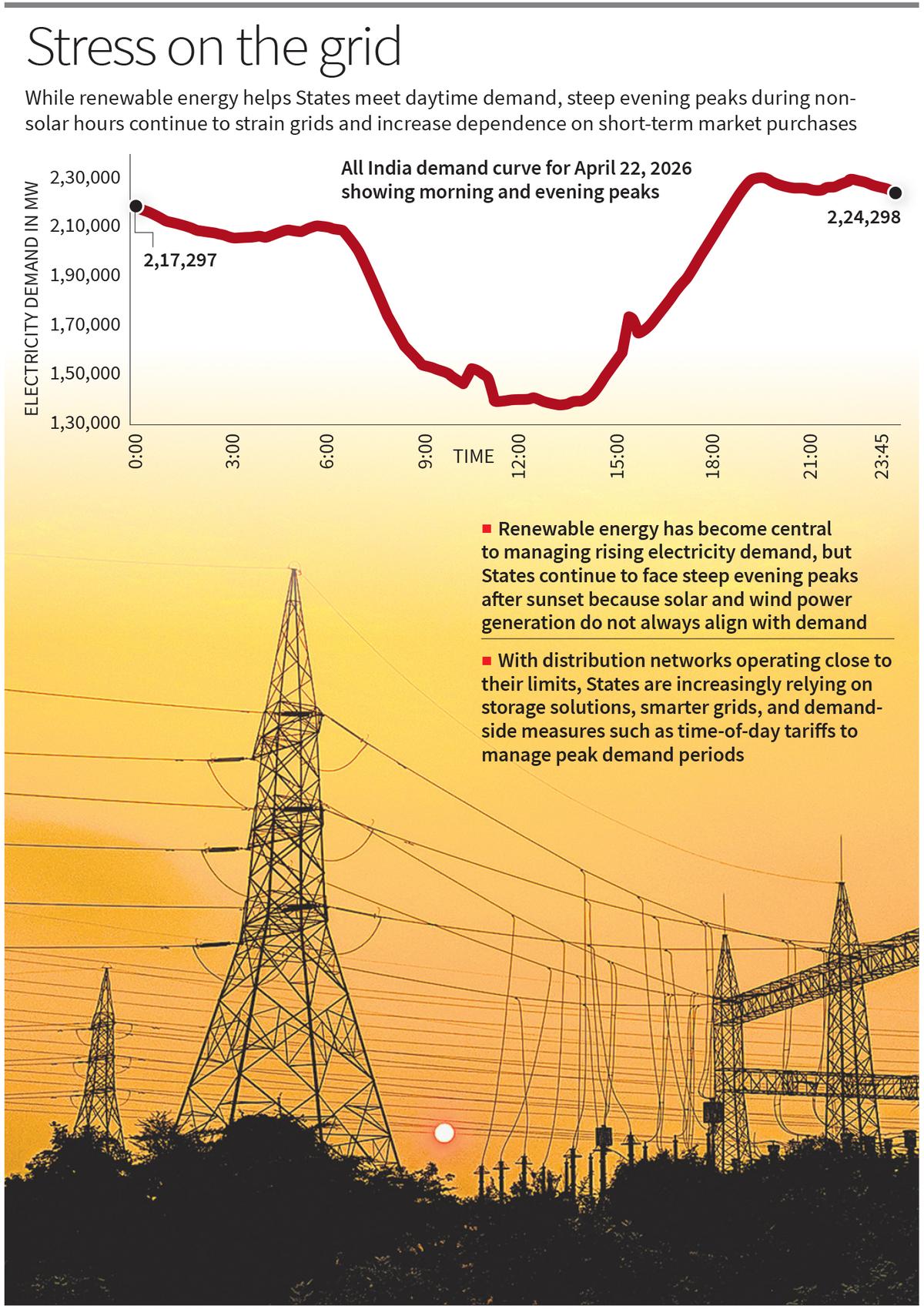
Paying heed to the duration of these peaks is important because even though they occur only for a short period, the grid needs to meet the peak load instantly. In fact, the entire power sector infrastructure (generation, transmission, and distribution capacity) needs to be planned to deal with this peak. But this is easier said than done. Building a system to serve the periods of highest load that last only for a few hours is neither resource-efficient nor economical. If enough capacity is built to meet the peak demand, it will remain underutilised during off-peak hours. On the other hand, if enough capacity is not available to meet the peak demand, then the system will face issues like load shedding and grid instability.

How do States manage demand?

States meet demand through two mechanisms: contractual supply and power exchange purchases. Contractual supply comprises the long-term power purchase agreements (PPAs) that State distribution companies (DISCOMs) sign with power generators to ensure power supply over several years. This helps the DISCOMs in meeting the average demand for their consumers. Almost 85%-90% of the demand in India is being met through contractual supply or bilateral contracts between the DISCOMs and generators. In the event of real-time mismatches or when the contractual supply falls short due to sudden spikes in demand or power plant or transmission failures, DISCOMs turn to the second mechanism — buying power from power exchanges. At present, around 10%-15% of the electricity is traded on the power exchanges.

For managing peaks, States often undertake demand-side measures. Most States have relied on advisories urging consumers to reduce usage during peak hours, typically between 6 p.m. and 11 p.m. Delhi has increasingly utilised measures such as time-of-day tariffs (electricity charges that vary based on the time of day) and smart metering to flatten evening peaks that are driven by cooling demand.

What are some challenges faced by States due to rising demand?

A steady growth in household electrification, use of air conditioners, electric vehicle penetration, and agricultural power consumption has been driving the increase in India’s electricity demand. In the last 5 years, the country’s peak demand has risen by 37% — from 183 GW in December 2020 to over 250 GW in April 2026. This surge has made it tougher for States to fulfil the electricity requirements.

With DISCOMs committed to long-term agreements that are signed at a fixed capacity and price, any shortfall has to be met through power exchanges, which are short-term markets. This exposes the States to price volatility because prices in these markets increase during peak periods. Indian Energy Exchange data shows that electricity prices in the day-ahead market have seen sharp spikes during peak periods, with rates touching the regulatory ceiling of ₹ 10 per kilowatt-hour on several occasions during April and May this year.

Another challenge relates to the inadequacy of the distribution network. Infrastructure expansion and upgrades in India’s power distribution segment often lag demand growth, leading to issues with last-mile delivery of power to the end-consumer. Over the last decade, India’s generation capacity has increased by 76% (from 303 GW to 532 GW), its transmission lines have expanded by 47% (from 3,41,551 circuit kilometres [ckm] to 5,01,766 ckm), and the transformation capacity has increased by 115% (from 6,58,949 megavolt-amperes [MVA] to 1,41,63,76 MVA). However, a corresponding expansion in the distribution infrastructure has not happened, and distribution networks continue to face major stress. Recent assessments by the Central Electricity Authority indicate that nearly 13 lakh distribution transformers (DTs) fail annually in India. Some States have low DT failure rates of less than 2%, such as Kerala, while some (particularly the northern States) experience DT failure rates as high as 20%. Further, overloading of transformers and feeders, ageing equipment, and inadequate maintenance continue to compromise last-mile power delivery. Many States experience local outages, especially during peak demand periods, highlighting that their distribution networks are operating close to their limits and need upgradation.

The challenge posed by demand surges becomes acute for financially stressed States because they are neither able to procure costly short-term power nor invest in distribution network upgrades. States like Uttar Pradesh and Bihar continue to grapple with high losses, ageing distribution infrastructure, and overloaded transformers.

How does RE help?

RE has become central to the management of rising electricity demand, particularly during summer peak periods. Since solar and wind power plants have low operating costs, higher RE penetration can also reduce overall power purchase costs for DISCOMs.

States with high RE capacity, such as Gujarat and Karnataka, are able to meet daytime peak comfortably as the solar power generation aligns reasonably well with daytime commercial and agricultural demand. But these States face steep evening peaks after sunset, for which they need to increasingly depend on energy storage technologies such as pumped hydro storage (PHS) and battery energy storage systems (BESS). Similarly, Tamil Nadu, with a high wind capacity, benefits significantly from wind generation during the monsoon months, reducing dependence on thermal power. But the State has to resort to market purchases during periods of low wind output to meet the high evening urban demand.

However, Punjab, which has a meagre RE capacity and a dominant agricultural load during the paddy-sowing season that coincides with the summer peak, has to rely heavily on hydro imports and short-term market purchases.

What needs to be done?

Despite its growing contribution, RE cannot help in ensuring a reliable round-the-clock power supply because of its intermittent and variable nature. Also, electricity demand and RE power generation do not always align. Solar power generation falls sharply after sunset, though electricity demand often remains high during evening hours. Similarly, wind generation is seasonal and highly dependent on monsoon conditions. Because of this, States now face the challenge of managing variability and steep evening demand.

This is where energy storage technologies like BESS and PHS that enhance flexibility become critical for India’s power system, as they help to balance the grid when the output (power) generated by RE changes suddenly. PHS is already emerging as a key solution in States like Maharashtra, Andhra Pradesh, Tamil Nadu, and Karnataka. At the same time, the grid itself needs to become smarter and more flexible through stronger transmission networks, upgraded distribution systems, and energy efficiency initiatives.

With Indian States witnessing more peak demand periods, the challenge is shifting from simply generating more electricity to building a system capable of managing power efficiently across regions and time periods. This calls for substantial investments in storage solutions, along with adopting more demand-side measures like ToD tariffs and agricultural load scheduling.

(Rishu Garg is a senior policy specialist in the Energy Policy and Regulations group at the Center for Study of Science, Technology and Policy (CSTEP), a research-based think tank)