









On an unusually quiet Friday evening, I walk into a time zone bearing the weight of centuries. Figures who chose denial over indulgence, discipline over comfort, have made their home on the walls of Delhi’s DAG. Curated by art historian Gayatri Sinha, the gallery’s ongoing exhibit The Body of the Ascetic showcases a rich and diverse collection of 70 artworks, comprising mostly paintings, one textile and a few sculptures that depict the ascetic figure across cultures.
Amid the traditional re-imaginings sit some of the more modern interpretations from the 20th century that blend the personal and the social. F.N. Souza’s iconic untitled 1956 painting shows a bristling head, marked by lines, geometric pattern and textured background; Amit Ambalal’s indolent saint is stretched on a tiger skin; and Gogi Saroj Pal’s emaciated figure in Young Monks (1980) contemplates the solitary lives of ascetics.

F.N. Souza’s Untitled work from 1956. | Photo Credit: Courtesy DAG
“There is a personal axis in the works, which defies caste-based readings of acts of devotion or indeed sectarian divisions,” says curator Sinha. “There is a very fine set of watercolours by Nandalal Bose that has been interpreted as his mourning at the seaside at the death of his father. At the same time, it may signify the passing of the Vaishnava saint Shri Chaitanya, who is believed to have entered the waters at Puri and was never seen again.”
An evolving figure
Some of the world’s richest traditions of ascetic art can be attributed to the Indian subcontinent and its expansive archive spanning millennia. The Body of the Ascetic draws from this genre.
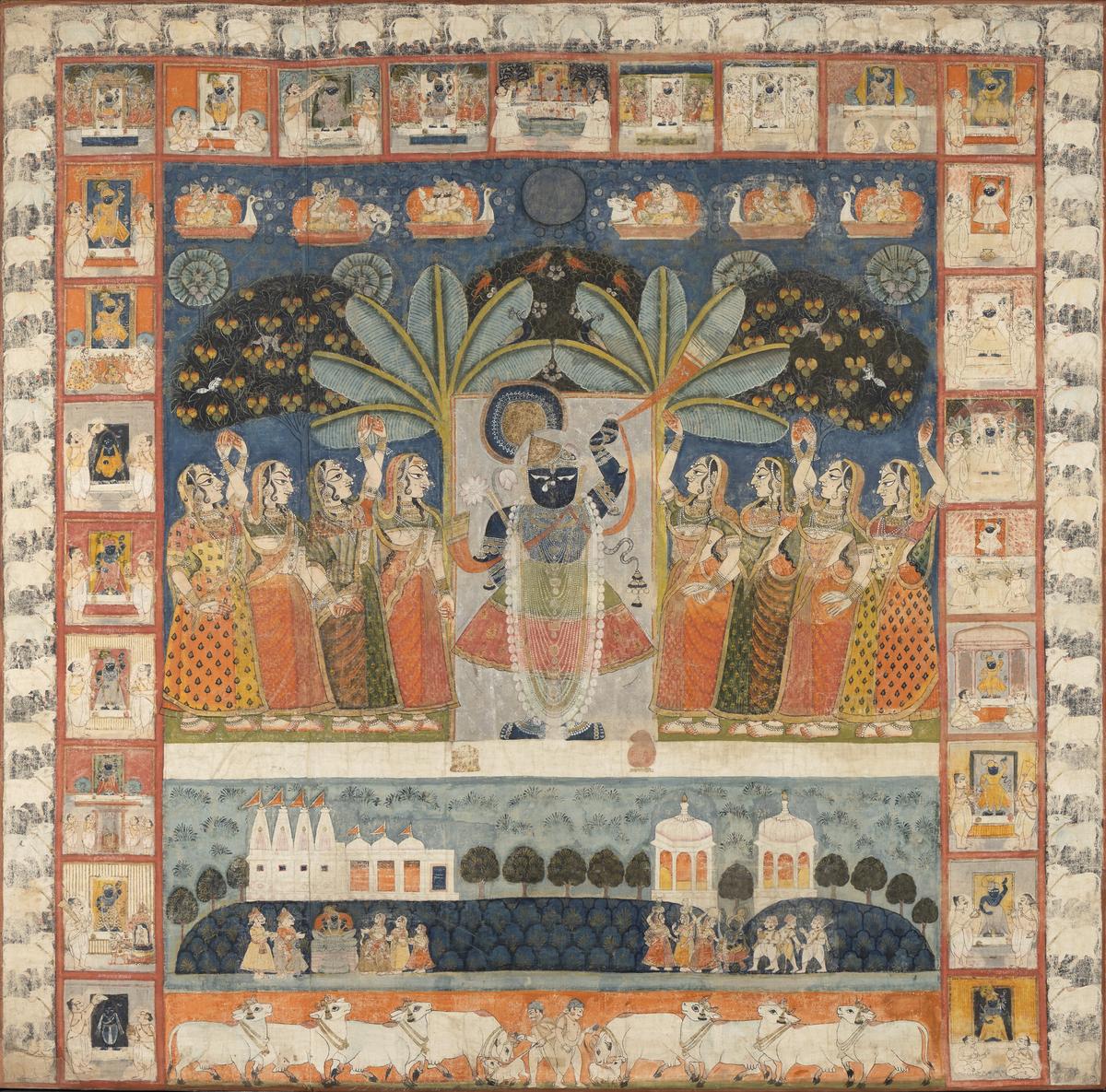
‘Shrinathji with Temple Dancers (A Pichhwai for Sharad Purnima)‘, an early 19th century Pichhwai work by a Rajasthani artist. | Photo Credit: Courtesy DAG
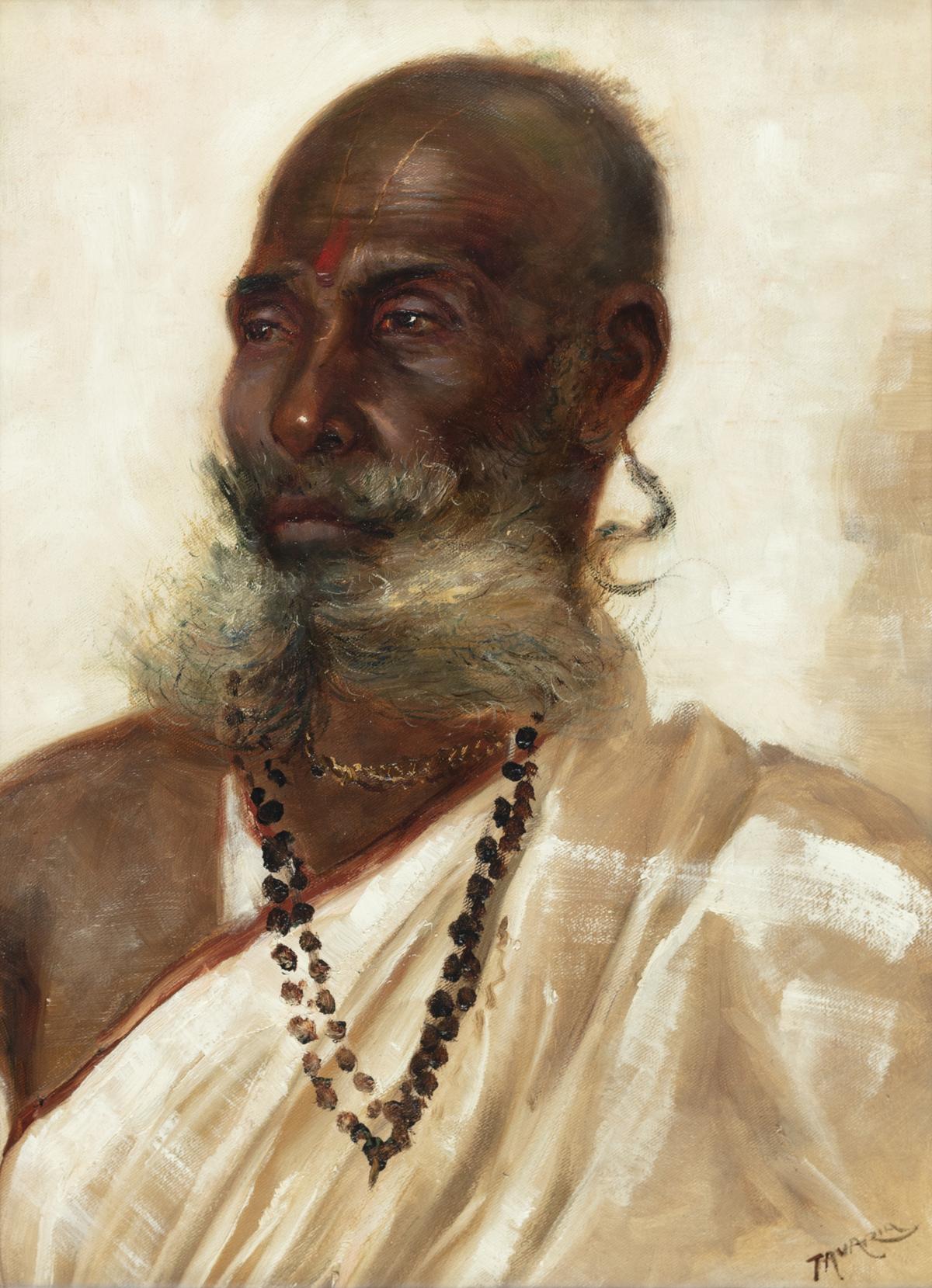
‘An Old Fakir’ (1907) by Ardeshir Ruishajee Tavaria. | Photo Credit: Courtesy DAG
“The ascetic is a very consistent figure in Indian history, and is abundantly represented in mythology, painting and sculpture. The visualisation of the ascetic is continuous from the Ajanta Caves, with figures of monks, to the dramatic representation of sages in Raja Ravi Varma’s art. They often appear as a teacher, guide, astrologer, defender of faith, but also as soldier, rebel, itinerant mendicant or mahant of a powerful math,” says Sinha.

‘Mr. P. Dass M. A’ (1978) by Bikash Bhattacharjee. | Photo Credit: Courtesy DAG

Hugo Vilfred Pedersen’s ‘An Old Buddhist Temple at Mendoot’ (1900–12). | Photo Credit: Courtesy DAG
She adds: “If ascetics altered the course of narratives in major epics with their curse or advice, they, equally, participated in historic events like the Sannyasi rebellion [1760s-1800s]. The idea was to represent some of these figures to draw attention to their place in the Indian cultural matrix. Normally, art has addressed kings, queens, great battles, romances. However, they [ascetics] are a category of their own and need to be seen as such.”

‘Hybrid Burraq-Kamdhenu with Hermit’ (1890). | Photo Credit: Courtesy DAG
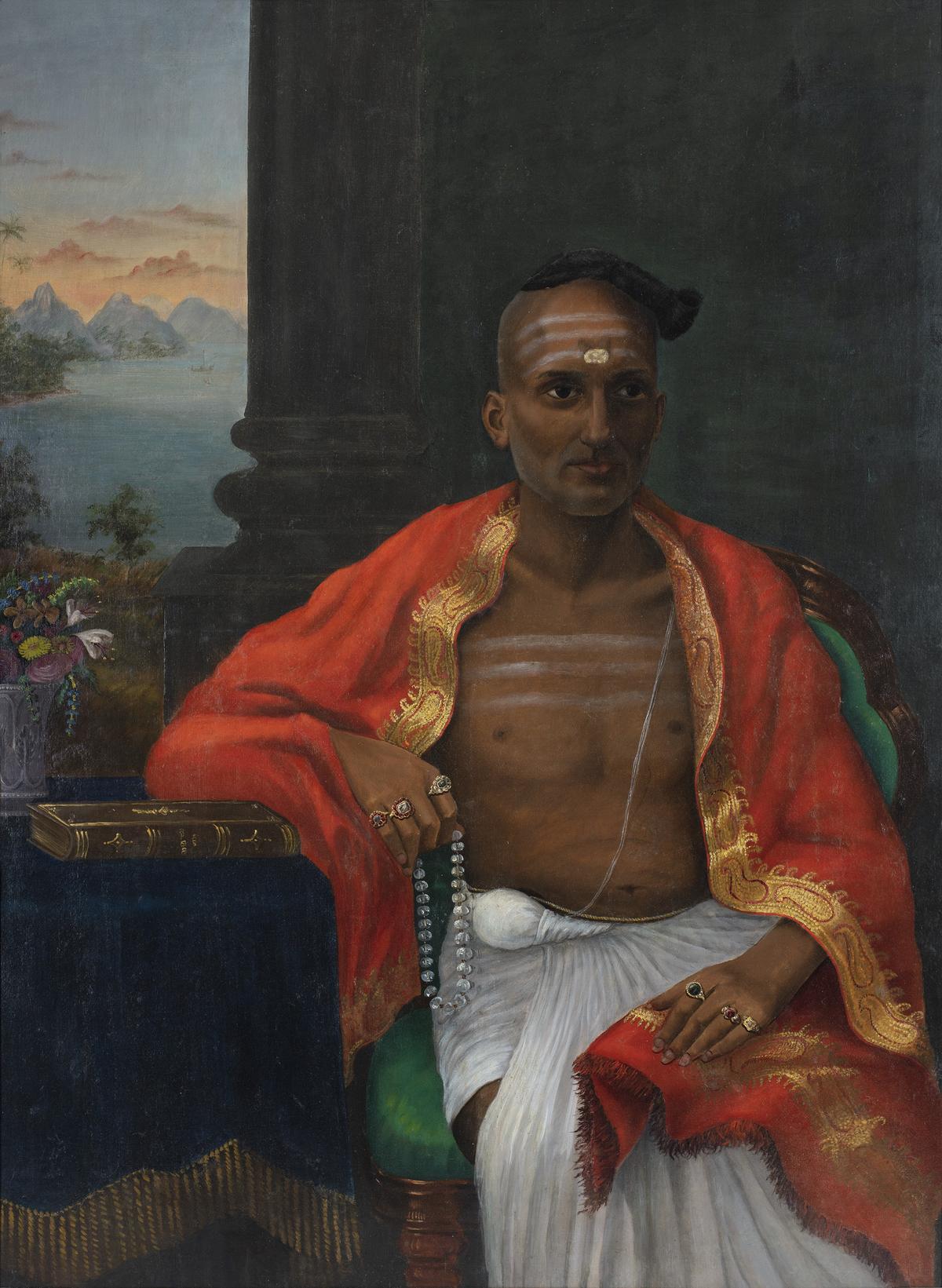
Portrait of Subramanyan Namboothiripad of Akavoor Mana, Cochin, an early 20th century, attributed to Madhava Warrier. | Photo Credit: Courtesy DAG
Fundamentally, asceticism is rooted in religion but, as Sinha points out, it has a broad spectrum of associations. “While the leaders of several sects are renunciates who practise celibacy, wear white garments, and inhabit minimal living conditions, such as Anandamayi or Ramana Maharishi, others such as the Vaishnava Pushtimarga celebrate abundance, community, and material wealth. The exhibition demonstrates these extremes with the highly decorative Tanjore paintings and Nathdwara pichhwais on the one hand, and the spare Shaiva ascetics on the other.”
The Mahatma, too
From the atmospheric renditions of religious sites by Marius Bauer (The Entrance to a Temple in Palitana, 1916) to William Daniell (Fakir’s Rock, Sultangunge, 1790), each work in DAG’s substantial Company Paintings and prints collection reveals a multifaceted portrayal of the ascetic — both conventional representations and those that challenge or reimagine established norms.

‘A Jain Pilgrimage Map of Satrunjaya’, 1800 AD. | Photo Credit: Courtesy DAG
But the highlight of the show is a large textile sprawled across one of the walls — a Jain artwork (1800 CE) by an unidentified artist, about 24-inch-tall and 17.5-inch-wide, in natural and gold pigments on fabric. It draws on the Jain pilgrimage map of Satrunjaya, depicting the grandeur of the sacred site of the first sermon by the first Tirthankara, Rishabhnath.
Another highly visible figure is of Mahatma Gandhi. His adoption of the half-dhoti and shawl as attire after seeing bare-bodied farmers toiling under the sun in Madurai in 1921, and walking the breadth of the country wearing khadavans (wooden footwear), invokes the figure of the sadhu. His austere clothing came to be associated with the ascetic despite the fact that he neither belonged to any religious parampara (tradition) nor took diksha (spiritual initiation).

‘Mahatma Gandhi’ (1934), a terracotta sculpture by Clare Sheridan. | Photo Credit: Courtesy DAG
Says Sinha, “Gandhi as the ascetic body is unique because he did not belong to any sect, but was celebrated as the Mahatma. There is a huge corpus of Gandhi as a subject in art, including works by Gulammohammed Sheikh, Atul Dodiya, Arpita Singh, Ashim Purkayastha, and so on. The fact that Gandhi continues to be a referent in our times makes him central to this discourse.”
Female figures
A striking sight is that of a group of sadhvis of the Jain tradition, barefoot and dressed in white with their heads covered, carrying whiskbrooms and bowls for collecting alms. The other works depict followers of Anandamayi Ma, Brahma Kumaris, and Sri Sarada Math (the female wing of Ramakrishna Mission).

‘Sa Femme (His Wife)‘, 1800 AD, by a Madras artist (Company School). | Photo Credit: Courtesy DAG

‘A Head of a Gosain’ (1877) by Pestonji Bomanji. | Photo Credit: Courtesy DAG

‘Muharram Celebration in the Murshidabad Imambara’ (1810), attributed to Sewak Ram. | Photo Credit: Courtesy DAG
This exhibition is ‘polyphonic’ as one realises that Buddhist, Jain, Hindu Christian, Islamic movements are all being represented in different ways simultaneously. “In contemporary India, we see a huge churn in the representation of the ascetic figure, from sadhus as vagrants in the post-Independence era to their emergence as powerful political figures, and preceptors of huge congregations, as we witness a revival of religious sentiment in the country,” says Sinha. And, that makes this show quite topical.
The Body of the Ascetic is on view at New Delhi’s DAG till October 18.
The independent writer is based in Delhi.