








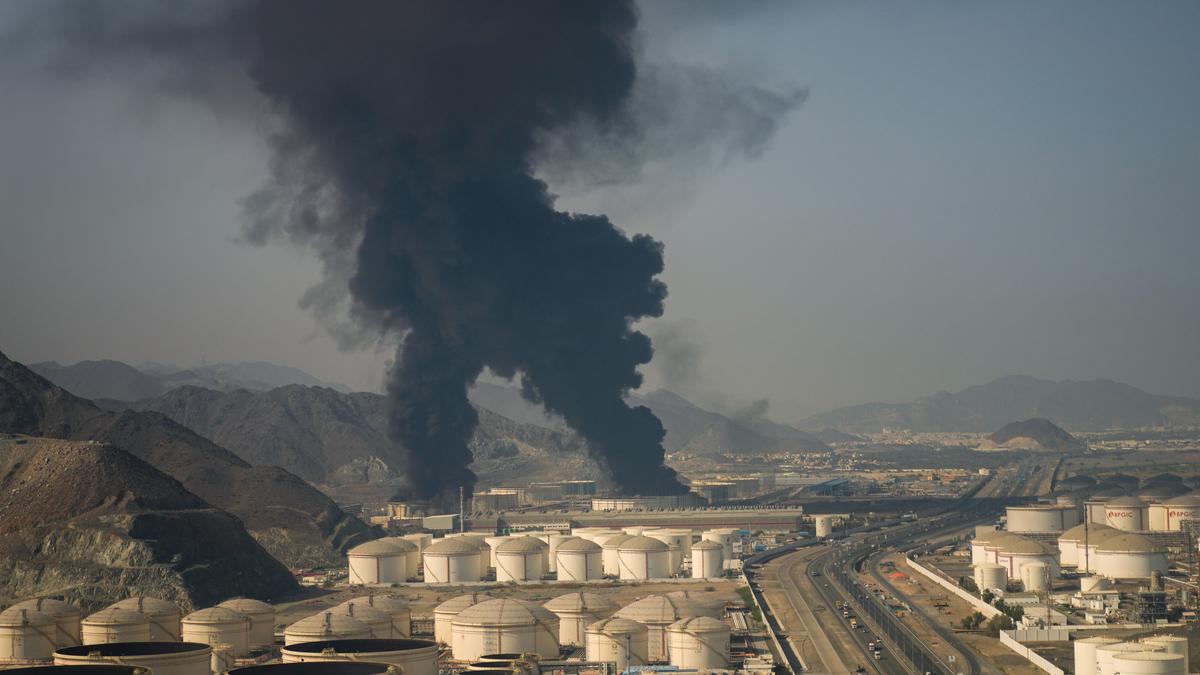
Iran’s closure of the Strait of Hormuz and the blockade by the United States of Iranian ports are among several recent acts of brinkmanship. A legacy of the Cold War era, brinkmanship refers to single action or a series of actions during a conflict or a short-of-war situation that forces a perilous climb up the escalation ladder to force the adversary to back down, make concessions, negotiate or even do something irrational that would justify the use of uncalibrated or widespread use of force. Coined by western political scientists in the 1950s and 1960s while analysing crises such as the Berlin Blockade (1948-49) and the Cuban Missile Crisis (1962), the term also warned of the risk of escalation spiralling out of control, particularly in the nuclear context (Armageddon).
The return of brinkmanship
With the vast spread of the spectrum of conflict in the post-Cold War era without the disappearance of the nuclear overhang, brinkmanship has once again assumed dangerous proportions and merits some examination in a contemporary context. Terrorism has emerged as a principal instrument of brinkmanship, frequently used by non-state actors to provoke disproportionate state responses and gain international attention and sympathy in pursuit of larger goals. Without debating the dilemma posed by the proposition that argues, ‘One man’s terrorist is another man’s freedom fighter’, globally proscribed terrorist movements have rarely achieved their stated aims through brinkmanship — al Qaeda and the Islamic State being among them. A few such as the Irish Republican Army (IRA) and the FLN (National Liberation Front) in Algeria did force the more powerful adversary to make concessions.
Another flavour of brinkmanship that has emerged in recent decades is proxy brinkmanship of the kind that Pakistan and Iran have engaged in for the last four decades against stronger powers. Using proxies largely designated as global terrorist outfits, this brand of asymmetric brinkmanship seeks to erode the resolve and power of stronger powers and force them to make concessions over long-festering issues of statehood and sovereignty. The attacks by Hamas on Israel on October 23, 2023, are an example of this kind of brinkmanship. Israel’s disproportionate counter-brinkmanship in Gaza in pursuit of destroying Hamas is testimony to the breakdown of deterrence and the propensity to climb the escalation ladder at breakneck speed to achieve difficult strategic outcomes.
Rising geopolitical tensions
Among the larger powers today, the U.S. has seldom resorted to brinkmanship and prefers instead to achieve its geopolitical objectives through the brute and direct application of force or economic coercion. Frustrated at its inability to drag Iran to the negotiating table, the U.S. has resorted to brinkmanship by imposing a blockade on Iran, hoping to squeeze it economically and make it come to the negotiating table. Iran, on the other hand, has resorted to its own brand of asymmetric counter-brinkmanship that has yielded disproportionate strategic outcomes by blocking the Strait of Hormuz. Where this will go is anybody’s guess until both the parties agree to meet mid-way — such are the complications of the brinkmanship game.
Russia’s brinkmanship, driven by frustration over its inability to halt the North Atlantic Treaty Organization’s eastward expansion despite Moscow’s takeover of Crimea in 2014, and by expectations that Ukraine would capitulate after the advance on Kyiv in February 2022, has instead resulted in a prolonged war. Russia’s periodic sabre-rattling over nuclear restraint is also a legacy of the Cold War that Russian President Vladmir Putin wants to keep alive. The indiscriminate use of hypersonic and other area weapons against population centres such as Kiev by the Russians triggers a brinkmanship chain that is hard to control and infuse any semblance of restraint in the four-year-long conflict.
Ever since China upped its maritime game since 2006 and laid claims to vast expanses of the South China Sea and parts of the East China Sea, it has mastered the art of controlled brinkmanship against weaker neighbours, daring them to push back against its attempts to establish maritime hegemony in the region. Except for Japan which has pushed back strongly against Chinese coercion over claims on the Senkaku Islands, and Taiwan which continues to stare the People’s Republic of China in the eye, all other countries with shores along the South China Sea have been mute to Chinese reclamation of Islands and claims on territorial waters.
If there is one nation that has perfected the art of brinkmanship in the 21st century, it is North Korea. This largely underdeveloped and opaque country, with its demonstrated missile and nuclear prowess and nuclear proliferation, has kept the most powerful power in the world from forcing it into a ‘rules based world order’, while also keeping the region on edge.
The displacement of diplomacy
India’s strategic DNA of restraint and responsibility and its calibrated use of force eschews any inclination to resort to brinkmanship even under the gravest provocation. The fragile global geopolitical system is now fraught with danger, and diplomacy no longer seems to be the preferred choice for conflict resolution. With global institutions such as the United Nations increasingly marginalised, coercion, brinkmanship and the uncalibrated use of force seem to be emerging as preferred options in settling conflicts of various genres. The world needs to seriously introspect this.
Arjun Subramaniam is a military historian and a strategic analyst
Published - May 29, 2026 12:08 am IST