





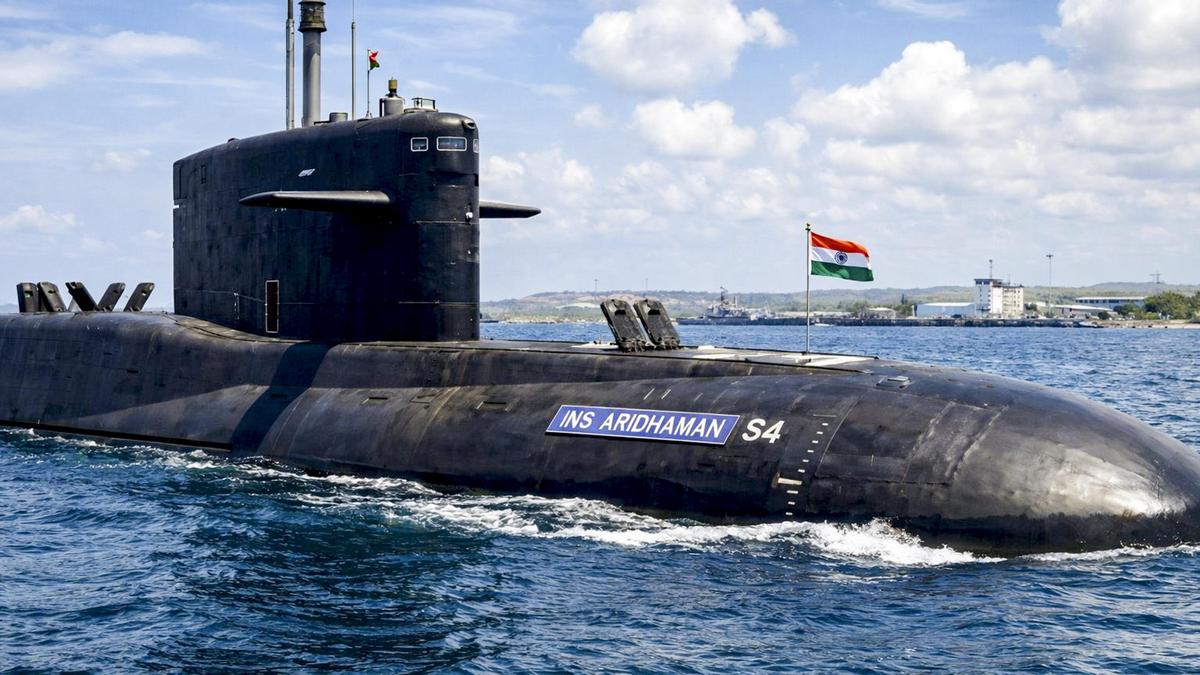
On April 3, the word ‘Aridhaman’ found mention in India’s Defence Minister Rajnath Singh’s cryptic post on the social media platform X, prompting widespread speculation that it indeed signalled the quiet commissioning of INS Aridhaman, the third submarine in the Indian Navy’s SSBN (nuclear ballistic missile submarine) programme. Launched in 2009, the Indian Navy commissioned its first SSBN, INS Arihant, in 2016, followed by the second submarine, INS Arighat, in 2024. Speculation about the commissioning of INS Aridhaman assumed momentum since last year after Admiral Dinesh Tripathi, Chief of Naval Staff, confirmed that the submarine was in the final stages of its trials. The next submarine in this series, which is of the Arihant class as well, is likely to be commissioned next year.
Compared to its predecessors, INS Arihant and INS Arighat, INS Aridhaman has greater firing power and marks a gradual upgrade in the series of SSBNs commissioned by the Indian Navy. It is a larger 7000-tonne vessel, which can reportedly carry up to 24 K-15 Sagarika missiles, and up to eight nuclear-tipped K-4 or K-5 missiles. In contrast, the previous submarines in this series hold the capacity for carrying twelve K-15 Sagarika missiles and four K-4 missiles.
Through the commissioning of INS Aridhaman, India appears to have further emboldened its nuclear triad, which refers to New Delhi’s capability to launch strategic nuclear delivery systems from land, sea, and air. Importantly, apart from India, the P5 countries – the U.S., Russia, China, France and the U.K. – possess the nuclear triad capabilities. In addition to this, the commissioning of the submarine further enhances India’s deterrence capabilities in the maritime domain. Strengthening of sea-based deterrence is seen as especially critical, given that it has rapidly emerged as a key imperative in bolstering India’s nuclear capabilities. To be sure, India’s nuclear outlook is anchored on its ‘no first use’ policy. However, the strategic environment in the Indian Ocean is continually worsening, led by increasing Chinese presence in the region by way of research and survey vessels which possess dual-use technologies and run the risk of being deployed for the purpose of intelligence gathering. Sea-based deterrence is indeed critical to forestall adversarial manoeuvres by China and even Pakistan.
Notably, the Indian Ocean has for long remained dormant due to the lack of any significant maritime security conflict. However, in today’s time, the changing nature of warfare which possesses the possibility of swift transition from one domain to the other, it is essential to strengthen deterrence capabilities across all domains – land, air, and sea. More recently, the evolving conflict in the West Asia serves as a crucial reminder of how modern warfare is not limited to a single domain anymore. What started as American and Israeli air campaigns against Iran has quickly assumed a critical maritime character, whereby the Strait of Hormuz has now emerged as the epicentre shaping much of the future of this war. Furthermore, last year, Operation Sindoor, India’s measured counter-terror response against Pakistan, too demonstrated that a naval dimension to the campaign could have indeed been a possibility. Wars in this era do not belong with different domains in silos but rather remain susceptible to spilling over to other domains as well. This complexity of modern warfare underlines why possessing nuclear triad capabilities, especially boosting deterrence will continue to remain a key priority for India’s national security apparatus.
Furthermore, the SSBN project has significantly boosted India’s defence establishment’s quest for self-reliance in defence production. With active conflicts persisting in different strategic pockets of the world, a strain in defence supply chains appears to be on the horizon. For India, the prolonged Russia-Ukraine war has spurred momentum in strategies to work towards self-reliance in defence production given Moscow’s importance for India as a traditional defence partner.
In addition to this, plans to soon induct a fourth vessel of the Arihant class is likely to guide India’s SSBN programme going forward. Importantly, New Delhi also seeks to commission India’s first fully indigenously designed nuclear attack submarine (SSN) by 2036, with the commissioning of the second in the programme in 2038. The rapid strides taken by the Indian Navy is building its nuclear-powered submarine programme signals that submarine dominance is fast emerging as a key component in scripting New Delhi’s strategy to bolster deterrence.
Going forward, the key challenges confronting the Indian Navy in this domain is likely going to emanate from how efficiently New Delhi balances spending its resources on upgrading its submarines programme and how it inducts new technologies like Artificial Intelligence and Autonomous Systems in design and production of these vessels. At a time when the roster of the Indian Navy’s assets is continually compared with that of China, it will be critical for New Delhi to keep pace with Beijing.
Harsh V. Pant is Vice-President, Observer Research Foundation, New Delhi; Sayantan Haldar is Associate Fellow, Maritime Studies, Observer Research Foundation, New Delhi
Published - April 11, 2026 12:56 am IST