


On a February evening at the Tottenham Hotspur Stadium, Mikel Arteta stood on the touchline with clenched fists as Arsenal dismantled north London rival Tottenham Hotspur 4-1.
The result was one of the clearest indicators of Arsenal’s evolution this season. The manager’s reaction reflected the composure and confidence of a side that had steadily developed into a genuine title contender.
Scoring four goals in a derby away from home, Arsenal combined attacking precision with control, underlining the tactical maturity and consistency that carried it to its first Premier League (PL) title in over two decades.
The victory over Tottenham came to symbolise the authority with which Arsenal approached a season that had been years in the making under Arteta.
By then, Arsenal had developed into a team defined by tactical control, defensive consistency and attacking depth, qualities that sustained its challenge through the closing weeks of the PL campaign.
For Arsenal, it marked the end of a 22-year wait for the Premier League crown, and the trophy was a reward for Arteta’s rebuilding project.
After three successive runner-up finishes, the London club finally reclaimed the title with a campaign built on balance rather than dependence on a single player.
Arteta became the first manager to secure the PL crown with a club he had represented as a player. He is the first to win it for the Gunners since Arsene Wenger, who guided Arsenal’s ‘Invincibles’ all the way in 2004.
The weight of history
To understand what this title means, one has to understand what came before it. Three consecutive second-place finishes. Three years of watching the trophy go elsewhere. In 2022-23, City overtook it in the final weeks.
The following season, Guardiola’s side pipped it by a gut-wrenching two points. Last year, it was Liverpool which denied the London-based club.
Each near-miss left its scar, and each scar was absorbed, processed, and turned into fuel for success.
Rather than abandoning his methods, Arteta continued to refine the squad and improve its tactical balance. The current contingent has combined defensive organisation with attacking depth, evolving into a team capable of controlling matches as comfortably as it created chances.

Arteta is the first manager to have won the Premier League with the club he had represented as a player. | Photo Credit: Reuters
Arsenal led the league for more than 200 days. When City briefly moved ahead on goal difference late in the season, Arteta’s side responded emphatically, winning four successive matches without conceding and reclaiming control of the title race.
The response reflected a squad hardened by repeated near-misses and one that was fully equipped to meet the demands.
When doubt came calling
The final weeks of the league season were not without tension. A 1-2 home defeat to Bournemouth on April 11. A 1-2 loss at the Etihad a week later; it trimmed the lead and invited familiar narratives back in.
For a brief and uncomfortable period, it felt recognisably, painfully, like seasons past. Arsenal’s answer was wins over Newcastle United, Fulham, West Ham United, Burnley, each dispatched with economy of effort and with clarity of purpose. A title reclaimed, methodically and without drama, from the precipice of doubt.
On May 19, it did not even need to take the field. Bournemouth, the very side that had beaten it at the Emirates six weeks prior, held City. What Arsenal had fought for across nine months of sustained, disciplined, collective endeavour was now formally confirmed. The celebrations that followed outside the Emirates had been 22 years in the waiting.
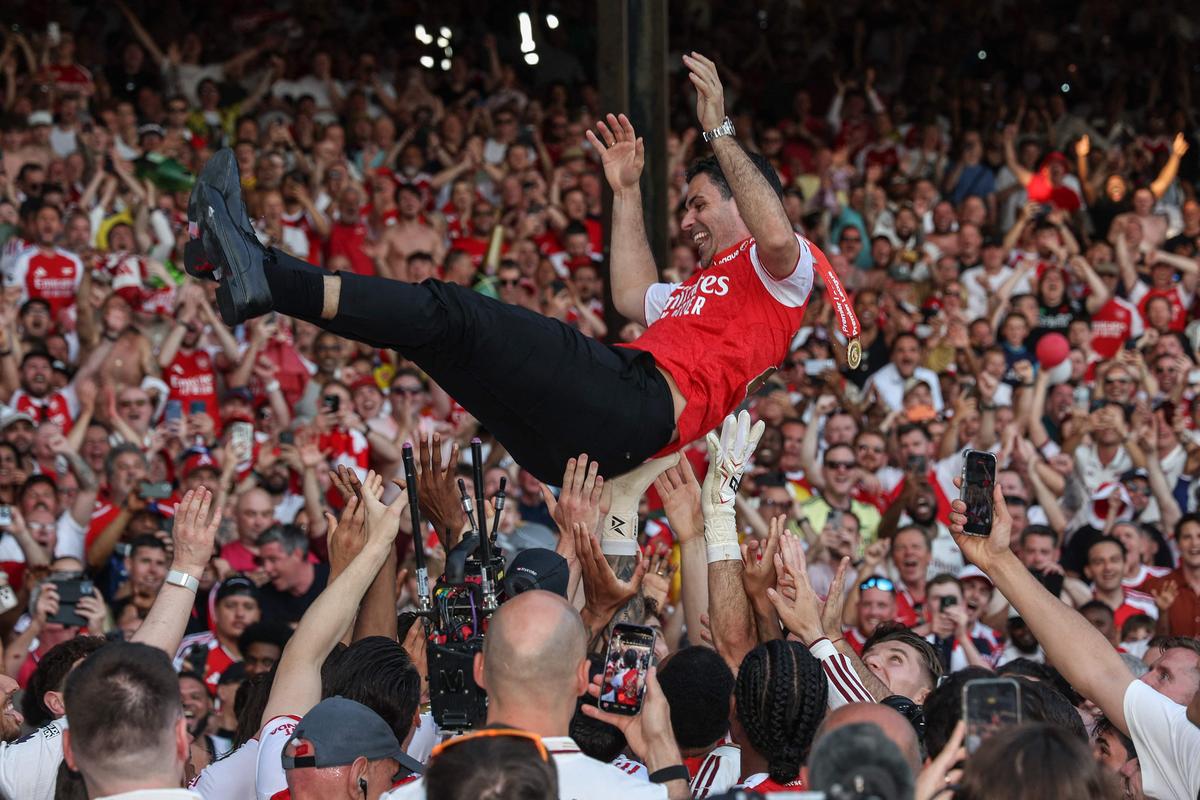
Arsenal players and staff throw Arteta into the air. | Photo Credit: AFP
The team that delivered
Behind the PL title lies not the brilliance of one man but the quiet, accumulated excellence of many. It is precisely that collectivity which lends the triumph its peculiar beauty.
Viktor Gyokeres, recruited from Sporting CP last summer, has led Arsenal’s attack with authority. He is the club’s leading scorer this season — 21 goals across all competitions, a distinction earned through persistence as much as talent.
Around him, Bukayo Saka has remained the relentless, indispensable force he has been for several seasons, a player who simply does not allow the game to pass by. Eberechi Eze has brought unpredictability — a top-corner volley on the turn in the Champions League bout against Bayer Leverkusen, a moment of improvised genius.
Leandro Trossard, Declan Rice, Martin Zubimendi, and Mikel Merino scored with such regularity, no single absence unsettled the architecture of the side.
The assists tell an equally compelling story of shared responsibility. Trossard and Martin Odegaard led the way with six Premier League assists, their creative instincts operating on different frequencies yet producing identical returns. Rice, Saka, and Jurrien Timber each contributed five.
It created an attacking structure with multiple points of entry and no discernible weakness. Opponents who prepared for Saka encountered Eze. Those who planned for Gyokeres found Trossard threading quietly through the lines.
At the back, Gabriel and William Saliba have fashioned a defensive partnership that now ranks among Europe’s finest. David Raya won the Premier League Golden Glove for the third consecutive season, keeping 19 clean sheets, a defensive record that underpins everything Arteta has built.
And then there is Max Dowman, at just 16 years old, became the youngest goalscorer in Premier League history earlier this season.
He also earned the distinction of being the youngest player ever to win the PL title. At 16 years and 144 days, he has surpassed Phil Foden’s record.
A European statement
While the league title has commanded the broader narrative, Arsenal’s Champions League campaign runs it close for sheer quality. It merits careful examination, for it reveals dimensions of this side that domestic results alone cannot fully illuminate.
In November, Bayern Munich arrived at the Emirates. It left having conceded three. It was neither fortune nor a smash-and-grab. It was controlled, methodical, and at times imperious, a performance that communicated, with quiet authority, that Arsenal had come to Europe not merely to participate but to contend.
The away fixtures that followed carried the same conviction: three goals at Club Brugge in December was followed by three more against Inter Milan in January, the latter stirring comparisons to the great continental nights the Gunners have known only too rarely.
The knockout rounds became a study in temperament as much as technique. The round-of-16 tie against Leverkusen witnessed an Eze volley of such ferocity and precision that it will be replayed for years; the 2-0 home win completed the job.
Against Sporting in the quarterfinals, Kai Havertz’s goal proved sufficient in Lisbon. The goalless second leg was not beautiful, but it was purposeful; exactly the manner in which great sides distinguish themselves from merely good ones.
The semifinal paired Arsenal with Diego Simeone’s Atletico Madrid, a side built on structure and hard lines, the yardstick against which all European challengers are tested. A tense 1-1 draw in the Spanish capital.
Then a 1-0 victory at a thunderous Emirates, settled by the tie’s only moment of decisive quality courtesy Saka. Arsenal had passed, unbeaten, every examination Europe had put before it.
In Budapest on May 30, it faces defending champion Paris Saint-Germain in the final — Arsenal’s second appearance in the competition’s showpiece, 20 years on from the heartbreak at the hands of Barcelona in Paris. And a chance to claim the one honour missing in its 139-year history.
Etched in red and white
Arteta has written his name permanently into Arsenal’s history. He inherited a club that had plainly lost its way, rebuilt it patiently, methodically and without compromise. And he delivered.
Arsenal claimed its 14th English top-flight championship, sitting behind only Liverpool and Manchester United (20 each).
Arsenal put the icing on the cake with a victory over Palace. | Photo Credit: Reuters
The Crystal Palace fixture on Sunday was, in every meaningful sense, a joyful formality. Beyond it lies Budapest and the possibility of a double that would render this the finest season in the club’s 140-year history.
The promised land is within reach and Arteta’s Arsenal, it would appear, is only just getting started.