


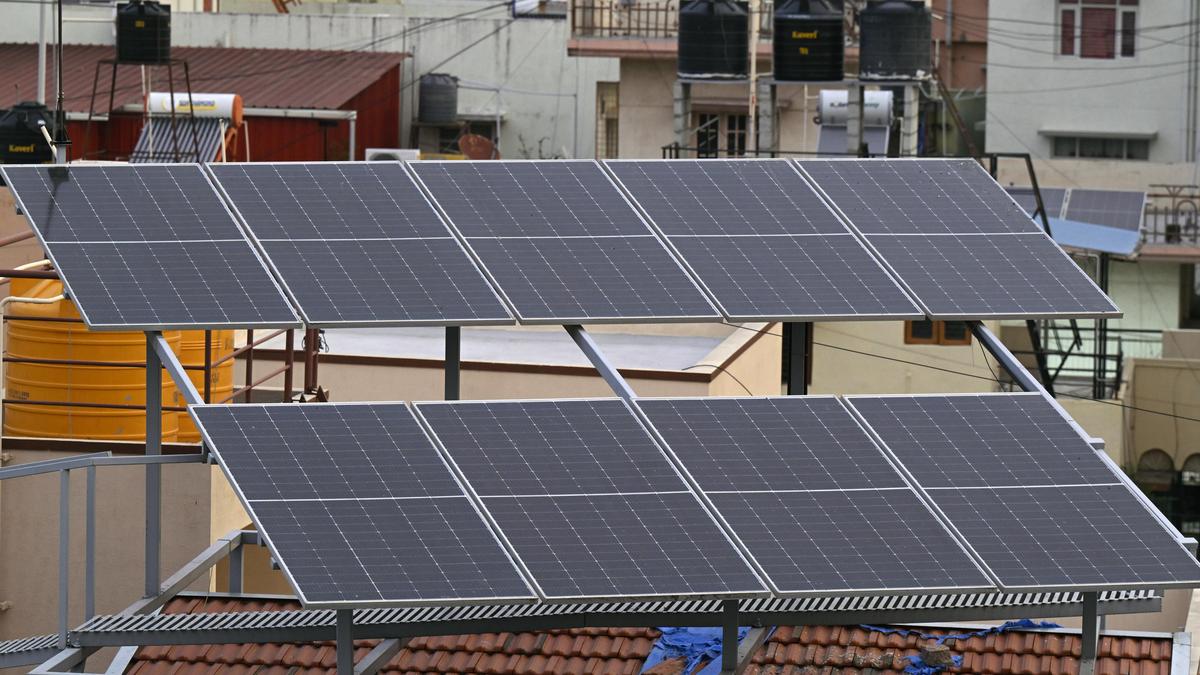
Karnataka’s Gruha Jyothi Scheme, that offers up to 200 units of free electricity per month to households, has dimmed the scope of the Union government’s Surya Ghar Muft Bijli Yojana, said Surendra Kumar K.R., President, Karnataka Renewable Energy System Manufacturers Association (KRESMA).
Mr. Kumar said the adoption of Surya Ghar Muft Bijli Yojana, a rooftop solar project meant to offer free electricity to 1 crore households in the country, was very slow in Karnataka as Gruha Jyothi came in the way of its roll out. Mr. Kumar, was speaking on the sidelines of an industry roundtable organised by Informa Markets India, a business-to-business exhibition/event organiser.
As many as 31 lakh households in the country are currently benefiting from rooftop solar installations under the Surya Ghar Muft Bijli Yojana since its launch in February 2024. However, according to Mr. Kumar, Karnataka has one of the lowest adoptions with some 23,900 households under Surya Ghar while Gujarat reported over 5.7 lakh homes under rooftop solar systems installations.

‘Trailblazer in renewable energy adoption’
However, speaking at the roundtable, Rajneesh Khattar, Senior Group Director, Informa Markets in India, said, Karnataka has been a trailblazer in renewable energy adoption, backed by its forward-looking policies and strong industry participation. Informa Markets is scheduled to host RenewX 2026, a Renewable Energy Sourcing Expo between April 27 and 29 in Chennai.
“Today, the State contributes nearly 10% of India’s total installed renewable energy capacity, underscoring its importance in the national clean energy landscape,’’ he said. According to Mr. Khattar, Karnataka has not only achieved key renewable energy milestones ahead of schedule, but continues to set benchmarks in innovation and deployment.

Zero bill displayed during 'Gruha Jyothi' launch in Bengaluru on August 01, 2023. | Photo Credit: MURALI KUMAR K
With a strong policy framework under the Karnataka Renewable Energy Policy 2022–2027, the State was actively supporting next-generation technologies such as offshore wind, green hydrogen, bio-energy, and hybrid renewable systems, he noted. The state was also exploring emerging concepts like peer-to-peer (P2P) energy trading enabled by blockchain, promoting efficient distribution and monetisation of rooftop solar energy.
Karnataka, being a frontrunner in the country’s renewable energy transition with over 20 GW installed RE capacity, currently plays a strategic role in shaping the country’s clean energy roadmap while offering a robust ecosystem for investments, research and development, and industrial growth, Mr. Khattar added.

India and energy
India stands fourth globally in renewable energy installed capacity, fourth in wind power capacity, and third in solar power capacity. The country’s installed solar capacity has increased more than 50 times from 2.82 GW in March 2014 to over 143 GW in 2026, with a target of 500 GW by 2030, as per industry players.
The roundtable witnessed participation from distinguished industry leaders including Bhupendra Singh Rawat, Group CEO, DhaSh Green Energy, Anand M Shivapuji, Senior Research Scientist, Centre for Sustainable Technologies, Indian Institute of Science (IISc); Raghavendra Asuti, Head of Solutions, Sigenergy India, Saptak Ghosh, Sector Head – Renewables and Energy Conservation, CSTEP (The Center for Study of Science, Technology and Policy) and Venkata Krishnan, Co-Founder & CGO, SmartGrid Analytics.
Published - April 11, 2026 01:06 pm IST