




Merubai Husain Jat explains her community’s relationship with the Banni grasslands simply: “Sukh ho ya dukh ho, hamare liye Banni he sab kuch hai,” (Whether there is joy or sorrow, for us, Banni is everything.) Everything around is brown, parched: her hut of thatched straw, the homes of those around, the trees stripped of leaves, and the landscape that stretches for miles around.
Looking at her husband Jat Husain Ismail, the mother of seven, who owns 50 camels, says that even through the worst droughts they never left the Banni grassland. They survived by finding ways, one season at a time, to keep themselves and their herd alive. This is home.
Sitting inside the straw house in Jatavira village in Gujarat’s Kachchh district, the sun streaming in to light up her heavy silver jewellery, she says, “If the grassland is taken, we will have to sell our herd and move on. We fear they we will become daily wage labourers.”
The couple is a part of the Fakirani Jat, a nomadic pastoral community of shepherds and herders locally known as Maldhari, who have chosen to settle only in the last couple of years. Thousands of Maldharis, the majority of them Muslim, live across 16 Banni villages, a part of the 2,600 square kilometres that the entire grassland area covers.

An NTPC Renewable Energy Limited is slated to move in to set up a solar project on the grassland. The villagers worry that this may impact their livelihood as pastoralists. They wonder whether to sell off their camels, buffaloes, sheep, and goats, and walk away from a way of life generations old.
Conservationists have joined the locals in opposing the project, pointing to what sits at its centre: the Chhari Dhand wetland conservation reserve, a fragile ecological site that shelters indigenous species and draws lakhs of migratory birds from across the world. In January, it was designated a Ramsar-protected site, meaning it is on the list of Wetlands of International Importance. The proposed solar project sits barely 500 metres away.
The villagers allege that the government has described the proposed site as unused wasteland belonging to the Revenue Department, a label that has left many furious. “How can they call this a wasteland?” says Mutva Agakhan Alayar, a livestock rearer from the Pulay panchayat. “Our herds graze here, our livelihood is here. This land belongs to no one person; it belongs to all of us. Every migration season rare birds arrive. This is where our camels breed.”
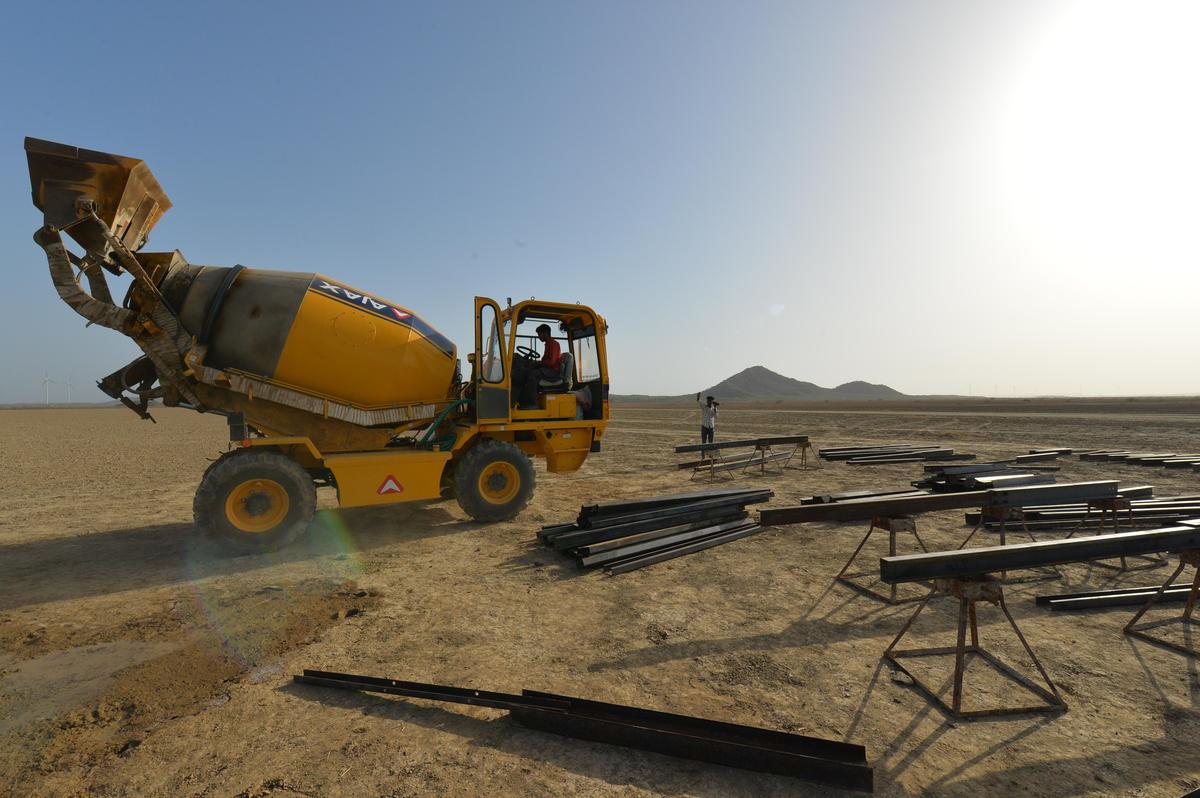
Workers start their solar project work for NTPC near the Kiro hill in middle of the Chhari Dhand wetland, in Gujarat. | Photo Credit: Vijay Soneji
Officials say the project is spread across the 16 villages, with the total project area measuring about 4,500 acres (approximately18 square km), including nearly 1,400 acres between the Kiro hill and the Ramsar site. According to Mutva Bhegmamd, a local actively involved in the protest, over 1,000 acres fall under the eco-sensitive zone, while the remaining 400-500 acres consist of agricultural land. “Forest Department officials have remained silent, claiming they have no role in the project, as it does not fall on forest land. But we know that a portion of the forest area is also part of the project, and they are not speaking about it,” he says.
The anger spilled into public view on May 22, International Day for Biological Diversity, when the community gathered for a day-long protest. “When our buffaloes graze in Chhari Dhand, the milk fetches ₹90 a litre because of its high fat content. But when we buy dry grass in summer, that same milk drops to ₹60,” says Mutva Rafeeq, also from Pulay panchayat, who owns 30 buffaloes. “Banni has over 70 varieties of grass, every one of them rich in nutrition. If they take this land, we do not just lose a grassland. We lose our playgrounds, our graveyards, our places of worship. Everything is falling under this project.”
The Fulay villages alone are home to over 5,000 buffaloes and almost the same number of goats and sheep, according to locals, and they fear those numbers will fall sharply in the coming years if the project goes ahead. Camel herders say the losses would extend well beyond the villages. Every monsoon and winter, over 5,000 camels from across Kutch make their way to Banni for grazing and breeding. If the grassland is taken, that too would stop.
Backed by local BJP MLA Pradyumansinh Jadeja, the villagers have demanded a re-survey of the site. On May 26, they met Chief Minister Bhupendra Patel in Gandhinagar to press their case. “The Chief Minister heard our plea and asked us to submit our demands to the District Collector for administrative consideration,” Jadeja says.
District Collector Anil Ranavasiya says a delegation of villagers had submitted a petition to him last week raising concerns over the proposed project and its possible impact on the ecology and livestock in the region. “Their concerns are being examined. I have directed the local officials to submit a report at the earliest. We will address their issues,” he says.
But even as that demand remains under consideration, the ground is already shifting. Heavy machinery has moved into the wetland and begun a test pile, a preliminary foundation drilling used to assess the soil’s bearing capacity before full construction begins. Workers at the site, most of them from Uttar Pradesh, say the work will be wrapped up in a couple of days, after which the site supervisor will submit a report to the company. The locals say they are powerless to stop it. “We cannot take the law into our own hands,” one of them says.
The sense of helplessness runs deep. “The company officials come with police protection, as if we are some goons. They never talk to us. We have no contact with anyone. We don’t know how to take this protest further,” says Mutva Gulhasan, another livestock rearer from the area.
Documents accessed by The Hindu show that in 2023, NTPC applied to the government for allocation of 578 hectares of land at survey no. 60/part-1 in Fulay village, Nakhatrana taluka, and work began in May this year. Locals say they have not given their consent. That opposition is now visible from a distance. At the entrance of each village, large hoardings in Gujarati have gone up, each bearing a single word: Notice, declaring the community’s stand against the project. The Hindu reached out to NTPC for a response. The company did not reply.
When Chhari-Dhand was declared a Ramsar site, placing it on the global ecological map, locals allowed themselves a rare moment of optimism. Tourists would come, they reasoned. Homestays could be set up, cars hired out, guides trained.
For Mutva Salar, a college student and Maldhari who had been quietly planning to build a livelihood around the wetland’s growing reputation, it felt like the future had finally arrived. “But all our dreams are scattered now. When there are no birds or rare species left, why would any tourist come here? International students travel from across the world to study this place,” he says.
Kutch-based wildlife photographer Ashok Chaudhary says solar panels, viewed from above, resemble the surface of water and can disorient migratory birds mid-flight, causing them to crash land, with potentially fatal consequences for large flocks passing over the wetland.
Chhari-Dhand changes across seasons. In peak summer, with temperatures climbing past 45 °C, the site bears little resemblance to its winter self. The land is cracked and bare, without a patch of water or a blade of grass visible as far as the eye can see. It is a landscape that can, to the uninitiated, pass for the wasteland the government’s documents describe.
But come monsoon and winter, those who live here say the transformation is breathtaking. The cracked flats fill with water, the wetland blooms, and migratory birds arrive in lakhs. “This place is no less than Kashmir, a paradise for birds and humans. While the rest of Kutch is sun-baked and dry, our land becomes heavy with water, with wetlands in the monsoon and winter,” Salar says.
Across the vast flatland rises the Kiro Hill, an extinct volcano whose fossil-rich slopes have drawn palaeontologists from across the world for over a century. Unlike the scorched plains below, the hill stays dense and green even in the height of summer. For the Maldharis who graze their herds across the vast flatlands of Banni, it also serves as a compass. A herder who loses his way scans the horizon for Kiro Hill and walks towards it to find home.
The hill is a refuge too. “When wildfires break out in summer, birds and animals from across the region rush to Kiro hill for shelter. In the monsoon, when the entire area is waterlogged, people bring their herds up to the hill and stay there for weeks,” Salar says.
The proposed solar project is to come up beneath it. Panels and perimeter fencing, the villagers fear, will cut off access to the hill entirely, severing the connection between the wetland, the hill, and the communities that have depended on both for generations. “This project will do more damage to the ecology than anything the human race has done here before,” Salar says.
Asad Rahmani, ornithologist and former director of the Bombay Natural History Society, has studied Chhari-Dhand since 1981. He warns that any industrial development near the Banni Conservation Reserve will alter the larger ecosystem, bringing light pollution, human disturbance, and infrastructure such as transmission lines, which are among the leading causes of bird mortality.
“The land is part of the larger ecosystem and villagers have been grazing here for hundreds of years. The surrounding hills, particularly Kirat Dungar, are a treasure trove of fossils. Has anyone studied the impact of large-scale solar development on these fossil-rich surroundings? Will the stones and the fossils embedded in them be taken from the surrounding hills for construction?” Rahmani says.
Anu Verma, the Asia Regional Coordinator from the International Land Coalition, who previously served as the focal person in India for the South Asia Pastoralists Alliance adds, “Banni is one of Asia’s largest grassland ecosystems. It has been shaped over centuries of pastoral mobility, seasonal grazing, and community stewardship by Maldhari pastoralists. Mobility prevents overgrazing, regenerates landscapes, and maintains ecological balance.”
These concerns find little explicit mention in the State’s Solar Power Policy 2015, or the Gujarat Wind-Solar Hybrid Power Policy 2018, both of which are largely centred on land allocation, grid infrastructure, and incentives for renewable energy developers. The policies do not directly address issues such as compensation, rehabilitation, or livelihood safeguards for communities dependent on common grazing lands.
Megha Sheth, research and documentation associate at the non-profit MARAG — Maldhari Rural Action Group — says the vulnerability of such communities is structural. “Commons are easily diverted because they are classified as wasteland, despite being necessary for pastoral life. Maldharis rely on communal customary rights and not documents, making their rights often overlooked during projects like these,” she says.
In Gujarat, a government resolution mandates 40 acres of pastureland for every 100 livestock in a village, but Sheth says the provision is rarely implemented. “Pasturelands are either non-existent or integrated into larger survey numbers, making commons vulnerable to diversion and encroachment,” she adds. She also flags the poor implementation of the Forest Rights Act, 2006, for Other Traditional Forest Dwellers.
The gap extends to the national level. Solar parks are not required to undergo environmental impact assessments prior to commissioning, according to an August 2017 office memorandum issued by the Union Environment Ministry, which clarified that the provisions of the Environmental Impact Assessment Notification of 2006 do not apply to solar photovoltaic power projects. The memorandum noted only that the disposal of photovoltaic cells would fall under hazardous waste management rules, and that solar park development would continue to be governed by existing pollution control legislation.
Transitioning to renewable energy sits at the heart of India’s commitments under the Paris Agreement, adopted in 2015, which seeks to limit global temperature rise to well below 2°C and as close to 1.5°C as possible. Under its Nationally Determined Contributions, India has pledged to draw 40% of its cumulative installed electricity capacity from non-fossil fuel sources by 2030. The country has moved swiftly on that front. Solar power capacity has surged from 3,744 MW in 2014-15 to roughly 150.26 GW as of March 31, 2026, one of the sharpest expansions in renewable energy deployment anywhere in the world over the past decade, says the Ministry of New and Renewable Energy’s social media handles.
Conservationists are not against the expansion, but say these can be in other regions such as Kutch and the Thar desert, away from ecologically sensitive zones.
deshpande.abhinay@thehindu.co.in
Edited by Sunalini Mathew
此内容由惯性聚合(RSS阅读器)自动聚合整理,仅供阅读参考。 原文来自 — 版权归原作者所有。