


From the century-old red edifice of Lal Bari, the Writers’ Building, once the seat of Bengal’s colonial and postcolonial bureaucracy, and from where the BJP had promised to govern, to Nabanna, Bengal’s Neelbari, the blue and white secretariat that came to embody Mamata Banerjee’s aesthetic and political imprint, and further to the historic chambers of the West Bengal Legislative Assembly, the sudden wash of saffron light was not merely a matter of altered decor. It felt like a visual declaration of a deeper political rupture in a State that had, for decades, imagined itself resistant to the crudities of communal binaries.

The rise of the Bharatiya Janata Party in Bengal cannot be explained through electoral arithmetic alone. The 2026 Assembly election verdict, which gave the BJP 207 of 294 seats with 45.84% of the vote, while reducing the Trinamool Congress to 80 seats with 40.8%, unsettled much conventional political wisdom. The Left Front and Congress, once central to Bengal’s political imagination, were reduced to a combined 7.42%. But numbers alone tell only the surface story. Beneath them lies a longer tale of political exhaustion, organisational patience, and the collapse of older certainties.

Two convenient myths have quickly emerged. The first is that 2026 witnessed a dramatic fresh migration of traditional Left and Congress voters directly to the BJP. The second is that Bengal simply succumbed to an all encompassing Hindu consolidation. Both explanations are politically convenient and analytically lazy. Bengal’s political shifts have rarely followed such neat trajectories.
The BJP’s ascent was neither abrupt nor principally the result of a sudden Left exodus. Historically, the party’s greatest obstacle in Bengal was not the Left but Mamata Banerjee’s Trinamool Congress. When Ms. Banerjee broke away from the Congress, she successfully occupied the anti-Left political space, leaving little room for the BJP. During the Atal Bihari Vajpayee years, the BJP’s relationship with Ms. Banerjee was not antagonistic. She was part of the National Democratic Alliance and held cabinet office in the Union government. Leaders such as Tapan Sikdar and Tathagata Roy articulated a sharper ideological opposition, but the BJP remained peripheral in Bengal’s political imagination.
The existential crisis of the Trinamool
The real shift came later under Amit Shah, when the BJP’s organisational relationship with the RSS acquired sharper purpose. The RSS had maintained a quiet presence in Bengal for decades. From this ecosystem emerged Dilip Ghosh, deputed to build what the BJP had long lacked, a serious grassroots machine. Yet even then, the breakthrough was slow. In 2016, the BJP won only three seats with around 10% of the vote. The Trinamool remained dominant, while the Left-Congress alliance still held substantial space.
Editorial | Take east: On the BJP government in West Bengal
The real erosion of Left support began after that, accelerated by Trinamool dominance and the violence that increasingly accompanied political contestation. The 2018 panchayat elections became a grim marker, with at least a dozen deaths reported around polling and a wider climate of intimidation. For many grassroots supporters, politics ceased to be ideological and became existential. Those who once looked to the Left or Congress for protection increasingly found those structures incapable of defending them.
By 2021, despite an alliance that also included Abbas Siddiqui’s Indian Secular Front, the Left-Congress experiment collapsed to around 8.7%. The BJP rose to nearly 38%, while the Trinamool held steady at around 48%. This was not ideological conversion so much as the consolidation of anti-Trinamool sentiment behind the only viable challenger. By 2026, the Left-Congress combine slipped further to 7.42%, while the BJP gained roughly seven percentage points, largely at the Trinamool’s expense. This was not a sudden migration. It was the culmination of a longer anti-incumbency drift.
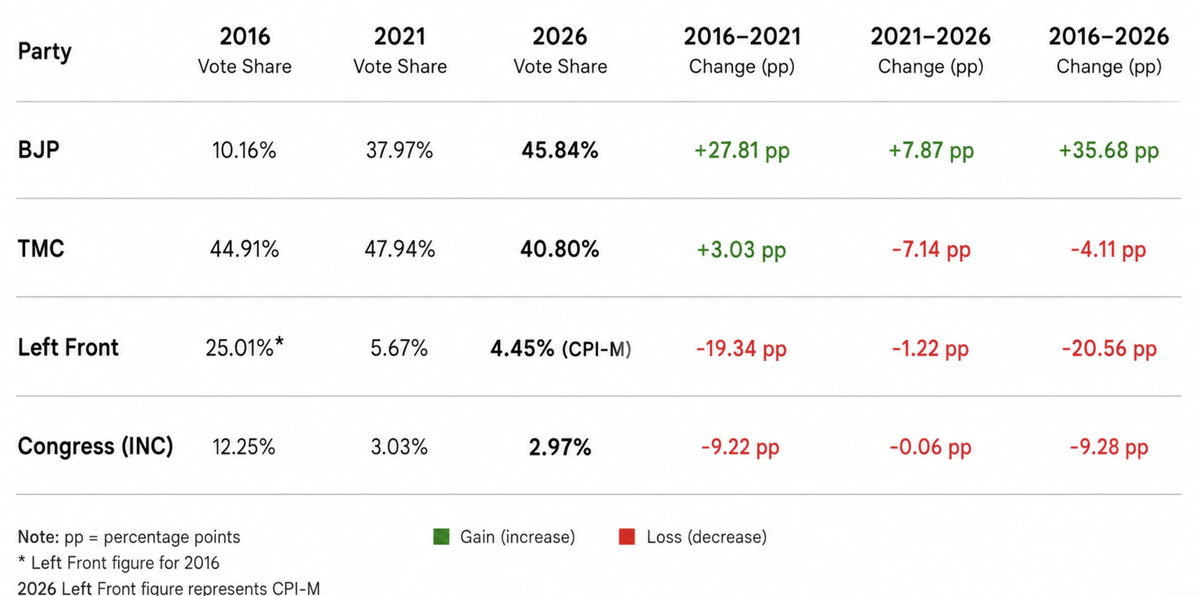
The second myth, that of wholesale Hindu consolidation, also demands caution. Nearly 30% of Bengal’s electorate is Muslim, and the BJP’s support there remains negligible. If this had simply been the story of monolithic Hindu consolidation, the BJP’s decisive breakthrough should have come in 2021, when the party deployed its most aggressively polarised campaign around the Citizenship Amendment Act, anxieties over the National Register of Citizens, and a distinctly majoritarian vocabulary. That strategy helped the BJP rise dramatically from three seats to 77. Yet even then, it fell short. Bengal still held.
What changed in 2026 was not simply the retention of that support, but the movement of an additional section of Hindu voters who had backed Ms. Banerjee in 2021, not out of ideological commitment, but because she appeared the strongest barrier against the BJP. Once disillusionment with the Trinamool deepened, that tactical resistance weakened. The nearly seven percentage point shift from the Trinamool to the BJP cannot therefore be read simply as religious consolidation. It was anti-incumbency finding its most effective electoral vehicle.
What Bengal delivered in 2026 was a watershed election, but not one that submits easily to simplistic templates. A significant number of votes were cast less in passionate endorsement of the BJP than in emphatic rejection of Ms. Banerjee’s regime. Yet electoral conquest and governance are profoundly different acts. Bengal is a political landscape shaped by memory, contradiction, intellectual inheritance, and social fault lines that do not disappear with a change of government.
The BJP would be mistaken if it chose to read this verdict as a sweeping ideological embrace of Hindutva in Bengal. This was not, in any simple sense, Bengal surrendering to saffron. It was Bengal reaching for saffron as an instrument of protest, draping itself in a colour not necessarily out of devotion, but out of despair, anger, and exhaustion. This was less an affirmation of the BJP’s grand ideological project than a fierce indictment of a regime that appeared, to many, to have grown distant, complacent, and convinced of its own permanence.
There is a warning here that extends beyond party lines. In politics, the moment power begins to imagine itself invincible, the electorate begins to search, desperately if necessary, for the sharpest available instrument with which to puncture that illusion. In Bengal, for many voters, the BJP became that instrument. Not because it had necessarily won their ideological allegiance, but because it stood as the only vehicle through which accumulated resentment against the Trinamool Congress could be translated into a decisive political act.
Sayantan Ghosh is the author of two books, Battleground Bengal and The Aam Aadmi Party, and teaches at St. Xavier’s College (Autonomous), Kolkata.
此内容由惯性聚合(RSS阅读器)自动聚合整理,仅供阅读参考。 原文来自 — 版权归原作者所有。