


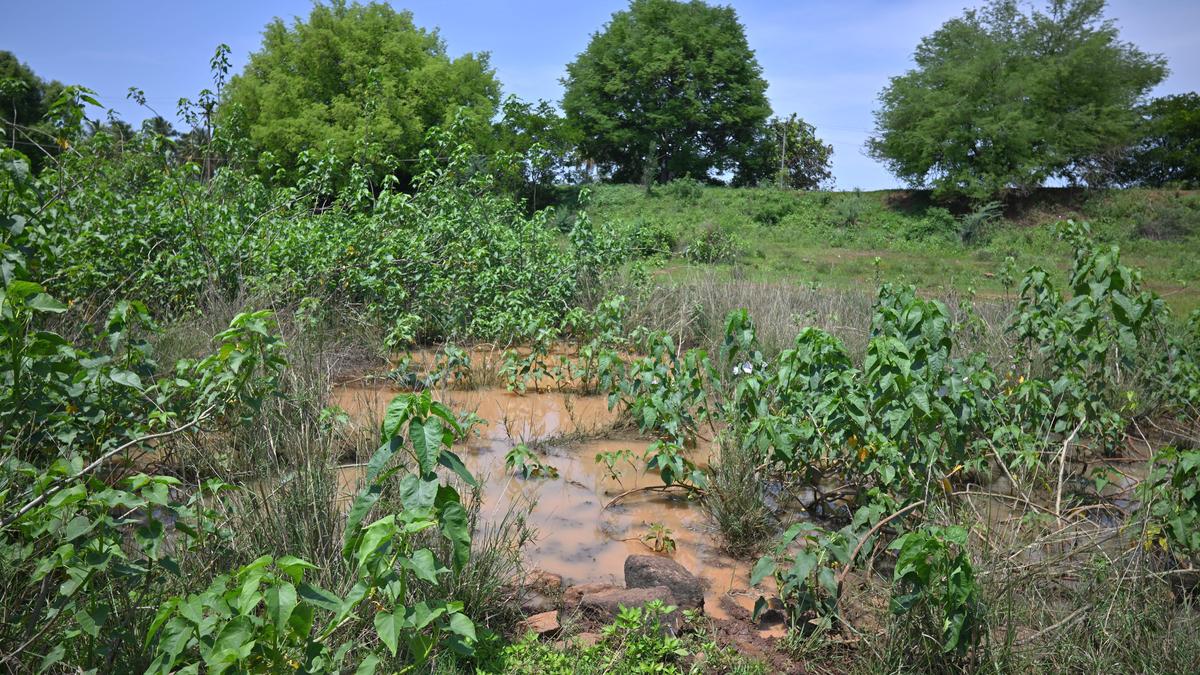

The Kodikulam kanmoi in Madurai. | Photo Credit: G. MOORTHY

Keela Sothoorani in Ramanathapuram. | Photo Credit: L. BALACHANDAR
The newly formed Tamil Nadu government has granted local farmers and potters open access to extract alluvial soil from all nearby waterbodies after reversing the previous administration’s restrictions.
The earlier system in practice had barred the potters and farmers from collecting clay outside their local taluk limits. The potters said it was a restriction that severely compromised on the quality of their pots and utensils.
Under the administration preceding the DMK government, the process of obtaining permission and locating a suitable waterbody were very simple,” said C. Nagalingam, Treasurer of the Manamadurai Pottery Workers Co-operative Cottage Industrial Society.
“The process was just to submit a written letter and our potter’s identification card to the respective taluk office. The letter would then be forwarded to the District Collector for the final approval,” he added.
The waterbodies that would be selected by the potters based on the quality and texture of the clay would be assessed by the authorities for approval, he noted.
According to Mr. Nagalingam, a once-simple process became complicated when the previous DMK government involved the Department of Mines and Geology in the approval pipeline. This change restricted artisans to selecting only government-gazetted waterbodies.
Further, a rule introduced two years ago tightened restrictions even further by limiting choices to waterbodies within the applicant’s own taluk.
“When an application is uploaded to the government’s website, the system automatically filters and narrows down the available waterbodies based entirely on the applicant’s location,” he explained.
He questioned how potters could possibly judge the quality of the clay if their choices were dictated by a government list.
As a result, he stated that the clay sourced from these approved waterbodies has turned out to be completely unusable for most artisans.
However, with the new Tamilaga Vettri Kazhagam party forming the government under the leadership of Chief Minister C. Joseph Vijay, in a move to benefit both local agriculture and traditional artisans, the government announced that farmers, potters and individuals would be permitted to extract alluvial soil from 40,000 waterbodies across the State.
Mr. Vijay recently directed Collectors to ensure the effective implementation of the scheme by officially gazetting the approved lakes and ponds in their respective regions.
Under the new guidelines, individuals requiring the nutrient-rich silt could apply online via the e-Sevai portal (tnesevai.tn.gov.in), with permissions guaranteed within 10 days.
By accelerating this desilting process ahead of the southwest monsoon, the government aimed to expand the water-holding capacity of local ponds and lakes to better support the upcoming farming season.
In Madurai, excavation permissions have been cleared for tanks and lakes spread across 11 taluks.
Hundreds of local water resources have been opened for removal.
The breakdown of permitted waterbodies per taluk is - Melur - 270; Madurai East - 126; Usilampatti - 83; Madurai North - 75; Peraiyur - 73; Thirumangalam - 63; Vadipatti - 49; Kallikudi - 47; Thirupparankundram - 20; Madurai West -12 and Madurai South - 6.
According to the Sivaganga administration, a total of 978 waterbodies, comprising 201 waterbodies under the control of the Water Resources Department and 777 waterbodies under the control of the Rural Development Department in Sivaganga district are open for alluvial soil extraction.
Similarly, in Ramanathapuram district 1,305 tanks / ponds (waterbodies) under the maintenance of the PWD and the Rural Development / Panchayat Raj Department in Ramanathapuram district are eligible for extraction.
Welcoming the move, M. Ilamaran, a potter based in Manamadurai, said it would be a massive lifeline for the local pottery industry, giving artisans the freedom to source the exact quality of clay they need to sustain their livelihoods.
However, he raised concerns over potential backlash from residents who might object to outsiders sourcing material from their local ponds, warning that resource depletion fears could spark village-level disputes.
Maranatan, a farmer from Sholavandan in Madurai district, emphasized the need for a clear framework to regulate how much soil each applicant can harvest and the exact timeframe allowed for the work.
Also, the rural administration should coordinate with the locals to ensure that outside farmers and potters are welcomed without hostility, and that resource sharing is managed peacefully.
He demanded that the government issue clear identity cards or official permits to authorized applicants, making it easy for local panchayats to verify who has legitimate permission to harvest the soil.
Nevertheless, he noted that the introduction of these new rules signals an end to the long-pending demands of local farmers, potters, and related trades.
Published - May 31, 2026 08:18 pm IST