








And then there were four. It wasn’t until the 69th, and penultimate, match of the 10-team league phase that the final qualifier for the IPL 2026 playoffs was identified. Sunrisers Hyderabad’s 55-run defeat of defending champions Royal Challengers Bengaluru on Friday had cemented the top three; the holders and table-toppers would take on Gujarat Titans, the 2022 champions, in Qualifier 1. Hyderabad, who like the top two also ended up with 18 points, had earned their place in the Eliminator, waiting to see who their opponents were.
When Shreyas Iyer blasted his maiden century against Lucknow Super Giants on Saturday to arrest an alarming slide of six straight losses and keep Punjab Kings in the hunt, the wait for the fourth qualifier spilled over to the final day of league action, in keeping with the IPL’s reputation and history. In the end, after a start-stop-start season, Rajasthan Royals, champions in the inaugural edition in 2008, earned that right following a 30-run conquest of Mumbai Indians under a blazing afternoon sun at the Wankhede Stadium.
As is inevitably the case, those that missed out on qualification narrowly – Punjab finished on 15 points, Delhi Capitals on 14 while 16 was the magic figure on which Rajasthan rode into the last four – will rue missed opportunities, a game that slid by here, a point that was dropped there. Kings will potentially point to the only no-result of the tournament, against Kolkata Knight Riders at Eden Gardens, as a decisive moment.
Struggling at the time to get on the points table, Ajinkya Rahane’s men, strangely opting to bat despite the threat of rain, were gasping at 25 for two when the skies opened up, gifting them a much-needed first point. Who’s to say how the match would have panned out had PBKS, riding the crest of an early wave, had the opportunity to play out a full game?
Kings will look back and understandably wonder how it came to this pass. For the first half, and more, of the league phase, they looked unstoppable and unbeatable. The no-result in Kolkata was the only point they dropped in their first seven outings; with 13 points and seven games remaining, it wasn’t a question of whether they would make the playoffs, but what their final points tally would be and who they might run into in Qualifier 1.
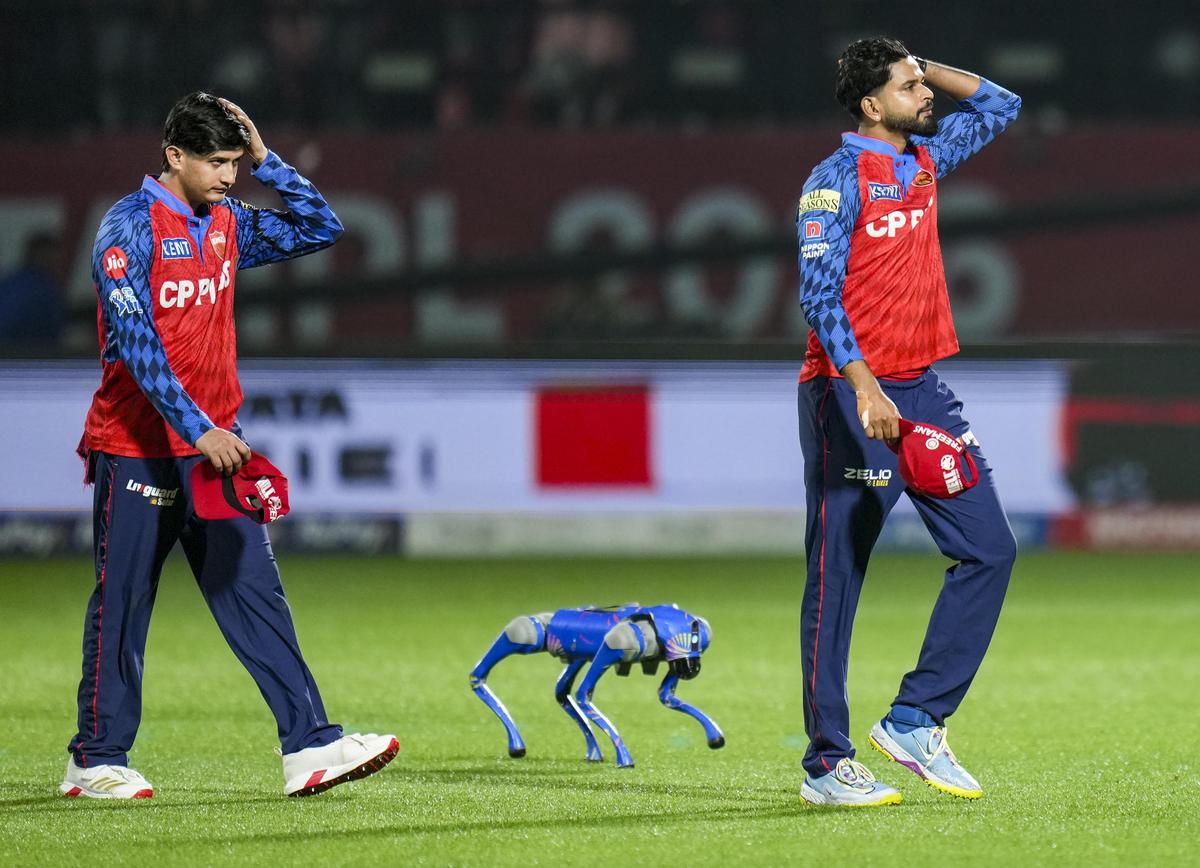
Punjab will wonder how they were eliminated after being in such a strong position. | Photo Credit: PTI
Then, remarkably, without warning, Punjab embarked on an inexorable tailspin, the celebrated leadership group of Shreyas and head coach Ricky Ponting powerless to arrest the slide.
The same personnel that fuelled their first-half charge started to repeatedly fluff their lines, their death bowling went to pieces and their catching and ground fielding was abysmal. The last development would have particularly incensed Ponting, for two reasons – one, he was among the best fielders of his generation and two, misfields and dropped catches are unforgivable unforced errors.
PBKS have plenty of time – nearly 10 months – to rue their self-inflicted misfortune and reflect on how they managed to embrace elimination when advancing to the next stage was infinitely the simpler and more inviting proposition. Shreyas had a great run with the bat and was tactically astute for the most part – at one point, there were calls for his elevation to T20I captaincy at the expense of the misfiring Suryakumar Yadav, though those calls have disappeared now – but the end result is something he will struggle to reconcile with.
Delhi fell tantalisingly short numerous times in closing out games, not least against Gujarat when they needed two runs off as many deliveries with David Miller and Kuldeep Yadav in the middle. For reasons best known to him, the South African turned down the scores-tying single off the penultimate ball from Prasidh Krishna, backing himself to get the job done.
It was a massive error in judgement and DC paid a heavy immediate and eventual price. Kuldeep was run out off the last ball looking for the bye that would have sent the game into a Super Over as Gujarat pulled off a one-run heist. From then on, one of only two from the original eight — apart from Punjab — to have not won the title even once blew hot and cold, struggling for consistency and crashing out despite bringing the curtain down on the league phase with a comprehensive victory over Kolkata on Sunday.
So much for the two that narrowly missed out. KKR and Chennai Super Kings recovered from early setbacks to stay in touch with the qualification race, though they were always chasing their tails and playing catch-up. The same couldn’t be said of the two cellar teams, Mumbai Indians and Lucknow Super Giants, both of whom managed a frugal four wins each from 14 outings. Five-time champions Mumbai were the biggest disappointment, reiterating that big names and celebrity superstars don’t guarantee success.
Lucknow are now licking their wounds and already contemplating changes, including to their leadership after ₹27 crore-signing Rishabh Pant had another modest season with the bat and has now led the side to just 10 wins from 28 outings across two campaigns.
Left-handed batters (mainly openers) and fast bowlers stole the individual honours, none more so than the youngest player in the history of the competition. Vaibhav Sooryavanshi rang in his 15th birthday just a day before IPL 2026 got underway on March 28. He celebrated that milestone in extraordinary fashion, sending chills down the spine of some of the most illustrious bowlers of the modern era. He instilled fear and uncertainty, he mesmerised and entertained with an array of strokes that screamed out intrepidness and great class. He spared no one – not Josh Hazlewood or Jasprit Bumrah, not Kagiso Rabada or Mitchell Starc. When was the last time you watched a match just for one player? And that too for a 15-year-old?
The good news — for everyone else except the bowling fraternity — is that more of Sooryavanshi is in store. He showed that he wasn’t an otherworldly being thrust upon us with a six-ball four against MI on Sunday, but that means he will be even more charged up against Sunrisers in New Chandigarh on Wednesday.
Already this season, he has had two interesting run-ins with the 2016 winners. In Hyderabad a month and a half ago, he perished first ball, caught on the pull off debutant pacer Praful Hinge. Retribution was swift, and just 12 days in coming. In the return fixture in Jaipur, he brought up the third fastest IPL century, off 36 deliveries (he holds the record for the second fastest too, let’s not forget), treating Praful with disdain and battering Sakib Hussain, who had also taken four wickets on his debut alongside his pace partner.
Hyderabad won both those games, by 57 runs and five wickets, but captain Pat Cummins and head coach Daniel Vettori will read nothing into those results as they head into the first actual knockout game of the competition. They know there’s more to RR than Sooryavanshi – yes, though it’s easy to lose track of that sometimes – but much of their focus will be concentrated on halting the boy wonder because, well, he is the boy wonder.
Sooryavanshi finished the league stage as the fifth highest scorer, with 583 runs, behind only Sai Sudharsan, Shubman Gill, Heinrich Klaasen and K.L. Rahul. Among those with more than 400 runs, he is one of only two batters with a strike rate of more than 200; his 232.27 is comfortably better than Abhishek Sharma’s 206.22 and these two left-handers also have the most sixes where, again, Sooryavanshi is clearly streets ahead, with 53 ‘maximums’ to the Hyderabad opener’s 43. Wednesday will therefore witness a battle within a battle, with the winner living to fight another night and vanquished taking an early flight home.
The two leading scorers of the competition are Gujarat’s Sai Sudharsan and Gill, with 638 and 616 runs respectively. But interestingly, as if to reinforce the belief that batters win matches while bowlers win tournaments, the GT bowing unit has accounted for more than 100 wickets, making them the only franchise to top that milestone this edition. Their charge has been led by the excellent Kagiso Rabada and the terrific Afghan leg-spinner Rashid Khan, who has purged a lean last couple of years with 19 wickets to go with an economy of 8.71. Rabada’s 24 wickets are the joint highest alongside Bhuvneshwar Kumar, the ageless wonder from RCB who holds the Purple Cap owing to a superior economy rate of 8.07 compared to his South African counterpart’s 9.18.
Rabada and Mohammed Siraj, who has picked up 17 wickets, are in a personal battle for the most dot balls bowled in the competition. Between them, the Rabada-Rashid-Siraj trio has 60 wickets which, allied with Prasidh’s 14 and Jason Holder’s 13, paint the picture of a wicket-hungry group that has backed up the heroics of their openers and the explosive No. 3, Jos Buttler.
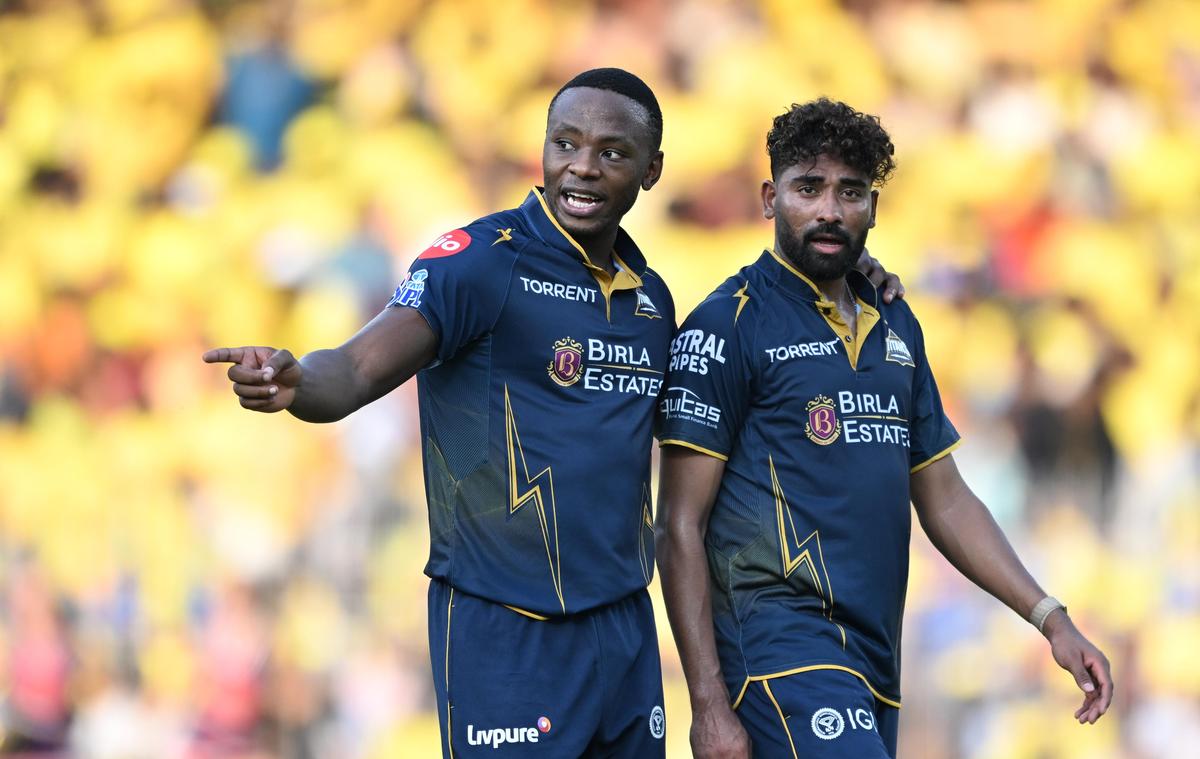
The GT bowling attack, led by Rabada and Siraj, has consistently troubled opposition teams. | Photo Credit: R. Ragu
RCB have just one bowler in the top 12 wicket-takers and one batter – Virat Kohli, at ninth, with 557 runs — in the top 15 run-makers, but clearly, they have maximised their depth in both departments, which explains their status as the table-toppers.
They were forced to split the opening combine of Kohli and Phil Salt after the latter picked up a finger injury, and Salt’s replacement, Jacob Bethell, has flown back home, also with a finger injury. In their absence, Venkatesh Iyer has stepped up nicely, while at No. 3, Devdutt Padikkal has been wonderful to watch with his rangy ball-striking and a rejigged mindset that’s allowed him to score at 171.82.
Rajat Patidar, who ended a long wait by leading the team to their first trophy last season, has scored 393 runs at a strike-rate of 183.64 while Tim David is a dangerously fierce middle-order presence. This is the fulcrum around which the batting has revolved, while the bowling has been shored up, in Bhuvneshwar’s wake, by Rasikh Salam and the crafty Krunal Pandya, though Hazlewood has blown hot and cold.
All to play for as we head to the final week then. Bengaluru and Gujarat will have two bites at the cherry by finishing 1-2, while Hyderabad and Rajasthan are at the point of no return. It’s taken nearly two months to reach this stage; now, it’s all about the next six nights.
此内容由惯性聚合(RSS阅读器)自动聚合整理,仅供阅读参考。 原文来自 — 版权归原作者所有。