









A recurring and deadly pattern is unfolding across Telangana’s high-speed corridors, where stationary and illegally parked heavy vehicles are turning highways into death traps, exposing glaring gaps in enforcement and the absence of basic infrastructure for long-haul transport.
From the Outer Ring Road to the national highways criss-crossing the State, lorries and tippers are routinely found pulled over on carriageways and shoulders without hazard lights, reflective markers or warning cones. In the dark or at high speeds, these hulking silhouettes become near-invisible obstacles, leaving motorists with little time to react.
The consequences have been deadly. In first four months of 2026, at least a dozen lives have already been lost and 13 have sustained serious injuries in crashes involving parked heavy vehicles. Earlier this week, six members of a family were killed when their car rammed into a stationary lorry on the ORR. On May 5, two people died and four were injured after their vehicle crashed into a goods carrier parked along National Highway 65 near Zaheerabad. Even emergency services have not been spared; in Vanasthalipuram, an ambulance transporting a patient slammed into a stationary lorry, leaving three critically injured.

These accidents are not isolated. They form part of a larger and worsening road safety crisis. Telangana, which has 30 national highways spanning 4,983 kilometres, recorded 24,826 accidents in 2025, resulting in 6,499 deaths and 14,768 injuries, according to the State police’s annual report. This marked a 5.6% increase from 23,491 crashes in 2024, which claimed 7,056 lives and left 21,664 injured. In 2023, 20,699 accidents resulted in 6,788 deaths and 19,137 injuries.
In April 2026, the Supreme Court of India imposed a ban on parking heavy and commercial vehicles on national highway carriageways and paved shoulders. The court also called for strict enforcement through Advanced Traffic Management Systems, GPS-tagged photographic evidence and e-challan mechanisms, noting that national highways account for nearly 30% of road fatalities despite making up just 2% of the total road network.
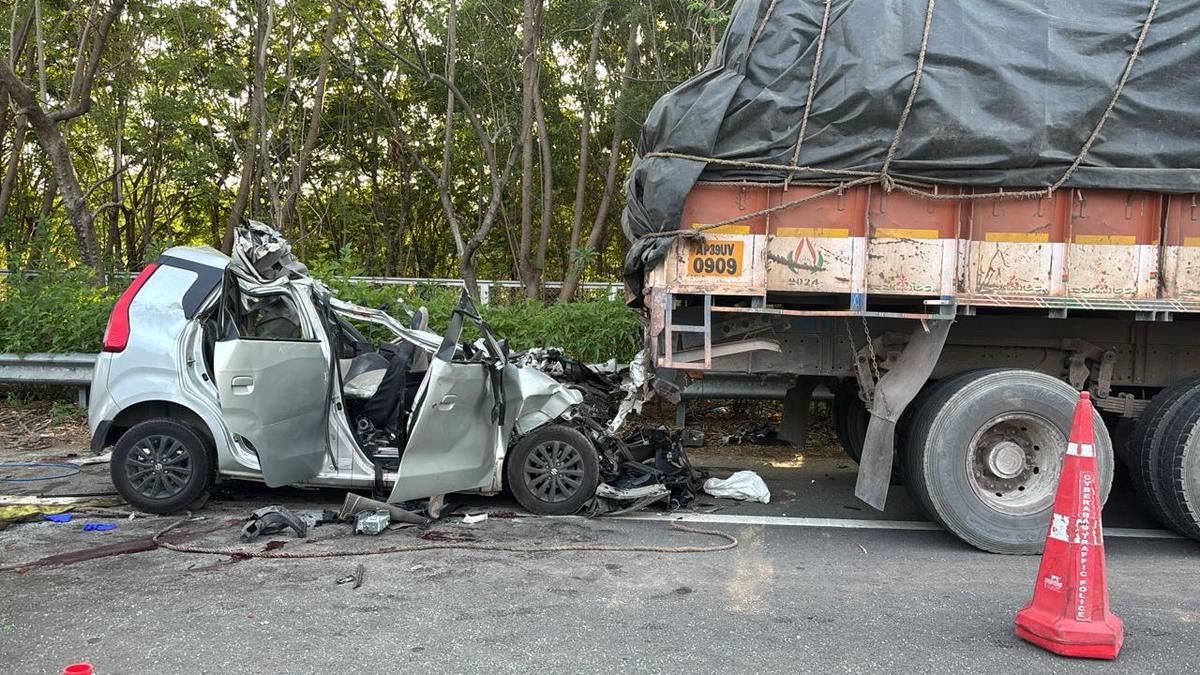
The mangled remains of the car after it rammed a stationary lorry on the Outer Ring Road near Thondupally in Shamshabad mandal accident on May 1. | Photo Credit: By Arrangement
Two years ago, in May 2024, Telangana had announced plans to establish designated parking bays for heavy vehicles along highways. The proposal, intended to provide safe halting points for long-distance carriers, remains pending with the State government.
Senior police officials familiar with the proposal said it has made no headway, noting that there have been no discussions on the issue over the past two years and no tangible progress towards its implementation.

The SC has also ordered the removal of unauthorised roadside establishments within highway limits and directed the creation of district-level highway safety task forces, alongside improved surveillance, identification and lighting of accident-prone blackspots, installation of warning signages and development of truck lay-bys and efficient emergency response systems. Progress on several of these measures remains limited.
The mounting death toll is not merely a statistic, but a stark reminder that without swift enforcement and long-promised infrastructure, the State’s roads will continue to exact a heavy human cost.