


The British natural historian David Attenborough turns 100 today. It is likely no one has done more to make the non-human world more legible and loveable to mass audiences. Attenborough’s career as a host, starting with Zoo Quest in 1954, spans seven decades and nine documentary series. His influence on how several generations of people worldwide perceive ecology and conservation is unparalleled.
Yet that is also what has made his work and his efforts to communicate it so troublesome.
Moving animals out
Zoo Quest made Attenborough famous, especially his genuine curiosity, but it also showed colonialism-like extractivism in action. The BBC filmed in exotic locations around the world, where wild animals would be captured and transported to the London zoo. While Attenborough has since said the show’s attitude would not be acceptable today, he also stopped short of acknowledging the post-war infrastructure of British cultural imperialism it benefited from.
The BBC and London Zoo were producing Zoo Quest for the metropolitan British public, using tropical countries as theatres of spectacle. That the show was what it was mattered also for the BBC’s history as its attitudes were baked into the broadcaster’s Natural History Unit and subsequent productions.
Attenborough’s own (professional) longevity has exacerbated his flaws. Among others, the English journalist George Monbiot has criticised Attenborough for saying almost nothing about the ecological catastrophe intensifying around him for decades. At various points in his career, Attenborough was feted for showcasing the beauty of the natural world — but which he often framed in a way to make it seem pristine, untouched by the difficult realities of ecological decline and the human hand in it.
For reasons including the BBC’s longstanding aversion to advocacy and his personal temperament, Attenborough chose aesthetics over the politics of harm. In fact, Attenborough’s genius was always aesthetic and strictly zoological: he told The Guardian in 2019 that he made “natural history programs not because I was a rampaging proselytizer preaching about conservation” but because he liked “looking at animals and seeing what they do”. But the thing with being the voice of the planet, so to speak, is that what you do not talk about can become what does not merit being talked about, and eventually what is not real.
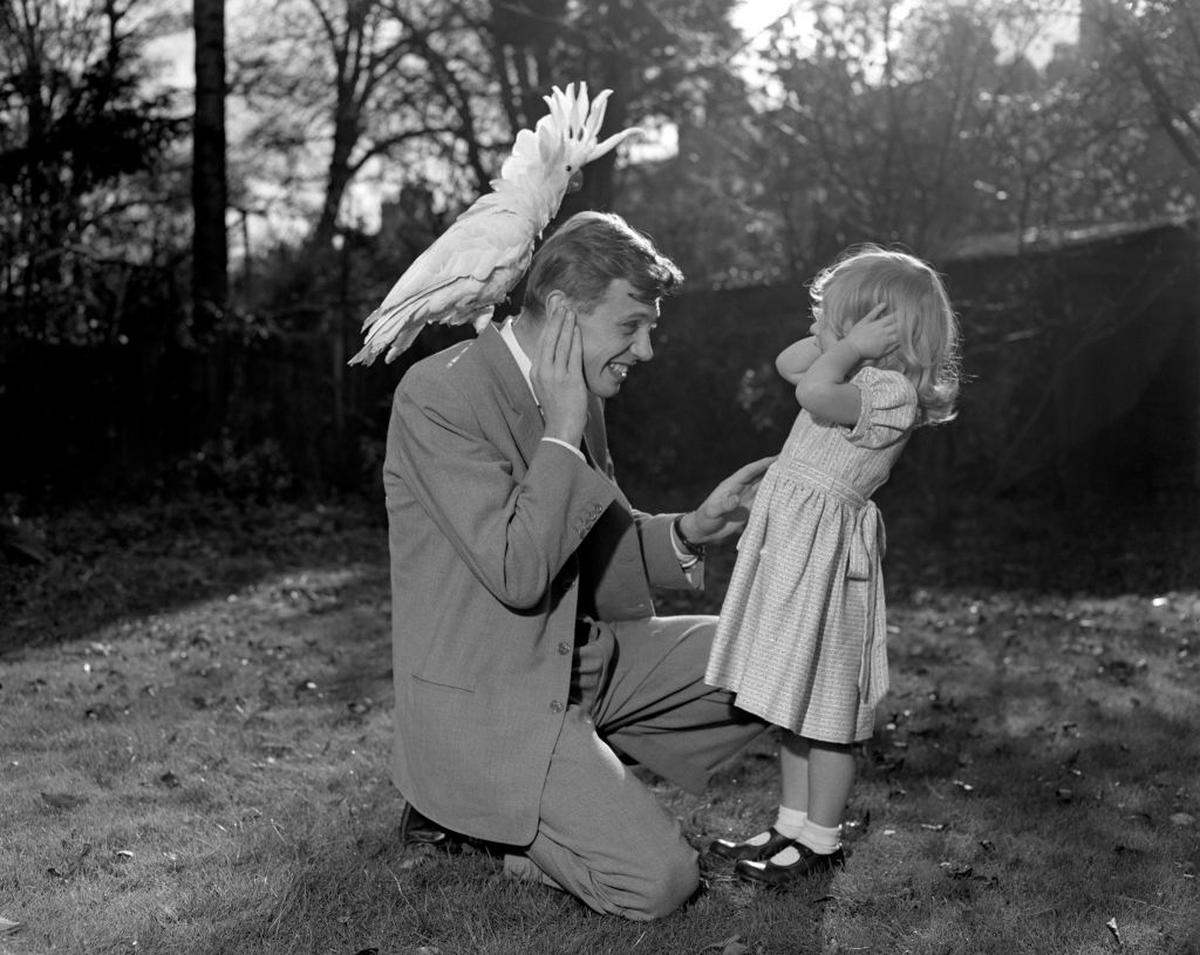
Three-year-old Susan and her father David Attenborough cover their ears as a sulphur-crested cockatoo lets out a piercing shriek. The bird was brought to the U.K. from New Guinea, which Attenborough had visited for his 'Zoo Quest' series. | Photo Credit: Getty Images
Of people and tigers
The BBC Natural History Unit for a long time presented the natural world as a space apart from the one humans lived in and shaped. This idea is closely related to fortress conservation — a conservation paradigm that, in India and elsewhere, has been inhumane to Indigenous peoples and communities that depend on forests for their survival.
Among other ‘features’, fortress conservation holds that natural parks and sanctuaries must be free of human presence. However, researchers, scholars, activists, and members of forest-dependent communities have repeatedly proved that this requirement is a myth. These communities have played an important role throughout history by protecting these forests. Yet governments and forest departments have been fond of fortress conservation because it confers the ability to conserve with the instruments of bureaucratic authority and territorial control, with guns if needed.
The idea also has a parallel in some western models of conservation, which believe the wilderness must be ‘defended’ against, even violently, by the people who live there — and in the case of shows like Zoo Quest, these people were often Africans and Asians. It does not brook the possibility, indeed reality, that national parks in Europe often have working farms and towns, partly because Attenborough’s documentaries poured enormous ideological work, even if they did not intend to, into sustaining the myth of the pristine natural. As the anthropologist Zoe Todd has said, Attenborough has been guilty of presenting the Anthropocene as a world shorn of the violence against Indigenous peoples.
In one show, Seven Worlds, One Planet, Attenborough said India’s tigers have it harder than ever to raise families. This is partly true and that makes his statement doubly irksome. Independent India did not massacre tens of thousands of tigers and push them to the brink of extinction — but the British Raj did. Today, India’s tiger populations face fragmented habitats, poaching, dwindling prey, disease, conflicts with humans, and the ravenous appetite of crony capitalism for natural resources. But India has also been striving to conserve the animal, with tiger populations expanding considerably since independence.
Attenborough painted an incomplete picture, giving the impression that what he was showing people was all of it. Just like that, the supposedly clueless people in India were to blame for the tiger’s plight rather than the forebears of his viewers back home.
In fact, many Indigenous peoples today also want to use land in non-traditional ways, and the overall tigers-versus-tribals debate is much less straightforward today.

In ‘Blue Planet II’, David Attenborough travelled to Trinidad to meet a community trying to save leatherback turtles, whose numbers had fallen catastrophically. | Photo Credit: Gavin Thurston
Problem focus
Attenborough has also patronised the U.K.-based Population Matters charity for years and in many of his documentaries has emphasised population growth as an important, or even the principal, driver of ecological distress. The focus on population remains disturbingly vital to this day, particularly among conservation philanthropists. Many neo-Malthusian assumptions among environmental NGOs and government agencies are also being deepened by climate migration and human demographic pressure on agricultural land. But despite repeated exhortations to the contrary, the world’s population growth rate has been dropping since the early 1960s, shortly after Attenborough launched his career.
On the other hand, a recent report from Oxfam and the Stockholm Environment Institute found that in the 25 years from 1990, the world’s richest 1% emitted twice as much carbon dioxide as the poorest 50%. Which should rank consumption patterns and the habits of industrialised societies far higher than population growth on the list of contributions to climate change. Yet Attenborough has not clarified this.
Such ideologies often stem from the notion that the populations of Commonwealth countries are growing ‘too fast’ today, thus moving blame away from the colonists. But as before, when Attenborough said “humans have overrun the world”, he furthered a deleterious idea and amplified it to millions of people without the proper context, and it did even more harm as it entered an information landscape primed by the anxieties of far-right ecological nationalism.
To be sure, Attenborough is not an ecofascist — only that he has seemed to be unaware of the great effects of what he was and was not saying at any time. (Perhaps his viewers are also to blame for trusting only one voice instead of seeking out multiple — but Attenborough should certainly have known better.) He has never professed any political views even though environmentalism is deeply political. He told The Guardian in the same interview that he wouldn’t risk getting banned from the BBC. But when your voice is the most trusted on the subject of the natural universe, and when you decline to name colonialism as a historical cause of biodiversity loss, you implicitly exonerate it. When you insist on speaking to an undifferentiated humanity — rather than one aware that a farmer in the Congo has done much less to harm the earth than an investment banker in the U.S. — your false equivalence only serves power.
Public backlash against fortress conservation is gaining an increasingly risible momentum and is bound to prevail, especially in Africa and South Asia, where the lines between conservation and land-grabbing are becoming clearer.
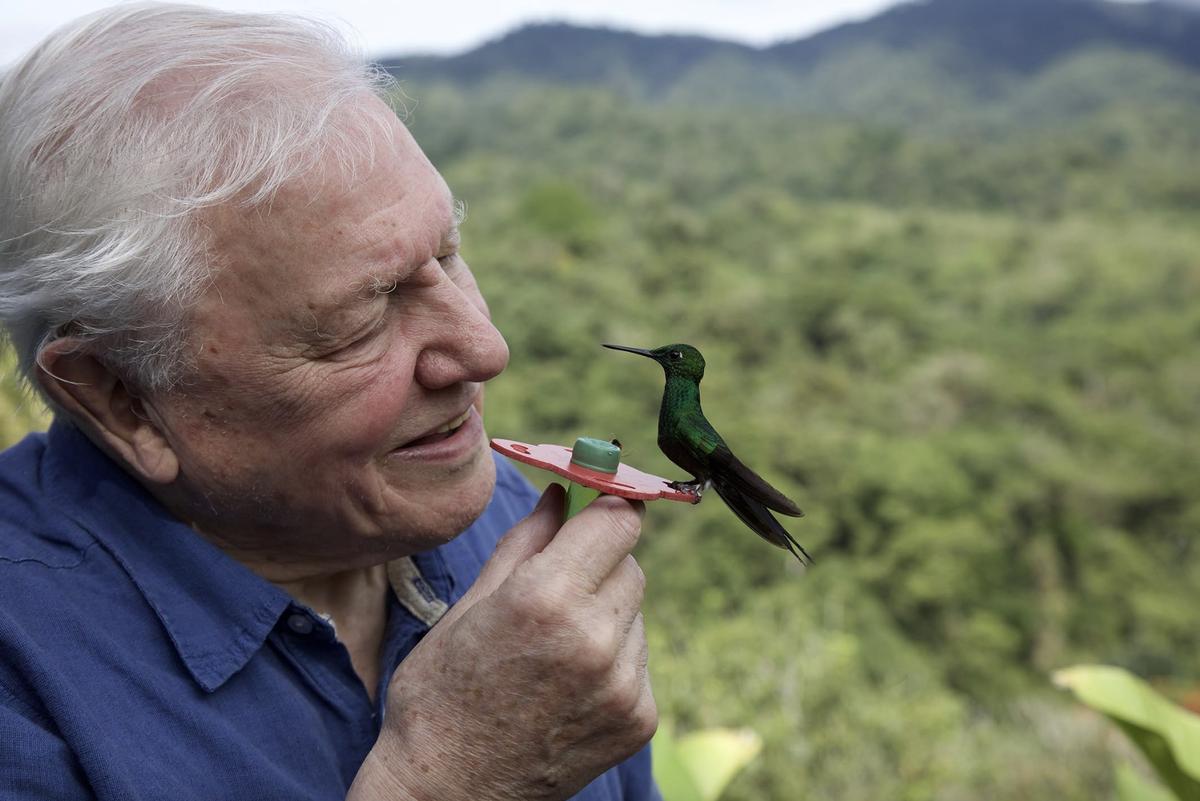
David Attenborough interacts with a green-crowned brilliant somewhere in Central America. | Photo Credit: Getty Images
Stopping at wonder
To be fair, these criticisms are not exclusive to Attenborough: they have become the pathologies of conservation practices that have only just begun to interrogate themselves in good faith. Even in 2021, 50 countries came together to commit to the ‘30 x 30’ initiative, to protect 30% of land and the oceans by 2030. It drew enthusiastic support from Attenborough but vehement criticism from Indigenous rights organisations for paving the way for a new wave of dispossession in the name of conservation.
Protected areas around the world, rather than in the Global South alone, are what they are today thanks to millennia of human stewardship as well, in particular that of Indigenous peoples. Mistreating these peoples leads to biodiversity loss. It is that simple, yet many mainstream conservation circles still think this a radical position and instead prefer Attenborough’s sanitised aesthetics.
None of this diminishes Attenborough’s other achievements. It is impossible to overstate the importance of his bringing the wild into the living rooms of people who may otherwise have never imagined a coelacanth swimming through an indigo sea or the mesmerising dance of birds against a twilight sky. Even the grief he voiced in the latter part of his career about what the world had lost in his own lifetime seemed sincere and meaningful.
Many wildlife biologists and ecologists have anecdotes about how they were inspired to get into their fields after watching Attenborough’s documentaries. And they may have gone on to ask the questions that he never did. However, there is no reason to believe the vast majority of Attenborough’s viewers were prodded in the same direction.
If the wonder he fixated on in his stories was the beginning of moral seriousness, Attenborough’s mistake was to stop there.
The author is grateful to conservation biologist Neha Sinha for her feedback and suggestions.
mukunth.v@thehindu.co.in