











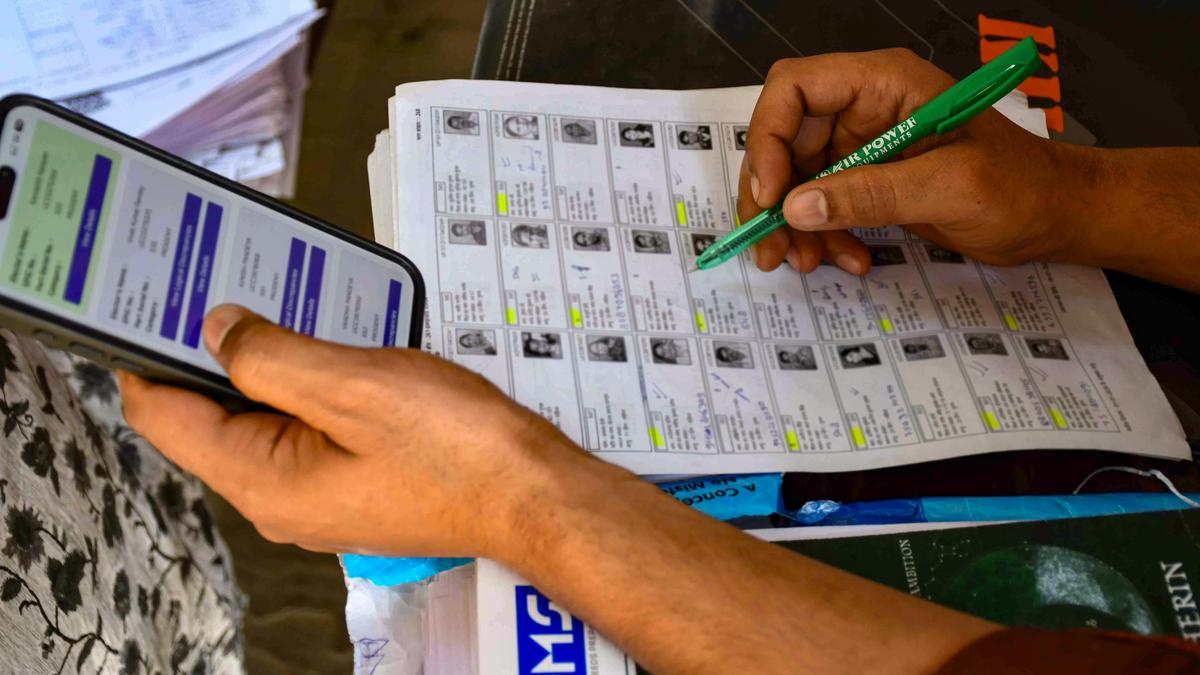
Despite Karnataka reporting 87.49% completion in voter mapping, including progeny mapping, as of May 23 ahead of the Special Intensive Revision (SIR), Booth Level Officers (BLOs) say the exercise is still far from complete on the ground. Migrant and marginalised populations are proving the hardest to map due to mismatched records, mobility and field constraints, they say.
The core problems, BLOs point out, include mismatches in voter records, poor phone network connectivity and migration.

Same person, different spelling
In many cases, names appear differently across records, with variations in spelling, initials and order, making it difficult to confirm whether entries refer to the same person. This is also leading to repeated visits and incomplete mapping. “Across many communities, there is a single name. In other cases, some people have initials in one document while the same initials are expanded in another. The system is not able to handle these variations,” a BLO in Bengaluru said.
A BLO, an Anganwadi worker in the city, showed several cases where voters holding EPIC cards issued years ago were still not traceable in updated 2025 rolls, with the system returning “record not found” despite correct details such as constituency and part number. Another common concern raised by BLOs is that many people are unable to recall where they were enrolled in 2002.
While Chief Electoral Officer V. Anbu Kumar had recently said BLOs would help trace such voters, officers said the electoral rolls are structured hierarchically – State, district, Assembly constituency, polling station and part number – and they try to narrow matches using age, family names and local identifiers. However, inconsistent spellings and missing details in the software often produce multiple possible matches, leading to confusion and incomplete mapping.
“The SIR guidelines require documentation based on age groups. This has become difficult in rural areas, especially where older generations themselves do not have complete records,” a BLO added.

Migration challenges
Migration has further complicated the exercise. In districts like Yadgir and Raichur, BLOs said many families have members working in cities such as Bengaluru and Hyderabad, while others move seasonally for agricultural work like sugarcane cutting in Maharashtra. Houses in such cases are often locked, leaving verification incomplete even after multiple visits.
In Kodagu and Chikkamagaluru, BLOs said they are facing additional challenges beyond mapping. A single polling booth often covers large, difficult terrain with steep slopes and interior roads that are not motorable. The area also has many workers who migrate every few months, while estate owners themselves are based in Bengaluru and other cities.
Adding to the challenge is poor network connectivity and issues with mobile phones allotted for the exercise. BLOs from Bengaluru, Yadgir, Raichur, Kodagu and Chikkamagaluru told The Hindu that network problems persist not only in interior areas but also in parts of cities. They said data often cannot be captured in one attempt.
Age factor
Several BLOs and teachers involved in the exercise are above 50 years of age and said they are also managing health issues while doing physically demanding fieldwork. They added that training was not adequate, a concern they said they have raised multiple times.
While BLOs acknowledge migration and lack of documents are causing many marginalised voters to be left out of the exercise, official data shows mapping has reached 96.02% in Kodagu and 92.02% in Yadgir.
Published - May 23, 2026 08:46 pm IST