



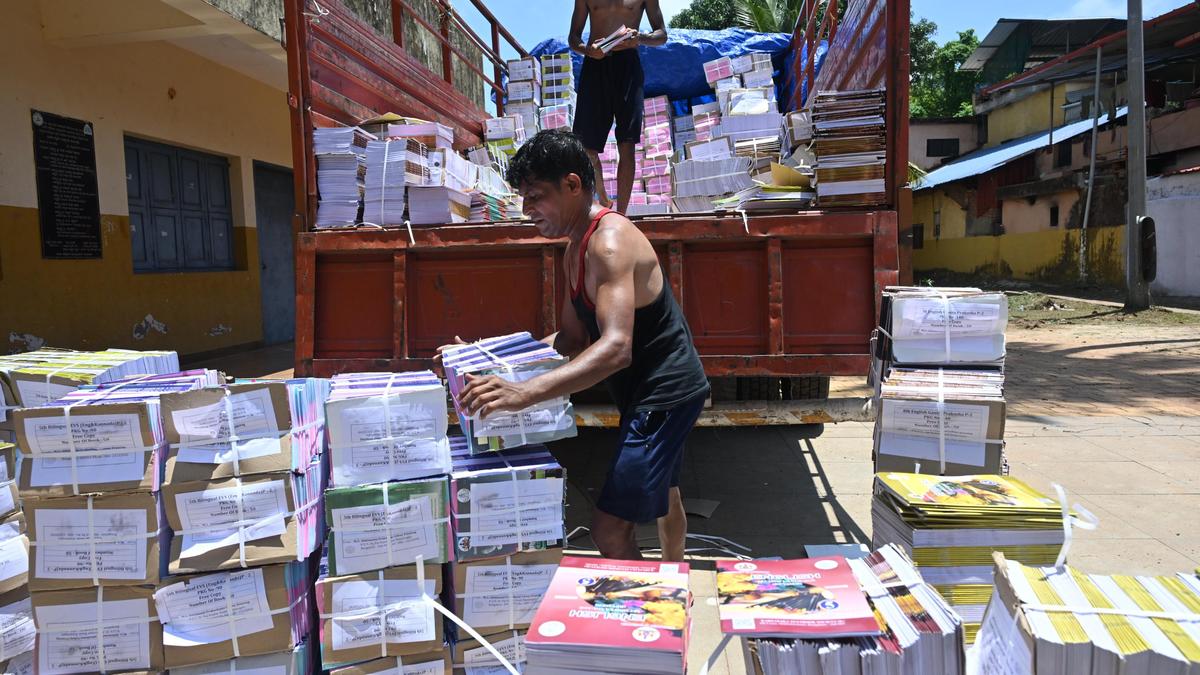

The cover pages of bilingual textbooks in Mathematics and Environmental Science for class 5, to be used in government primary schools in Dakshina Kannada from the 2026-27 academic year. | Photo Credit: H.S. Manjunath
Preparations are in full swing at 896 government primary schools in Dakshina Kannada to introduce bilingual (Kannada and English) medium for the 2026-27 academic year starting June 1.
Of the 896 schools, 220 have been teaching in a bilingual medium for the last five years. The class 1 batch of 48 schools that began bilingual instruction in 2019-20 will be in class 8 in 2026-27. Students of 34 schools that started in 2021-22 will move to class 7, while those from 38 schools that introduced the system in 2024-25 will be in class 3. The class 1 students of 159 schools that began bilingual education in 2025-26 will move to class 2.
Dakshina Kannada is among a few districts in the State where bilingual medium of instruction will be implemented in all schools from 2026-27.
The process of distributing bilingual textbooks for Mathematics and Environmental Studies to schools has begun. Teachers have been admitting new students to primary schools, as well as to 20 Pradhan Mantri Schools for Rising India (PMSHRI) and nine Karnataka Public Schools (KPS) in the district, since May 13.
The government has prescribed that a child has to be at least five years and 10 months old by June 1 for admission to class 1.
Deputy Director of Public Instruction, Dakshina Kannada, G. Shashidhara, said teachers in government primary schools are capable of teaching bilingually. All 1,541 teachers from seven education blocks have undergone five days of training in the bilingual medium of instruction between March and April. On May 29 and 30, a day-long training will be conducted for all teachers on month-long transition activities for class 1 and class 2 students, he said.
The government, on May 23, issued orders sanctioning over 50,000 guest teachers across the State. Those allotted to the district will undergo orientation after the start of the new academic year, Mr. Shashidhara said.
Teachers Vimal Kumar from the PMSHRI Government Primary School in Nelliyadi and Usman from Government School, Mullakkadu, said they have been teaching bilingually for the last five years. “With training at regular intervals, we have gotten used to the bilingual form of instruction,” Mr. Kumar said. There was a smooth progression of students from the bilingual medium up to class 5, and to English-medium instruction in class 6, he said. Admissions at Nelliyadi and Mullakkadu schools stood at 373 and 330, respectively, last year.
An English teacher from a government primary school in a village in Sullia said the school has been using the bilingual medium of instruction since 2025-26. “A good number of students have picked up English far quickly than Kannada,” the teacher said.
H. Kumaraswamy, who worked as a faculty member in Government Teachers’ College, Mangaluru, said government school teachers will quickly adapt to a bilingual medium of instruction.
A headmaster from a Government Higher Primary School in Bantwal taluk said schools with a kindergarten on their premises will find it easier to secure admissions to bilingual Class 1. For other schools, it will be a challenge in view of the admission campaign for nearby PMSHRI and Karnataka Public Schools.
Published - May 24, 2026 07:29 pm IST