








A lack of budgetary support from the government has hit apiculture farmers in Karnataka, said farmers and officials in the Horticulture Department.
The low budgetary allocation has forced the department to provide only two to three beekeeping boxes to farmers instead of providing a minimum of 10 boxes to each under the State Apiculture Development Scheme.
Hemalata K., Senior Assistant Director, Horticulture Department (Apiculture), said that in Karnataka, there are approximately 60,000 farmers involved in apiculture, mainly located in Dakshina Kannada, Uttara Kannada, Chikkamagaluru, and Shivamogga districts. Last year, in 2025-26, the State recorded the production of 858.113 tonnes of honey, generating a revenue of ₹106.49 crore.
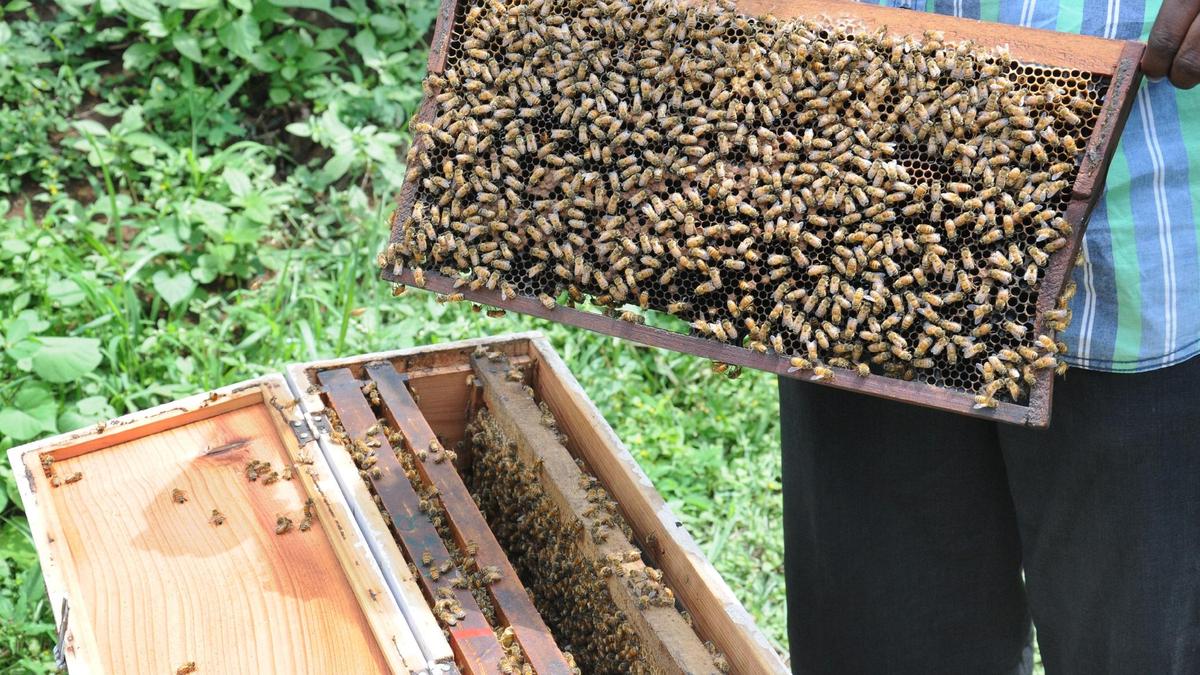
“This year, we have estimated the State to produce 1,200 tonnes of honey. While the potential to produce honey is high among farmers, the Budget allocated is low, ₹2 crore, this year. We provide around two to three beekeeping boxes to the farmers, keeping the small Budget in mind, instead of providing a minimum of ten boxes as per the actual demand. The beekeeping box contains atleast five to six frames with bee colonies and queen bee,” she said.
For Apis Cerana Indica
According to the department, the cost of each bee box is ₹4,500 of which 75% is paid by the government as subsidy and 25% is paid by the farmers. This is a move directed to encourage apiculture in the State. There are two types of bees usually found in India, including Apis Cerana Indica and Apis Mellifera. Under the scheme, the government provides box that comes with Apis Cerana Indica as it requires less flowers to collect honey, while Mellifera requires flowers in huge number to produce desired quantity of honey.
“The farmers can also apply for beekeeping boxes under the National Beekeeping and Horticulture Mission (NBHM) which also provides subsidy of up to only 40%. Though there is a provision to provide up to 59 beekeeping boxes under the NBHM, farmers prefer to buy under the State scheme, due to 75% subsidy,” said the officer.
Ms. Hemalata said if more allocation is provided, more beekeeping boxes can be given to the farmers and meet their demands. For one litre, it costs somewhere around ₹500 to ₹600. “The farmers also produce bee wax and its products like lip balm and other skin products,” she added.
Demand not being met
Rajappa, a migratory beekeeper in Karnataka, has been into apiculture for more than two decades. “I too applied for the beekeeping boxes under the State Apiculture Development Scheme and was given four boxes. The State government must increase the Budget threefold to provide atleast 10 beekeeping boxes. The demand is high among farmers across the State as it leads to employment, generation of products like honey, wax and additional revenue.”
He added, “These days, farmers from semi-arid regions like Belagavi, Gadag, Koppal, etc. are also buying beekeeping boxes for the purpose of pollination than producing honey. Pollination can keep their fields and crop cultivation healthy.”
A hobby in Bengaluru
Besides farmers, some people in Bengaluru have developed beekeeping as hobby. A beekeeping assistant with the Horticulture Department is one such hobbyist bee keeper.
“I have kept two bee boxes on the terrace of my house. Despite the heavy concretisation, I am able to extract honey twice in a year between October and May,” he said.
He noted that under the State scheme, hobby keeprs were given four boxes earlier. “As against thousands of applications we get only a few hundred beekeeping boxes, which have to be equally distributed. This year, we are yet to receive the boxes,” he said.
Another hobby bee keeper, Radha Krishna Yaji, highlighted how extreme concretisation in the city has led to low collection in the quantity of honey in the past few years. “I have three bee keeping boxes which I have placed on my terrace. My house is located close to Bangalore University campus which has huge forest area. Despite this favourable location, I can extract honey only in December and April months which comes upto six kgs. Last month, the honey collection was good because of mango season as well as flowering of Pongamia (hongemara). Probably, this is why the distribution of bee keeping boxes among people who has developed it as hobby has reduced,” he said.
Published - May 24, 2026 07:15 pm IST