





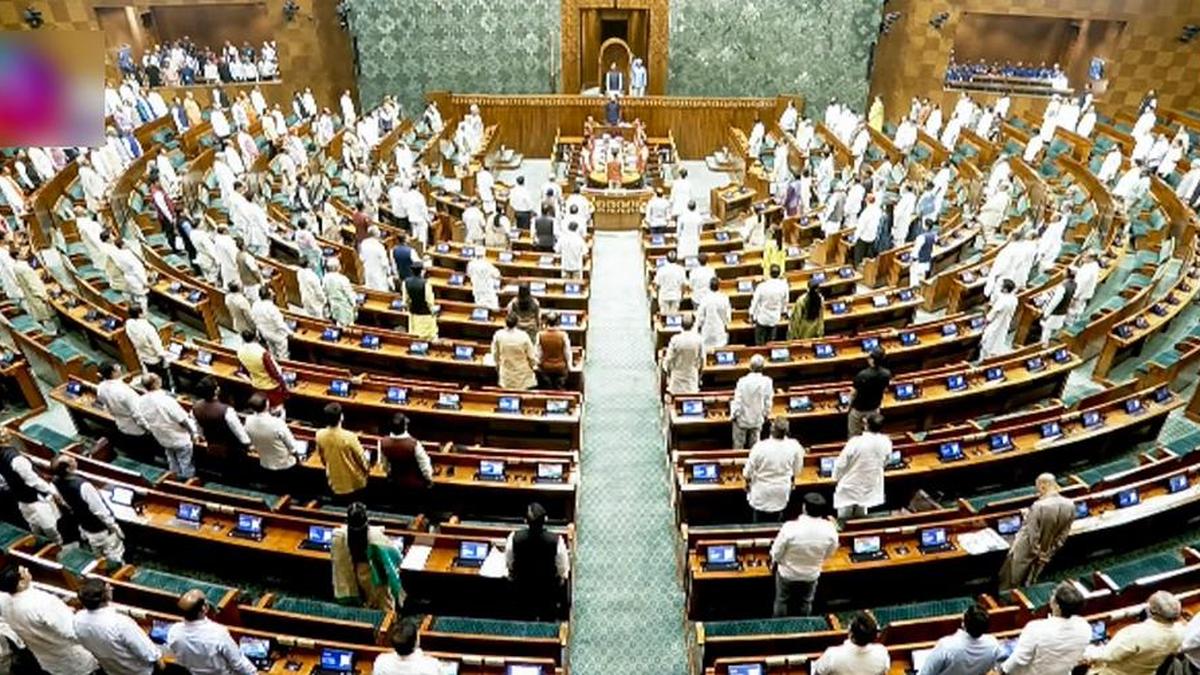
The issue of 33% reservation for women in the Lok Sabha and State Legislatures has come full circle in less than three years since the Constitution (One Hundred and Sixth Amendment) Act, 2023 — popularly known as the Nari Shakti Vandan Adhiniyam — was passed by Parliament in September 2023.
Clause (1) of Article 334A of the 106th Amendment mandated a three-step process to be done before women’s reservation in the legislature became a reality - the 2023 Act had to come into force, followed by a fresh Census and a delimitation exercise.
Women's reservation won't have to wait for long, says Law Minister Meghwal
During the 2023 debate, the Opposition parties had argued for an immediate operationalisation of the Amendment without waiting for a Census and delimitation. The government had not budged then.

Virtual U-turn
In 2026, with only a few days left for crucial Assembly elections, the government tabled the Constitution (One Hundred and Thirty-First Amendment) Bill, 2026. The proposed law was a virtual U-turn on paper. Through it, the Centre had come around to the Opposition’s viewpoint of 2023 to implement women’s reservation immediately, based on the 2011 census.
The 131st Constitution Amendment Bill sought to amend Article 334A, justifying its turnaround to the fact that a new census and a consequential delimitation exercise would “take considerable time and thus, delay the effective and dedicated participation of women in our democratic polity”. It pressed for women’s reservation based on the “population figures of the latest published census”, which remains the 2011 one.
However, the proposed law failed to garner the special majority in the House on April 17, on the second day of a special session of Parliament.
Timing questioned
Interestingly, the government chose to operationalise the 106th Amendment Act on April 16, even as debates on the 131st Constitution Amendment Act were on. Questions were raised as to why the government particularly opted to bring into force the 2023 Constitution Amendment on April 16, after such a long spell of silence and inaction.
The answer may be that the government had not expected the 2026 Amendment to succeed, and so had to fall back, after its heavy political messaging for women’s reservation, to operationalising the 2023 Constitution Amendment Act.
To reiterate, the commencement or operationalisation of the 2023 Act is the first step, followed by a fresh Census and delimitation, to bring into effect women’s reservation. The ongoing Census 2027, if clause (1) of the original Article 334A is narrowly and literally interpreted, would not count as it precedes the commencement of the 2023 Act on April 16. The current Census began on April 1.
Reviving a demand
Meanwhile, the Opposition has since rekindled its demand to remove the portion of Article 334A (1) which requires a fresh Census and delimitation to bring in women’s reservation.
In fact, the government had lost an opportunity before the Supreme Court way back in 2023 itself to do away with the “offending portion” of Article 334A(1).
At the time, a petition filed by Dr. Jaya Thakur had urged the apex court to declare the clause “void ab-initio” and a violation of Article 14(right to equality) of the Constitution. The petition had argued that the unanimously passed 106th Constitution Amendment Act of 2023 must not be made to wait indefinitely for a Census and delimitation to happen, but should be implemented without delay. The court had dismissed the petition as infructuous.
Later in 2025, the same petitioner had approached the apex court again, highlighting the delay in the implementation of women’s reservation, asking rather pertinently, “why delay the vandan?”
Published - April 18, 2026 08:40 pm IST