



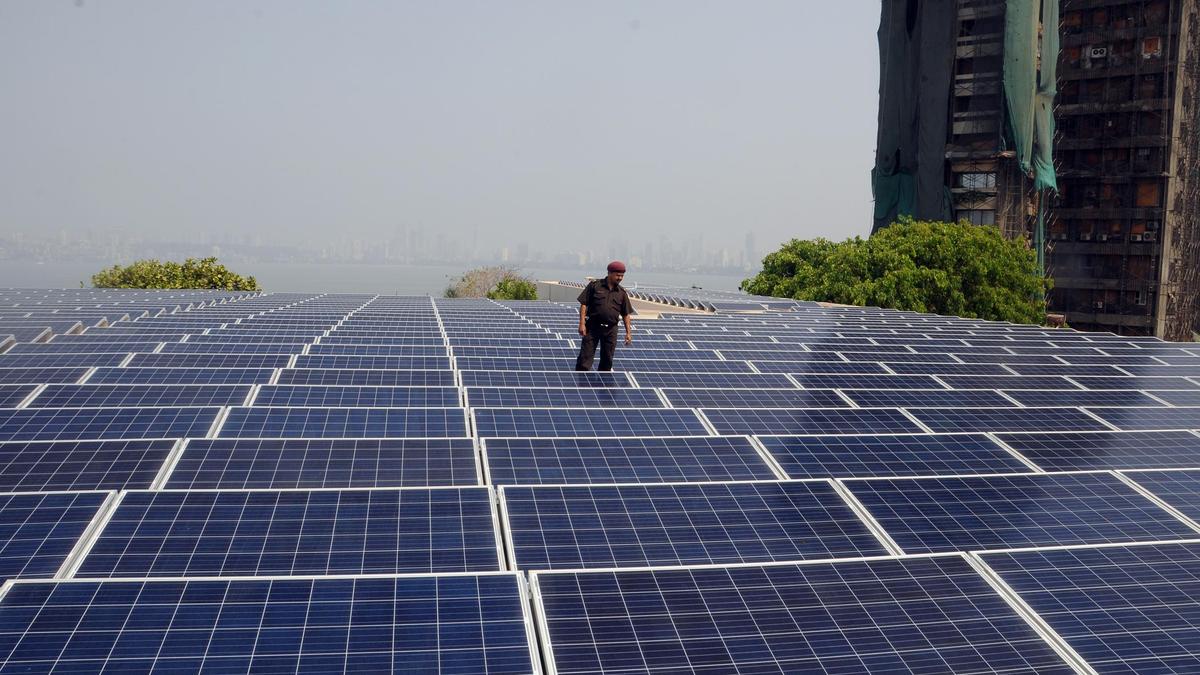
Indian States collectively spend nearly ₹2.4 lakh crore a year on subsidising electricity for agricultural and domestic consumers, Ministry for New and Renewable Energy Secretary Santosh Kumar Sarangi said, adding that the Centre’s solar programmes are increasingly designed not just to add clean energy capacity but to persuade States that this subsidy bill can be eliminated over time.
“Different States have different amounts which they give. So to that extent they will save on this huge subsidy outgo once they adopt more and more farm solarisation and more and more rooftop solarisation,” Mr. Sarangi told The Hindu in an interview.

India has an installed capacity of 535 GW as of March 2026, with about 150 GW coming in from solar — the single largest non-fossil energy source. With 54% of India’s installed power capacity drawing from non-fossil energy sources, the Centre — while expanding coal consumption — has generally touted its solar and wind capacity as evidence of its green commitments at international fora.
Mr. Sarangi’s remark frames two of India’s flagship solarisation schemes — PM KUSUM for agricultural feeders and PM Surya Ghar for household rooftops — as fiscal instruments rather than merely climate or energy programmes.
One of the challenges for the Centre, however, is that it runs these programmes through the Ministry of New and Renewable Energy, which operates under the Electricity Act and the Energy Conservation Act, both administered by the Ministry of Power. “We don’t have any act of our own,” the Secretary acknowledged.
The MNRE in March made a case before a parliamentary committee for a significant expansion of its administrative authority over India’s renewable energy sector, arguing that it should be recognised as the “Central Government” in all matters pertaining to renewables under the Electricity Act, 2003.
Maharashtra has emerged as the Centre’s primary exhibit. The State launched the Mukhyamantri Saur Krishi Vahini Yojana in 2017, installing decentralised solar plants of 2-10 MW capacity within a 5 km radius of agriculture-dominated substations, replacing expensive grid power on agricultural feeders with cheaper solar generation. Under MSKVY 2.0, the State scaled its ambitions to 16 GW — far exceeding the Central Financial Assistance (CFA), (the Centre’s share of funds ) available under PM Kusum. “The CFA under PM Kusum is only for about 4.5 GW,” Mr. Sarangi said, “but the rest they did because they realised that this kind of an intervention is helping them to wipe off the cross-subsidy charges towards agriculture subsidy.”
Maharashtra is now “one of the exceptional States which has actually filed for reducing the tariff to the consumers,” Mr. Sarangi noted, because the cross-subsidy that industrial and commercial consumers were paying to support agricultural feeders has shrunk. The State has also installed a large number of standalone solar pumps, in the process replacing individual diesel pump sets and ostensibly generating further savings.
Maharashtra’s ambition has, however, created a wrinkle in the Centre’s domestic manufacturing push. A portion of the State’s tender was structured under its own State-run scheme rather than under PM KUSUM, which allowed it to seek an exemption from the Approved List of Models and Manufacturers (ALMM) requirement for solar cells — effectively permitting the import of cheaper Chinese cells, even as modules must still comply with ALMM norms.

The ALMM — the Approved List of Models and Manufacturers — is the Centre’s primary tool for building a domestic solar manufacturing base. Introduced in 2019, it requires all Central-government-backed solar projects, including those under PM KUSUM and PM Suryaghar, to use only MNRE-approved domestic equipment. The challenge here is that such equipment is usually costlier and in short supply for vendors who are charged with installing solar equipment.
Mr. Sarangi explained this as saying that the Maharashtra exemption was available only because the State’s tender was issued before a cut-off date of December 9, 2024. “Rest of the States haven’t done so they will not get this exemption,” he said. Other States could theoretically have done the same, “but I’m not aware of any other State doing it before that.” The Secretary was categorical that this would not snowball and disincentives domestic producers of solar equipment: “That will not happen because the tender for this kind of exemption should have happened prior to 9th December 2024.”
The same subsidy-elimination logic now underpins the Utility-Led Aggregation (ULA) model within PM Surya Ghar. The scheme’s conventional demand-driven mode has already covered 35 lakh households, but it has a structural limitation: poor and lower-middle-class households that receive heavily subsidised or near-free electricity have no incentive to install rooftop solar. “People whose consumption is low, generally the poor people or lower-middle-class people, don’t apply for PM Surya Ghar because for them the monetary implication is either nil or a very little amount,” Mr. Sarangi said.
Under ULA, the utility installs rooftop solar on behalf of these households — either through its own capital expenditure or via a RESCO (renewable energy service company) contractor — so that the consumer pays nothing upfront. “The consumer doesn’t feel the pinch,” the Secretary said. “But the State is also saving in terms of the subsidy which it was giving for domestic utilities. States including Assam, Odisha, Bihar, Chhattisgarh, and Andhra Pradesh have been sanctioned under ULA, with work already under way.”

The Centre expects 30 lakh installations through ULA and another 35 lakh through the normal mode, bringing the total to approximately one crore by March ‘27 — the Surya Ghar scheme’s headline target.
“We are expecting ULA to act as a similar model [as PM KUSUM],” Mr Sarangi said, drawing an explicit parallel with Maharashtra’s experience in agriculture. “Our initial coverage may be only a few lakhs, but the number of such households is running into millions and we hope that the States will realise that over a longer period of time they can wipe off their domestic subsidy which they are giving to many of these households.”
Published - April 11, 2026 01:53 pm IST