





The year was 1991, and I was on my first visit to the U.K. As I presented my passport to the immigration officer at London’s Heathrow Airport, my chest tightened with apprehension. Getting the visa had been stressful, I hoped my entry wouldn’t be.
The officer stared at his computer screen for an uncomfortably long time before asking, “What’s the purpose of your visit?” When I explained that I was a wildlife filmmaker planning to spend six months in the country to learn advanced techniques, his impassive face broke into an appreciative smile. “Ah, you want to follow in the footsteps of our Sir David!” With that, I was waved through the gate with a cheery “Welcome to the U.K.”.
Admiration for David Attenborough runs deep in British society. Over a television career spanning more than seven decades, he has been a trusted guide to the animal kingdom for generations of Britons, who cherish him as a national treasure. Often hailed as the ‘world’s greatest broadcaster’, Attenborough became a global icon as television spread to the farthest corners of the world.
But all this might never have come to pass. When Attenborough joined the BBC as a 26-year-old natural sciences graduate in 1952, he was initially barred from appearing on camera because a boss felt his teeth were “too big”. However, when the presenter of the 1954 BBC series Zoo Quest had to step down unexpectedly due to illness, the new head of the ‘talks’ department decided that young Attenborough would host the show. The rest, as they say, is history.
A new perspective

A presentation on David Attenborough at the Earthshot Prize 2022 in Boston, 2022. | Photo Credit: Getty Images
My introduction to Attenborough’s documentaries began with the landmark 1979 television series Life on Earth. With the world as its canvas, the 13-episode show brought natural history to the screen like never before, setting a benchmark for films in this genre. For the first time, we saw sights such as a flying frog’s spectacular gliding ability in slow motion, and a sword-billed hummingbird’s hovering precision as it reached deep into a Datura flower to extract the nectar within.
But the most iconic moment came in episode 12, ‘Life in the Trees’. In the sequence shot in Rwanda, we see Attenborough crawling on all fours towards a group of wild gorillas, making soft “belch vocalisations” to signal friendly intentions. After a while, he is sandwiched between a female and her two playful adolescents. As the mother looks deeply into his eyes from just inches away, Attenborough turns towards the camera and, in a half-whisper heard around the world, tells us that “there is more meaning and mutual understanding in exchanging a glance with a gorilla than with any other animal I know”.

A still from Attenborough’s 1979 TV series Life on Earth.
Not only did this endearing scene dispel the myth that gorillas were ‘bloodthirsty’ creatures, but it also cemented Attenborough’s reputation as an unflappable presenter, deeply empathetic towards the natural world. In an interview decades later, he recalled this encounter with the mountain gorillas as “one of the most privileged moments of my life”.
The enthusiastic public reception for Life on Earth led to dozens of other series — featuring Attenborough as presenter or narrator, or both — each more spectacular than the last, thanks to remarkable advances in imaging technology.
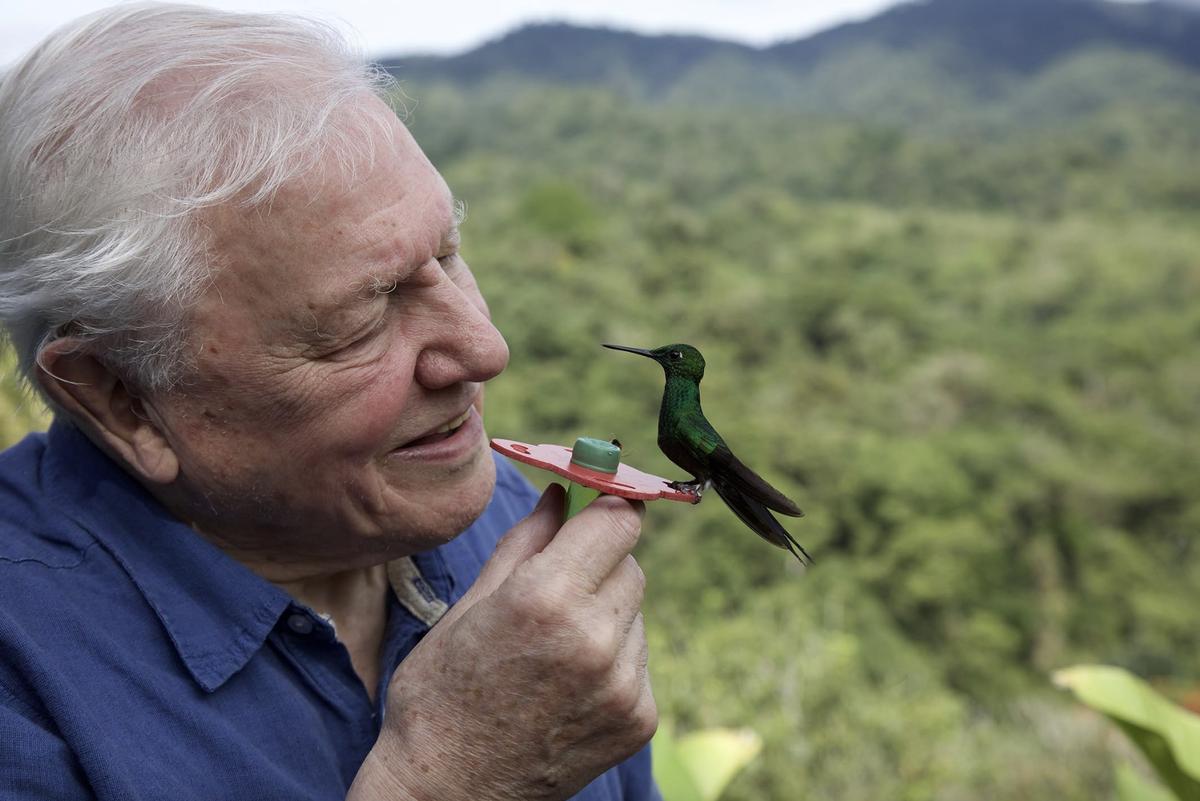
David Attenborough in Life in Colour (2021).
Apart from these, there have also been numerous standalone documentaries, including two of my favourites — Attenborough in Paradise (1996), which transports us to New Guinea and introduces us to a variety of birds of paradise, and The Amber Time Machine (2004), in which Attenborough examines the feasibility of extracting DNA from insects trapped in amber millions of years ago. This idea was popularised in Steven Spielberg’s 1993 sci-fi blockbuster Jurassic Park, which, incidentally, starred Attenborough’s elder brother, Richard.
Celebrating a legend
From nature walks to special screenings, several events are being held in the U.K., Australia and elsewhere to celebrate Attenborough. On his birthday, May 8, fans will gather in London’s Trafalgar Square, dressed as animals or Attenborough himself, for a spirited rendition of ‘Happy Birthday’ and a few nature-themed classics, including ‘The Lion Sleeps Tonight’.
Celebrations will continue at Royal Albert Hall with ‘100 Years on Planet Earth’, a 90-minute live show honouring his life and career. Featuring archive footage, the BBC Concert Orchestra, and special guests, the event will pay tribute to Attenborough’s lasting impact on natural history storytelling.
Since June 2025, Attenborough has narrated the Natural History Museum’s immersive show Our Story With David Attenborough. The 50-minute, 360° experience uses projected real-world footage to trace Earth’s history and humanity’s impact. Running until August 2026.
Team Planet Earth
As Attenborough looks back on his 100 fruitful years on this planet, he can take great satisfaction in his unparalleled body of work, which has educated and inspired hundreds of millions around the world and documented the richness of our beautiful yet beleaguered planet for posterity.
But how could anyone accomplish all this in a single lifetime, even a long one? As Attenborough has explained in public appearances and TV interviews, he does not produce or shoot these films himself. Behind his on-screen presence are teams of highly skilled and dedicated cinematographers who toil for weeks or months to capture nature’s intricate wonders. And behind them is a team of researchers, producers, writers and editors.
However, one thing is certain: no one else has travelled the globe as extensively, experienced as many ecosystems, or observed as many species as Attenborough. Through the legion of documentary films he’s been involved in and the numerous books he’s authored, he has witnessed the impact our species has had on the natural world for longer, and perhaps with a keener eye, than anyone else. What an eventful 100 years he has lived through.
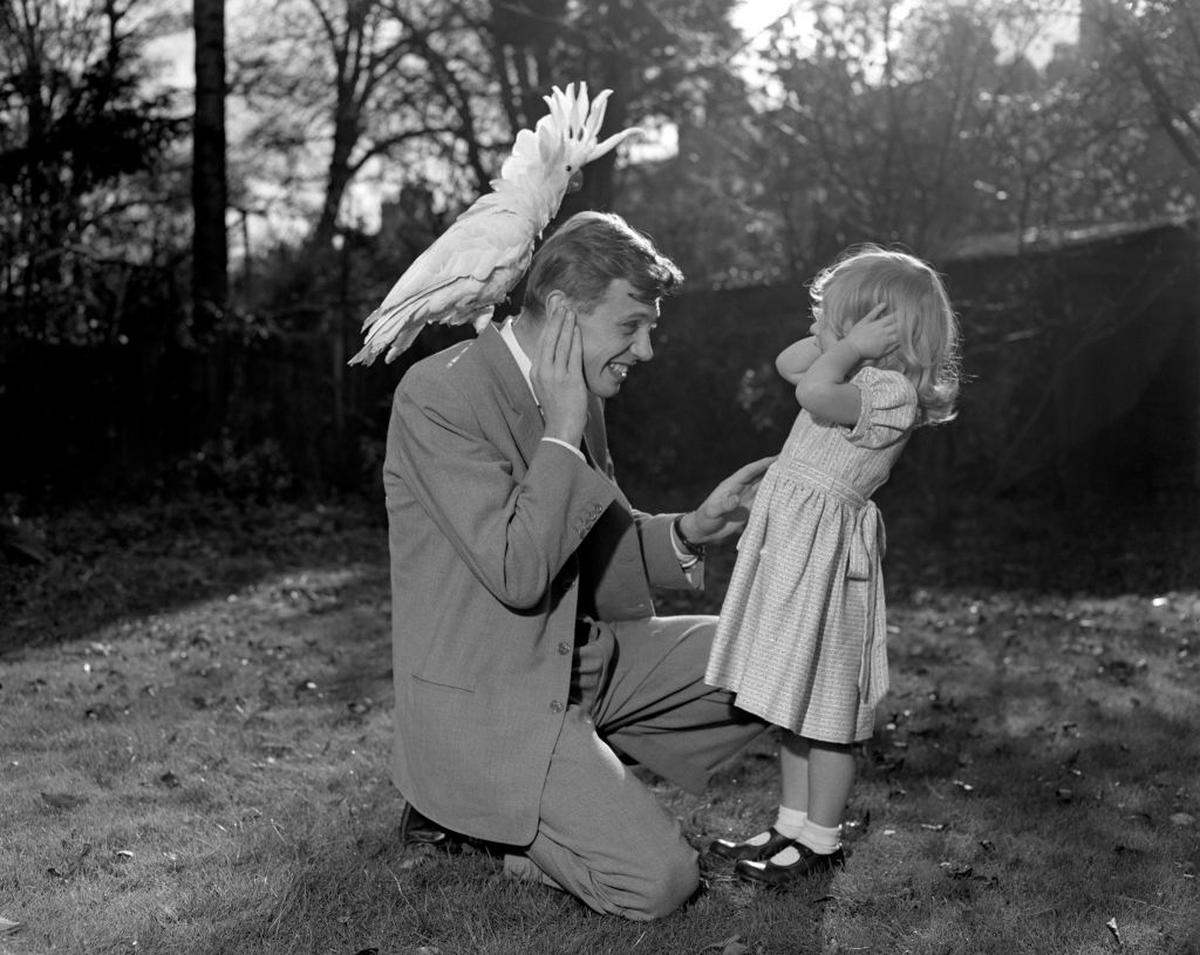
David Attenborough and his three-year-old daughter, Susan, with Georgie, a sulphur-crested cockatoo that Attenborough brought from New Guinea to his home in Richmond, Surrey, in 1957. | Photo Credit: Getty Images
When he entered the world on May 8, 1926, the global population was a mere 2 billion, compared with 8 billion today. Forests covered roughly half the world’s land area, compared with about one-third now. Atmospheric carbon dioxide concentration has risen from about 300 parts per million to 425 parts per million, wreaking havoc on the world’s climate. All this and more are poignantly captured in Attenborough’s 2020 documentary, A Life on Our Planet: My Witness Statement and a Vision for the Future. It should be compulsory viewing for everyone.
However, all the awareness generated by his work will be in vain if we sit back and allow our planet’s continued destruction. The best gift we can give Attenborough on his 100th birthday is to pledge, each in our own way, to heal the wounds we’ve inflicted on the Earth. Although nature is dying by a thousand cuts every day, it still retains a fragile resilience. To pull back from the precipice, we must shed our customary indifference and urgently unite as citizens of Planet Earth.
The writer is a wildlife and conservation filmmaker.