









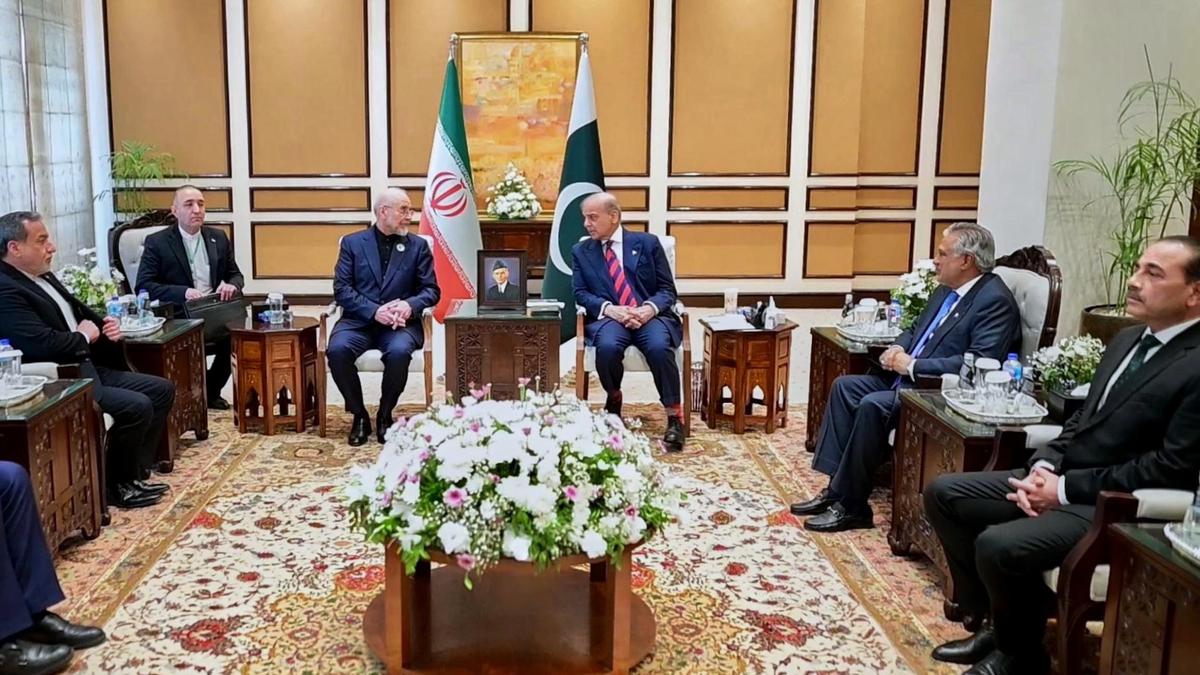
The Iran-U.S. talks in Pakistan have ended without a deal due to "excessive demands" made by the American side, a top Iranian official said on Sunday (April 12, 2026).
Iranian Foreign Ministry spokesperson Esmaeil Baqaei, however, said Iran is determined to utilise all tools, including diplomacy, to secure national interests and protect the country's well-being.
Follow Israel-Iran war LIVE updates
U.S. Vice-President J.D. Vance, who led the American delegation, said the talks failed to reach a peace deal, citing Tehran not forgoing its nuclear programme as one of the key sticking points. He said the American side presented its "final and best offer" to the Iranian side, but it did not accept it.
Iran's chief negotiator Ghalibaf blames U.S. for failure of talks in Islamabad
Iran's chief negotiator to the Islamabad talks, Mohammad-Bagher Ghalibaf, has blamed the United States for failing to reach a deal.
In a series of posts on X, the Parliament Speaker said the Iranian delegation provided “forward-looking initiatives” during the 21-hour talks, but the Americans could not gain Iran's trust. He said now is the time for the U.S. “to decide whether it can gain our trust or not.”
He asserted that Iran pursues powerful diplomacy, alongside military force, for upholding the rights of the Iranian people. “We believe that diplomacy of power is another approach alongside military struggle for the realisation of the rights of the Iranian people, and we will not cease our efforts to consolidate the achievements of forty days of national defence by the Iranians for a moment,” he said.
He also thanked Pakistan for facilitating the peace talks. He also lauded the “heroic people of Iran” for supporting the negotiators and appreciated his team for their tireless efforts during marathon talks in Pakistan.
‘Success depends on the seriousness and good faith’
Mr. Baqaei, however, said that the two sides reached a consensus on some issues, but they held different views regarding 2-3 important matters.
He said that during the intensive negotiations that began on Saturday (April 11) morning, with Pakistan's mediation, numerous messages and texts were exchanged between the two sides. "In the past 24 hours, discussions were held on various dimensions of the main negotiation topics, including the Strait of Hormuz, the nuclear issue, war reparations, lifting of sanctions, and the complete end to the war against Iran and in the region," Mr. Baqaei said.
"The success of this diplomatic process depends on the seriousness and good faith of the opposing side, refraining from excessive demands and unlawful requests, and the acceptance of Iran's legitimate rights and interests," he added.

He said it was natural that Iran should not have expected from the beginning to reach an agreement within one meeting. "No one expected that either."
"We have not forgotten and will not forget the experiences of America's breaches of promise and malicious acts," he said.
He thanked Pakistan for hosting the negotiations and for its efforts in advancing this process.
Pakistan expresses hope for progress
In a brief statement to the media, Pakistan's Deputy Prime Minister and Foreign Minister Ishaq Dar said Pakistan helped mediate several rounds of “intense and constructive” discussions over the past 24 hours.
Expressing hope for progress, Mr. Dar said both sides should maintain a positive spirit to achieve durable peace and regional stability.
Mr. Dar said Pakistan would continue to play its role in facilitating engagement and dialogue between Iran and the United States in the coming days.
The Iranian delegation, led by Speaker Ghalibaf, had arrived in Islamabad on Friday (April 10) night, while the U.S. delegation, headed by Vice-President J.D. Vance, arrived on Saturday (April 11) morning.
It was the first direct, high-level engagement between Iran and the U.S. since the 1979 Islamic Revolution.
With PTI, AP inputs
Published - April 12, 2026 11:48 am IST