


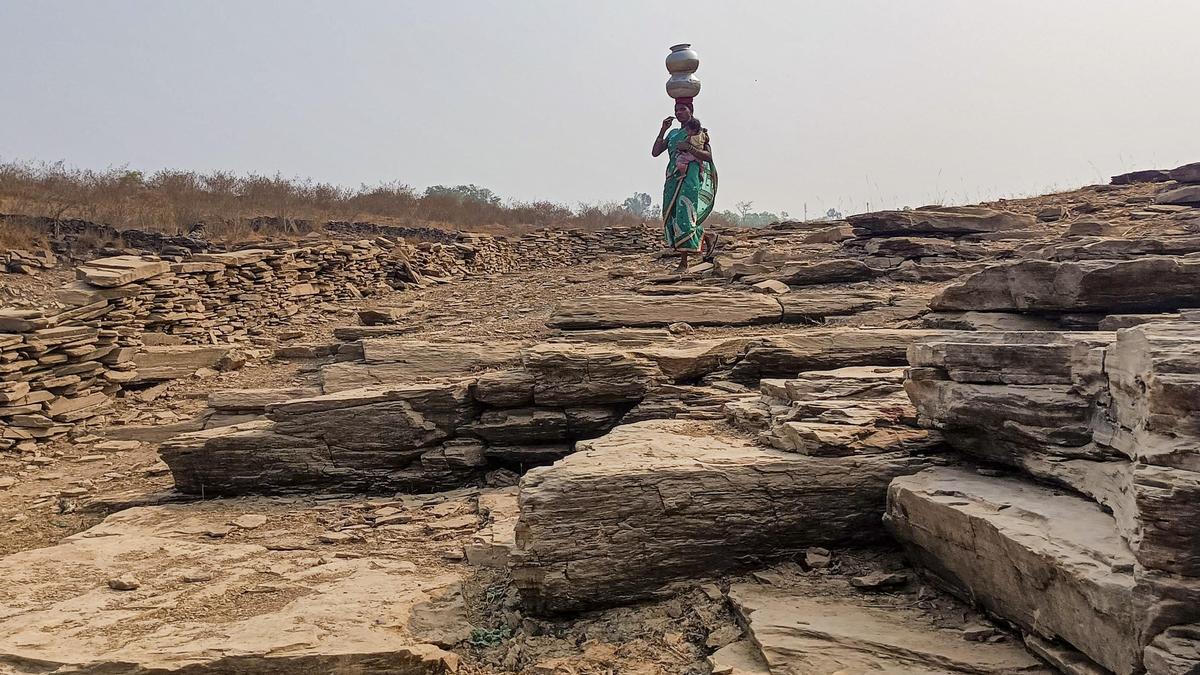
For the 35-odd families of Nelangur — a remote hilly village deep inside Abujhmad forests in Chhattisgarh’s Narayanpur district — summer ordeal of travelling long distances for water may be a thing of the past.
Once a Maoist stronghold, the village on the Chhattisgarh-Maharashtra border and nearly 52 km from the district headquarter, received tap water connection this past week. This means that the families residing here would no longer be dependent on streams and endure shortage of water at this time of the year, said officials.

Narayanpur Collector Namrata Jain said that a water supply system had been set up in the village under the Jal Jeevan Mission. Water was being lifted from the source using a solar pump and supplied directly to homes through pipelines, she added.
Also Read | Building the information backbone for India’s drinking water future
Another government official said the village long struggled with drinking water scarcity. Located in the remote Orchha block of Narayanpur district near the Maharashtra border, “the village is now witnessing a clear shift in daily life as piped water reaches households across this once highly sensitive area”.
Orchha block, located in the forested Abujhmad region, has long remained one of the most remote and difficult areas to access. The terrain, coupled with the area’s past sensitivity, made the delivery of basic services such as drinking water to remote villages a major challenge earlier, the official added.

Meanwhile, the situation in Nelangur, that had long faced a shortage of drinking water, had completely changed with the tap connection , say residents.
“The implementation of the Jal Jeevan Mission in Nelangur shows that government schemes are reaching remote and border areas. Efforts are ongoing to strengthen the system and ensure regular supply to every household. This also marks a step towards improving basic services and building trust in development efforts in the region,” said the official.
On the journey, the official said that exactly a year ago, the security forces built a police camp clearing the security vacuum around the villages.
This was one of the many camps built from east to west connecting Narayanpur to Maharashtra via the 130D National Highway and divided the district horizontally. These camps helped in bringing services such as drinking water to the villages around those. The road construction on the highway is also on. For now, the villagers have to travel to nearby villages to access some services but once the road construction is completed, service delivery would come closer and other economic activities will also pick up, officials added.
Published - April 14, 2026 01:47 am IST