







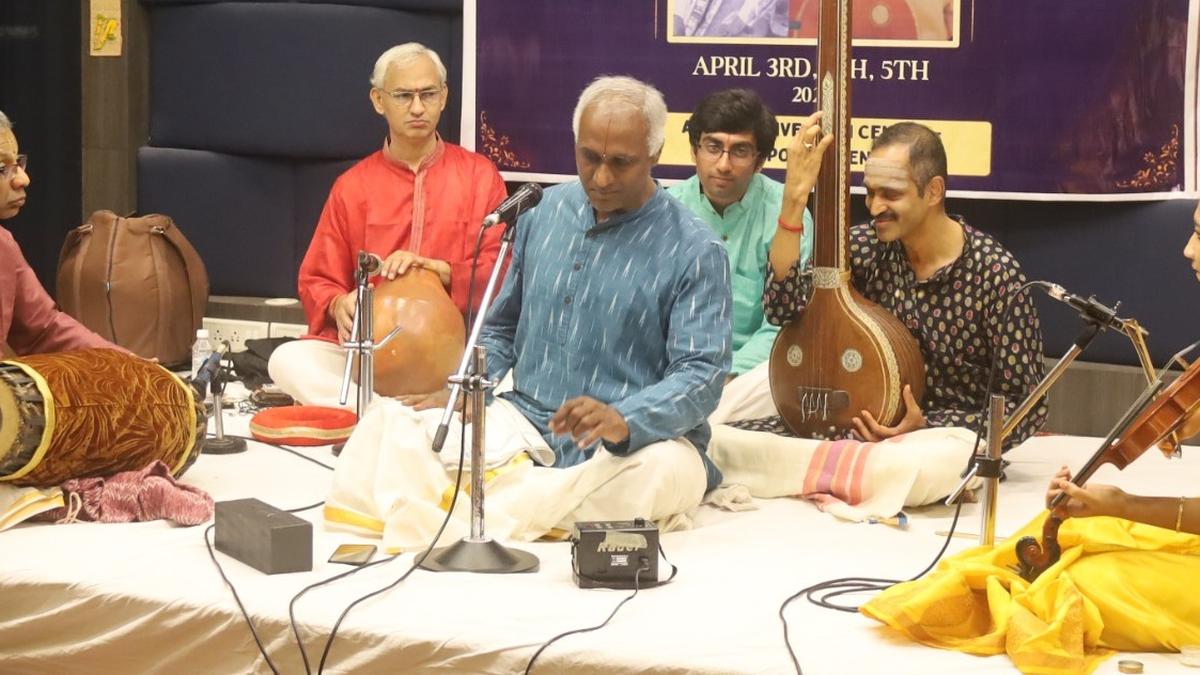
In a recital that felt like an intimate dialogue with the past, Hemmige S. Prashanth presented a concert deeply rooted in the aesthetic of his guru, the legendary K.V. Narayanaswamy. Accompanied by V.S.P. Gayatri Sivani on the violin, V.R. Srinivasan on the mridangam and Trichy Murali on the ghatam, the evening featured a remarkable line-up of songs.
Beginning with the Nattai varnam ‘Sarasijanaabha’ of Palakkad Parameshwara Bhagavatar, Prashanth went in for the less commonly heard Kedaram composition ‘Tyagaraja gurum ashraye’, composed by M.D. Ramanathan on Tyagaraja in Tisra Adi tala. Created using the Dikshitar mould replete with a madhyama kala sahityam, this kriti features both the raga mudra and the composer’s mudra.
An alapana in Anandabhairavi followed by many characteristic phrases condensed well within its short duration. ‘O jagadamba’, a song immortalised by KVN, was taken up by Prashanth with an engaging niraval . In the rendition of Papanasam Sivan’s ‘Manam irangadha’ in Mayamalavagowla (Rupaka tala), the alapana stood out for being thorough. Every phrase captured the foundational gravity of the raga, offering a clear and focused introduction that avoided unnecessary clutter. The transition into the kriti led to a sophisticated niraval at the phrase ‘Paadi panindhu bhaktar.’
The rendition of Tyagaraja’s ‘Evari mata’ in Kamboji, as the main composition, tests a singer’s breath control and rhythmic precision because of its architectural grandeur. The structure of the composition allows for a steady build-up of energy, which is essential for a main piece. Prashanth’s alapana eschewed flashiness, and the niraval and swaras were marked by clarity and rhythmic grace. A notable highlight was the daivata kuraippu in the final swara, which served as an effective melodic anchor. Much like KVN’s style, the kalpanaswaras built anticipation through precise, unambiguous ideas, maintaining a soulful raga bhava even as the tempo escalated.
Gayatri Sivani displayed musical maturity throughout the concert, with her alapanas standing out for precision and timing. Her synchronisation with the vocalist during the manodharma sections made for a lucid listening experience. Srinivasan and Murali provided a robust percussive foundation that complemented the vocalist’s style. .
KVN was undoubtedly a master of viruthams, which stood out for their sahitya shuddham, ensuring the lyrics remained intelligible through complex melodic phrases. He employed the Ariyakkudi style of transition, shifting between ragas with technical seamlessness. A key feature was his ability to establish a raga’s swaroopa (identity) using only a few foundational notes, allowing for a comprehensive presentation despite the short duration of each segment. His approach prioritised steadiness over vocal gymnastics, often using the final raga to transition precisely into the tonic note of the following composition. Prashanth presented ‘Ayi murali’ and ‘Amsaalambitha vaama kundala bharam’ from Sri Krishna Karnamrutham in the same vein before ending with a Tiruppavai.
Published - April 11, 2026 06:05 pm IST