







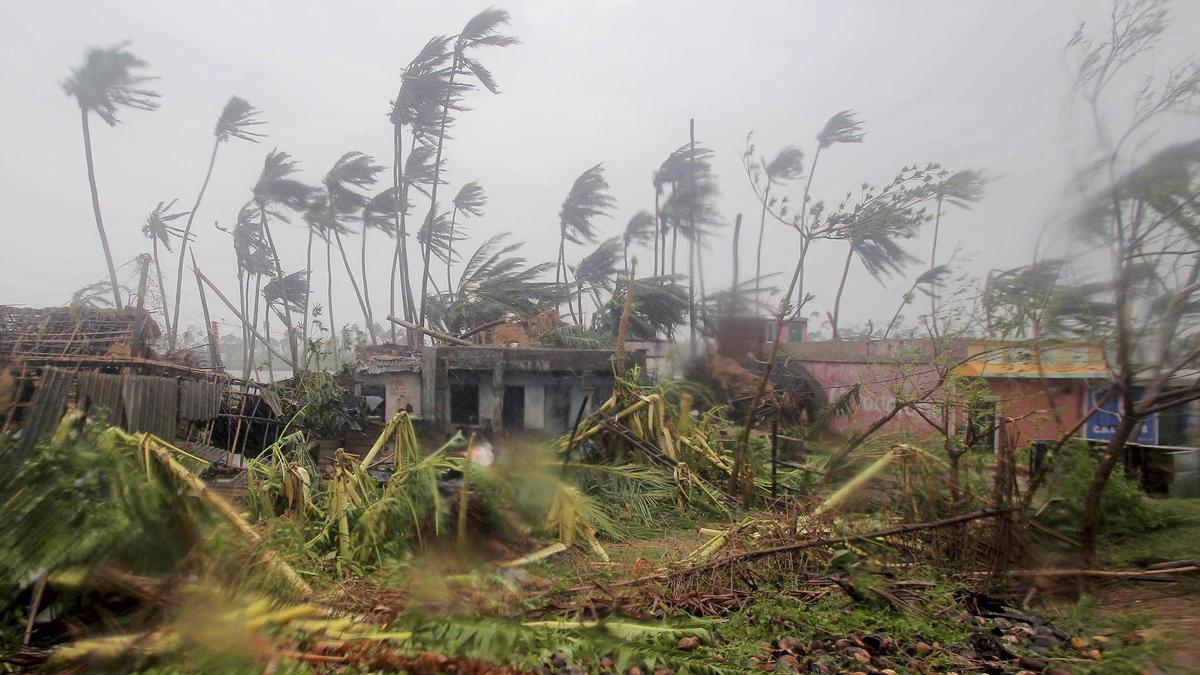
Odisha is, by any measure, one of India’s most disaster-prone States. Its 574.7-kilometre coastline has absorbed some of the most powerful cyclones to make landfall on the subcontinent. Over two decades, through investment in early warning systems, cyclone shelters, and mass evacuations, the State has reduced cyclone mortality to near zero. It is, therefore, not merely paradoxical but troubling that the 16th Finance Commission has awarded Odisha the single largest reduction in disaster funding share among all 28 States, a decline of 1.57 percentage points relative to the 15th Finance Commission’s allocation.
How does a State with the highest hazard score in the country, and the deepest investments in preparedness, end up losing the most? The answer lies in a structural problem in the Finance Commission’s allocation formula.
The revised formula and its rationale
The 16th Finance Commission has allocated ₹2,04,401 crore to State Disaster Response Funds (SDRF), a 59.5% increase over its predecessor. The Commission adopted a multiplicative Disaster Risk Index (DRI = Hazard X Exposure X Vulnerability), drawing on the theoretical framework. This is a departure from the additive approach of the 15th Finance Commission, which treated hazard and vulnerability as substitutes rather than complements. Risk arises only when hazard intersects with exposed and vulnerable populations. A powerful cyclone striking an uninhabited coastline is a natural event, not a disaster. The logic is correct. The operationalisation is not.
The first problem lies in the measurement of ‘Exposure’. The Commission uses the total population of each State, scaled linearly between 1 and 25, as its exposure metric. Uttar Pradesh receives 25 and Sikkim receives 1. This is administratively convenient but scientifically indefensible. Exposure, per the United Nations Intergovernmental Panel on Climate Change (IPCC)’s Sixth Assessment Report, is the presence of people in places that could be adversely affected by hazards, not simply the number of people within a political boundary. A State with 10 crore people on a hazard-safe inland plateau has lower exposure than a State with three crore people settled entirely along a cyclone-prone coastline. Total population and hazard-zone population are not the same variable.
The practical consequences are stark. Odisha’s hazard score of 12 is the highest in the country. But because its population score is only 5, its computed DRI of 79.8 is overshadowed by Bihar’s 224.2 and Uttar Pradesh’s 413.2, two States with lower hazard scores. The multiplicative formula, in practice, rewards demographic size. A State can face the most intense hazard in India and still lose funding because it is not populous. This is precisely the outcome that a risk-based allocation framework was designed to prevent.
The second problem compounds the first. Vulnerability is measured through each State’s average per capita Net State Domestic Product (NSDP), inverted so that poorer States score higher. The intuition is clear — poorer States have fewer fiscal resources to absorb disaster shocks. But the NSDP measures fiscal capacity, not disaster vulnerability. Vulnerability is multidimensional, encompassing housing quality, health infrastructure in hazard zones, early warning reach, and the share of population in structurally unsafe dwellings. Average per capita income conceals enormous intra-state inequality.
In 2018, Kerala suffered its worst flooding in a century, causing estimated damages of ₹31,000 crore. Yet, the formula assigns Kerala a vulnerability score of just 1.073, near the minimum, because its per capita income is relatively high. Combined with a population score of 4, Kerala’s DRI, of 34.5, is lower than many States with negligible disaster history. Jharkhand, with the second-highest vulnerability score reflecting genuine poverty and tribal fragility, still loses 0.78 percentage points of funding share because its population score cannot compensate in the multiplicative framework. Twenty States in total have lost relative share. The common thread is not that they are safer; it is that they are smaller, wealthier on average, or both.

What needs to change
Exposure should be measured as the number of people living within defined hazard zones, flood plains, cyclone-prone coastal belts, earthquake-susceptible zones, using the Building Materials and Technology Promotion Council (BMTPC) Vulnerability Atlas cross-referenced with Census enumeration block data. Vulnerability should be reconstituted as a composite index incorporating the share of kutcha housing, agricultural labour dependence, health infrastructure density in high-hazard districts, crop insurance penetration, and early warning effectiveness. The National Family Health Survey (NFHS)-5, the Pradhan Mantri Fasal Bima Yojana (PMFBY) database, National Health Mission (NHM) facility surveys, and India Meteorological Department (IMD) monitoring records collectively provide that information. The Finance Commission should mandate the National Disaster Management Authority to publish an annual State Disaster Vulnerability Index as the authoritative input for each subsequent award period, institutionalising the methodology and ending contested metrics at every Commission.
India cannot afford to get disaster finance wrong. Climate projections indicate intensifying cyclone frequencies along both coastlines, expanding drought belts across peninsular and central India, and escalating extreme rainfall in already-stretched States. The States most likely to face the sharpest increase in disaster frequency — Odisha, Andhra Pradesh, Kerala, Assam — are precisely those the current formula underserves. A formula that measures total population rather than the exposed population is not a risk index. It is a headcount.
Aswathy Rachel Varughese is Assistant Professor, Gulati Institute of Finance and Taxation, Thiruvananthapuram, Kerala
Published - April 01, 2026 12:08 am IST