






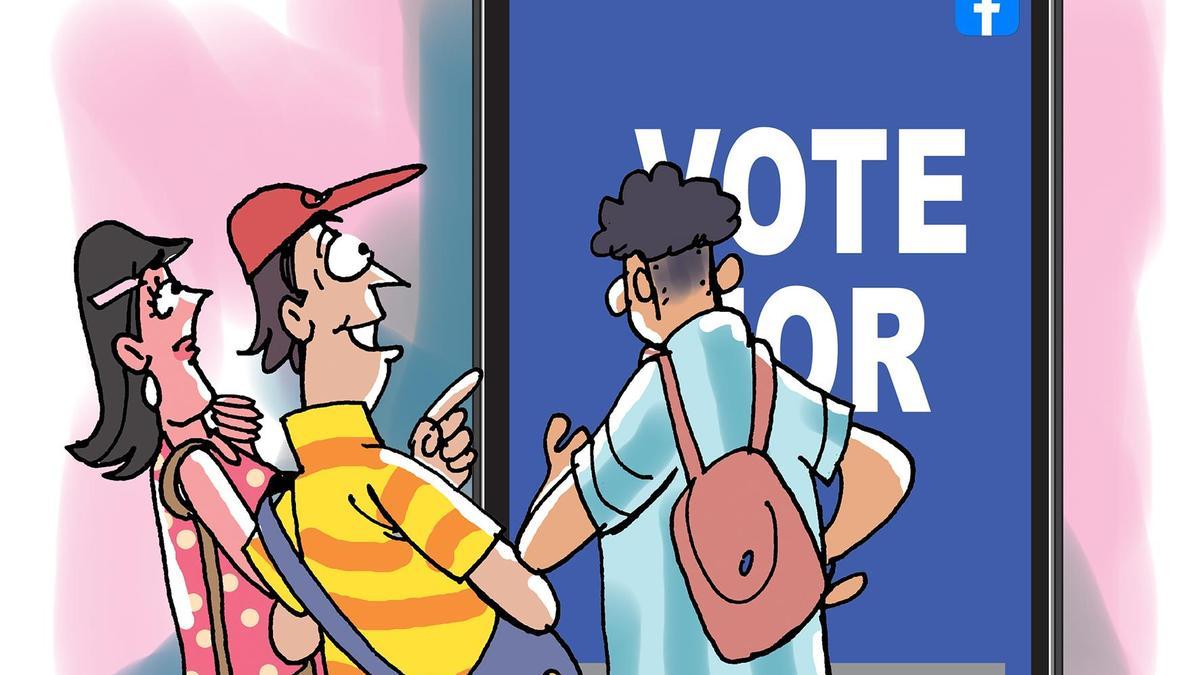
Sometimes, civic sense can get in the way of culture. With serious clampdowns on posters, festoons, banners, wall paintings and advertisements by the Election Commission and civic bodies, it does indeed feel like the culture of elections itself in Tamil Nadu has changed, dramatically. From walls, they have migrated to feeds.
Posters and wall paintings were iconic in elections in the past in Tamil Nadu. They were more than mere advertisements for the party or candidates — they evolved form as a multitude of purposes rolled in one, starting with the very basic marking of physical territory, but also equally importantly, an identity system, candidate branding and propaganda.

In the past, the first sign of an impending election was the emergence of party symbols or colours on the walls of homes in the State, particularly in the cities. A literal bidding campaign would begin, and the first mover advantage (for seizing a wall and stenciling the imprint of the party symbol) had value and prestige. Sometimes, it would escalate into a war, with rival parties painting over rival colours with theirs. These notings would soon give way to elegant art and vibrant colours, and a whole ecosystem would spring up in public, crafted by the best wall painters of the State. On the other hand, the inelegant campaigner would make do with posters, surreptitiously pasted over that of rivals, in the dead of the night.

A.S. Panneerselvam, journalist and political commentator, traces back this culture to its very roots. He explains that in the 20th century, two of Tamil Nadu’s towns defined the public visual culture of the State — Sivakasi and Kovilpatti. The imported printing machines, and the growth in travelling theatres propelled artists to look at defining a new form of culture that would depict modern Tamil Nadu. “Pioneers such as C. Kondiah Raju produced calendar art, magazine covers, theatre and film decor. At the same time, there emerged a secular prose that kept itself away from a vertical social hierarchy. The Kovilpatti and Sivakasi images were not only about gods and goddesses, but also freedom fighters, revolutionaries, and social reformers. The inclusive basket of this period changed the public visual culture of the State for well over a century,” he says.
Era of cutouts
Joining the walls, for a while, there were the life-size cutouts for the cult figures of Tamil Nadu politics. A report in The Hindu recounted how in 1984, to compensate for the absence of M.G. Ramachandran (as he was being treated in a U.S. hospital for a kidney ailment), the party flooded the State with life-size cutouts. The poster culture worked well when visibility on the streets was the primary way to signal strength.
Also read: Assembly elections LIVE
But over the years, this has been shrinking, the old yielding place to hectic online commentary, memes and reels on social media. Today, street cred is earned by putting out memes and images on social media, entertaining sometimes, but not always factual, and with the gleeful creation of fake videos, aided by AI. “While some of it might reach a lot of people, it remains to be seen what the full impact of such a social media-led campaign will be. The one example we have from the past is how it worked for the Aam Aadmi Party for a while, and then actually went against it,” says Mr. Panneerselvam. This time, one indicator of the power of social media to influence political decisions might be the performance of the fledgling party – actor Vijay’s Tamilaga Vettri Kazhagam.
Today, walls have been edged out by screens, no doubt. Whether the largely anonymous, unreliable content on social media and the memes will endure to form a sub-culture is in question, but there is no doubt that Tamil Nadu still remembers a time when elections were first fought on the walls and streets.
Published - April 22, 2026 01:06 am IST