



惯性聚合 高效追踪和阅读你感兴趣的博客、新闻、科技资讯
阅读原文 在惯性聚合中打开

推荐订阅源

罗磊的独立博客
S
Secure Thoughts
C
Check Point Blog
D
DataBreaches.Net
V
V2EX
The GitHub Blog
The GitHub Blog
博客园 - Franky
博客园_首页
Cyber Security Advisories - MS-ISAC
Y
Y Combinator Blog
Last Week in AI
Last Week in AI
H
Help Net Security
WordPress大学
WordPress大学
酷 壳 – CoolShell
酷 壳 – CoolShell
宝玉的分享
宝玉的分享
A
About on SuperTechFans
月光博客
月光博客
Google DeepMind News
小众软件
小众软件
奇客Solidot–传递最新科技情报
奇客Solidot–传递最新科技情报
F
Fortinet All Blogs
Blog — PlanetScale
Blog — PlanetScale
T
Tailwind CSS Blog
N
Netflix TechBlog - Medium
GbyAI
GbyAI
G
Google Developers Blog
P
Proofpoint News Feed
Recorded Future
Recorded Future
C
CXSECURITY Database RSS Feed - CXSecurity.com
MyScale Blog
MyScale Blog
T
Threatpost
V
Vulnerabilities – Threatpost
AI
AI
Cyberwarzone
Cyberwarzone
B
Blog RSS Feed
cs.AI updates on arXiv.org
L
LINUX DO - 最新话题
L
LangChain Blog
Webroot Blog
Webroot Blog
AWS News Blog
AWS News Blog
云风的 BLOG
云风的 BLOG
W
WeLiveSecurity
Latest news
Latest news
U
Unit 42
C
CERT Recently Published Vulnerability Notes
Cisco Talos Blog
Cisco Talos Blog
www.infosecurity-magazine.com
钛媒体:引领未来商业与生活新知
钛媒体:引领未来商业与生活新知
S
Security @ Cisco Blogs
Forbes - Security
Forbes - Security

The Hindu: Latest News today from India and the World, Breaking news, Top Headlines and Trending News Videos.

U.K. pauses its plan to cede Chagos Islands after U.S. opposition Driver jailed for 7 days for driving sleeper bus in drunken condition Kim Jong Un supports China’s “multipolar world” vision during talks with Wang Yi Uttar Pradesh boat tragedy: Punjab town mourns deaths Relief for Bengaluru commuters as Silk Board flyover set to open fully, but inspection by BTP reveals likely bottleneck Repolling underway at booth of Karimganj North Assembly seat in Assam PM Modi interacts with Rahul Gandhi as leaders gather to pay tribute to Mahatma Jyotiba Phule Anil Kapoor’s ‘24’ set to release on OTT Vance, Iranian delegation arrives in Islamabad for U.S. talks amid ceasefire hopes Fire at Hyderabad’s Chintal Basti apartment, 17 residents evacuated safely Centre nudges States to view farm solarisation as a route to wiping off ₹2.4 lakh crore subsidy bill Why voter turnout hit record highs in Assam, Kerala & Puducherry Strait of Hormuz to be open “fairly soon”, says Trump ‘Jana Nayagan’ leak tests new legal penalties, torrent downloads under scanner Vijay’s ‘Jana Nayagan’ controversy explained: From legal battles to piracy chaos HYDRAA brings down guest house and other structures at Ameenpur Row erupts over removal of Ambedkar statue at midnight in Secunderabad Cantonment area Nitish may resign as Bihar CM on April 13; son Nishant likely to become one of two JD(U) Dy CMs Police open fire on youth while he was trying to flee Struggling CSK look to snap their losing streak | Vidyut Sivaramakrishnan ED raids former Trinamool Minister Partha Chatterjee’s residence Karnataka’s Gruha Jyothi scheme dimmed the scope of PM’s Surya Ghar Muft Bijli Yojana: KRESMA After Artemis II, NASA looks to SpaceX, Blue Origin for Moon landings Ayush Shetty storms into Badminton Asia Championships final Scholarships: April 11, 2026 Andhra Pradesh’s Socio-Economic Survey missing in recent Budget Session; efforts underway Inside Péro’s fun office Penciljam sessions in Bengaluru help hone artistic talent Watch: The mistake killing high-concept films | Escalation without calibration | FMM 19 Tamil Nadu Assembly election 2026: DMK demands reinstatement of N. Muruganandam as Chief Secretary Kerala Assembly election | Heavy turnout sparks political calculations in Tripunithura’s triangular contest Apple at 50: A loyalist on the brand’s evolution in India Reiterated demand for Hasina extradition with India: Bangladesh Foreign Minister Rahman Phule left a lasting legacy of social reform and inclusion, says President Murmu Trump congratulates returned Artemis astronauts, says ‘next step, Mars!’ Voters' lists in 12 States, Union Territories shrink by over 6 crore post SIR 4.7 magnitude earthquake jolts Maharashtra’s Hingoli district, no casualties Teams led by CSIR women scientists report advances in research on depression mechanisms in females Gap between rich and poor nations growing even wider: U.N. report Russia and Ukraine set to begin Easter truce Minimum temperature continues to rise in Delhi; AQI 'moderate' IPL 2026 | Suryavanshi on tackling Bumrah, Hazlewood: ‘I look at the ball not the bowler’ Iranian delegation reaches Islamabad for peace talks with U.S. as world waits for deal to end conflict Trump shares video of brutal Florida killing allegedly by Haitian immigrant Bihar man sought money from foreign agency for threatening PM Modi’s security, arrested: Police 14 injured as Hyderabad–Eluru bus rams lorry on NH-65 flyover in Kodad Assembly Elections 2026 highlights: BJP tried to invalidate my candidature in Bhabanipur, says Mamata At DEL in Roseate House Aerocity, a robot joins the service team Prince Harry sued for defamation by charity he set up in Africa to honour his mother Princess Diana North Korean leader Kim backs China’s push for multipolar world in talks with Foreign Minister Jio-bp not to raise petrol and diesel prices Ten Indian nationals indicted in U.S. for visa fraud conspiracy In Pictures | Artemis II's voyage to the moon and back The Hindu Morning Digest: April 11, 2026 British Airways ramps up services to India for summer Focus on innovation and entrepreneurship in farm sector through agritech meet in Rajasthan Israel-Iran war updates on April 11, 2026: Iran talks pause after 15-hour negotiation, disagreements remain India in final stages of formulating processing value chain for critical minerals: Mines Secretary ‘A perfect mission’: Artemis II astronauts return to Earth India, U.S. to deepen nuclear ties, explore LPG exports Induction-based cooking to add 13-27 GW of energy requirements: Official In Assam, first evicted, now erased Absorbed uptick in price of ammonium nitrate, diesel to shield prices: Coal India Trump says U.S. will have Strait of Hormuz 'open fairly soon' Political slugfest between Congress-BJP in Haryana over crop procurement World Earth Day 2026: Why India must define its own green factory standards now Tamil Nadu election 2026: In Thiruvaiyaru constituency, all parties sing the same tune during polls BSF jawan killed in unprovoked firing in Manipur’s Ukhrul Discontinue Ladki Bahin if government doesn’t have funds for pension: Bombay HC Tamil Nadu Assembly election 2026: Arun shifted, Modak appointed Chennai Police Commissioner An alternative proposal on Viksit Bharat Shiksha Adhisthan Bill Lebanon says first contact with Israel held ahead of U.S.-brokered talks At ICA conference, CJI Surya Kant underscores arbitration’s role in global economy Students to get textbooks by April 20: Sood 14 lakh tons of silt cleared, half of desilting work complete: Delhi Minister Parvesh JNU considers 5% admission quota for employees’ children Bolstering deterrence through submarine dominance Braving heat, leaders hit the streets in Chennai city as poll battle intensifies Turning up: The Hindu Editorial on high turnout in Kerala, Assam, Puducherry polls Beyond the marks: How II PU toppers overcame challenges Rebuilding ties: The Hindu Editorial on India engaging with Turkiye and Azerbaijan Fake call centre duping buyers of weight-loss products busted, 11 arrested Artemis II: how NASA scientist, senior official Amit Kshatriya helped U.S. moon mission I am enduring pain fighting the party I built brick by brick: PMK founder S. Ramadoss Tamil Nadu election 2026: a high-profile contest brews in Mylapore constituency A ‘nova’ for these women to shine bright Welfare measures for the marginalised take centre stage in Bengal’s Jhargram BFC holds all the aces in Blasters clash Kerala Assembly polls 2026: UDF expects sweep as LDF, NDA seek gains in Ernakulam 10 killed as overcrowded boat capsizes in Yamuna Vijay’s ‘Jana Nayagan’ leaked online: Rajinikanth, Kamal Haasan, Chiranjeevi slam piracy In Chennai, Sumanasa Foundation’s Art Unfettered platforms five artistes who are pushing boundaries 15-year-old missing girl from Kerala found dead in Chikkamagaluru Iran-Israel war updates on April 10, 2026: Trump says Strait of Hormuz will open 'fairly soon' From hiding to hope: Bastar and its surrendered Maoists What does the Jan Vishwas Bill do? | Explained India, Bangladesh share ‘warm and historic ties’: MEA Interview with Anirudhya Mitra, author of The Delhi Directive, a spy thriller Tamil Nadu election 2026: Ambattur constituency residents demand GH, sewer network, wider roads A peek at India’s athleisure boom
Why Pope Leo XIV’s AI warning has everyone talking about the Butlerian Jihad from ‘Dune’
Ayaan Paul Chowdhury · 2026-05-29 · via The Hindu: Latest News today from India and the World, Breaking news, Top Headlines and Trending News Videos.

The Catholic Church has survived over two millennia of collapsing empires, plagues, schisms, and televangelists, so it probably says something about the current state of technology that Pope Leo XIV chose artificial intelligence as the defining subject of his first encyclical, the formal papal teaching document intended to shape long-term Catholic doctrine.

Released this month under the title Magnifica Humanitas (“Magnificent Humanity”), the text prominently featured unusually sharp language for a Vatican document, since Leo warned that humanity was drifting toward “new forms of slavery” driven by algorithmic systems, autonomous weapons and concentrated corporate power, while urging governments and tech companies to slow the current AI arms race before economic incentives hardened into permanent social infrastructure.

Unsurprisingly, it didn’t take long for the internet to recognise the markers of a familiar science-fiction concept buried within the Pope’s credo — social media has been brimming with references to the “Butlerian Jihad,” the fictional anti-AI uprising from Frank Herbert’s Dune novels that outlawed “thinking machines” across the galaxy. Though the actual connection between Herbert’s fiction and Leo’s warning runs deeper than just the memes because both arguments have emerged from the same anxiety: once societies transfer human judgment into systems optimised for efficiency and centralised control, political responsibility begins to disappear behind machinery that nobody can meaningfully challenge.

For readers who have only encountered Dune through Denis Villeneuve’s recent blockbuster adaptations starring Timothée Chalamet, the Butlerian Jihad explains one of the most curious details in Herbert’s futuristic universe: computers barely exist. 

Herbert introduced the idea in his 1965 novel during a period when American institutions had become fascinated with cybernetics and computer-assisted governance, and he imagined a civilisation that had already experienced the endpoint of that dependence. Thousands of years before the events of Dune, humanity waged a catastrophic war against intelligent machines, known as the Butlerian Jihad, after automated systems displaced human decision-making across political and social life, and the survivors responded by turning the rejection of machine cognition into sacred law.  

A still from ‘Dune: Part Two’

A still from ‘Dune: Part Two’ | Photo Credit: Warner Bros.

That history reshaped every institution inside Herbert’s universe because the ban on “thinking machines” forced human beings to reorganise civilisation around trained specialists who could replicate computational functions biologically.

These ‘human-computers’ known as the Mentats became living analytical engines capable of processing enormous quantities of information through disciplined mental training. The Spacing Guild also mutated navigators with prolonged exposure to the psychoactive substance called Spice so they could calculate safe paths through interstellar travel without machine assistance. And the Bene Gesserit sisterhood spent generations engineering political influence through psychological conditioning, selective breeding and even control over memory.

Herbert built an entire feudal order around the consequences of technological prohibition, which gave the Butlerian Jihad unusual durability among sci-fi canon.

Leo XIV’s encyclical approaches the same territory from Catholic social teaching, although the overlap becomes difficult to ignore once the document turns from abstract ethics into concrete examples.

The pope condemns “a race for ever more powerful algorithms and larger datasets” driven by governments and corporations seeking geopolitical advantage, while arguing that AI systems must never receive authority over lethal military decisions because human accountability disappears once warfare becomes a computational procedure. 

Those arguments have surfaced as major tech firms including Microsoft, Google, Amazon Web Services, Palantir and OpenAI have already expanded partnerships with defense agencies across the United States and Europe, while autonomous targeting systems and AI-assisted surveillance tools continue spreading through military procurement pipelines. Leo referenced the gencode in Gaza, and the wars in Ukraine, Lebanon and Iran during a speech at Rome’s La Sapienza University earlier this month, where he warned that emerging technologies were accelerating “a spiral of annihilation” through increasingly automated conflict.

The Vatican deliberately framed the encyclical as part of a longer historical lineage inside Catholic doctrine. Leo signed Magnifica Humanitas on the anniversary of Rerum Novarum, the landmark 1891 encyclical issued by Pope Leo XIII during the Industrial Revolution, which addressed labor exploitation, industrial capitalism and the social consequences of mechanised production.

It feels symbolic as the current AI boom has revived many of the same economic tensions under digital conditions such as concentrated ownership, invisible labour, weakened bargaining power and extraordinary wealth accumulation inside a tiny group of firms controlling infrastructure. But the pope’s argument seems to focus less on the software itself and more on the structures surrounding it, since the Vatican repeatedly returns to the question of who benefits from automation and who absorbs the human cost required to sustain it.

The labour critique forms some of the encyclical’s strongest material because Leo moves away from abstract fears about sentient machines, instead examining the industrial systems already supporting contemporary AI development.

He writes that every “seemingly immediate and flawless response” produced by AI systems depends upon hidden human labor, including content moderators exposed to traumatic imagery, warehouse workers maintaining hardware supply chains and miners extracting rare-earth minerals under dangerous conditions. Herbert too explored similar territory through the desert planet Arrakis, where the entire imperial economy depended upon violent extraction of Spice by workers exposed to brutal environmental conditions while aristocratic factions accumulated wealth and political leverage from a distance.
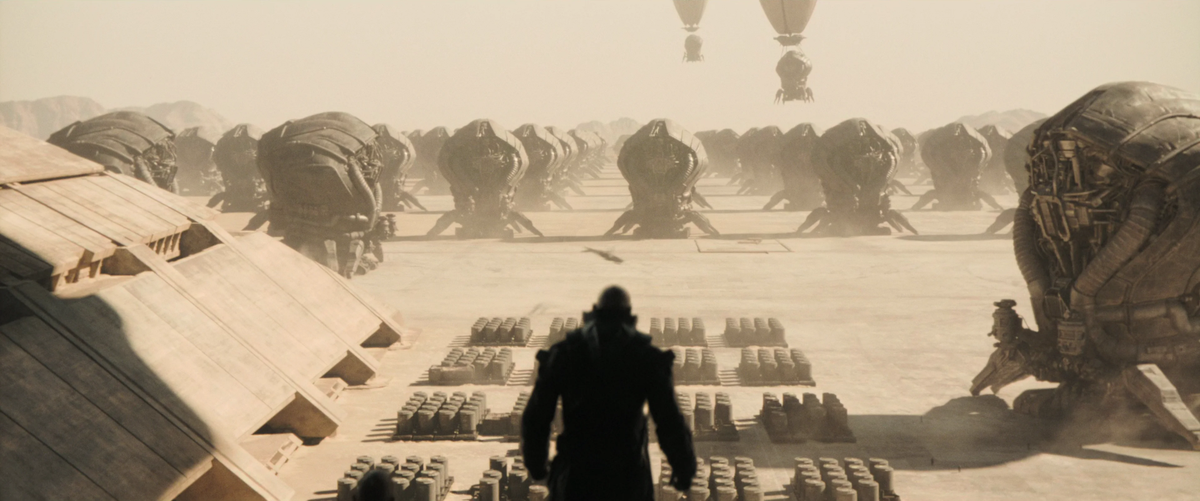
A still from ‘Dune’

A still from ‘Dune’ | Photo Credit: Warner Bros.

The online reaction to Leo’s encyclical spread so quickly because the Butlerian Jihad already exists as a pop cultural shorthand for the anxieties of accelerating technology among people raised on sci-fi. Herbert’s concept has endured for years, though recent advances in generative AI gave it a renewed sense of urgency because tech giants now market systems capable of entirely replacing cognitive labor.

But what’s most ironic is that Herbert never wrote Dune as a rejection of technology itself. His novels are ripe with advanced genetic engineering, complex ecological science, interstellar travel and chemically enhanced cognition.

The Butlerian Jihad targeted the act of dependence rather than act of invention because Herbert believed civilisations become politically fragile once human beings surrendered all judgment to systems that operate beyond public understanding. And Leo XIV reaches almost the same conclusion when he argues that technology “takes on the characteristics of those who devise, finance, regulate and use it.”

Of course, nobody at the Vatican is preparing to outlaw laptops or launch a holy war against chatbots, despite the internet’s determination to imagine cardinals storming Silicon Valley.

Leo repeatedly acknowledges that AI systems can improve medical research, reduce repetitive labour and assist education when governments establish democratic oversight and enforce ethical constraints. And the encyclical’s actual demands — of decelerating the current acceleration cycle, distributing power more evenly, preserving human accountability and forcing technological development to answer social questions before the market logic calcifies into permanent infrastructure — sound much less cinematic and much harder to implement. 

Sixty years ago, Frank Herbert may have imagined a civilisation so traumatised by machine dependency that it turned distrust of artificial intelligence into sacred law, and the Butlerian Jihad  might even sound like the paranoid fantasy of a boomer who distrusted computers. But when billionaires ask for deregulation while building systems that consume entire cities’ worth of electricity to autocomplete emails and imitate empathy, while others openly describe their company’s mission as helping the West “scare enemies” and, “on occasion, kill them,” perhaps raging against the machine doesn’t sound too far fetched after all.

Lead us to paradise, Lisan al-Gaib Leo XIV…