




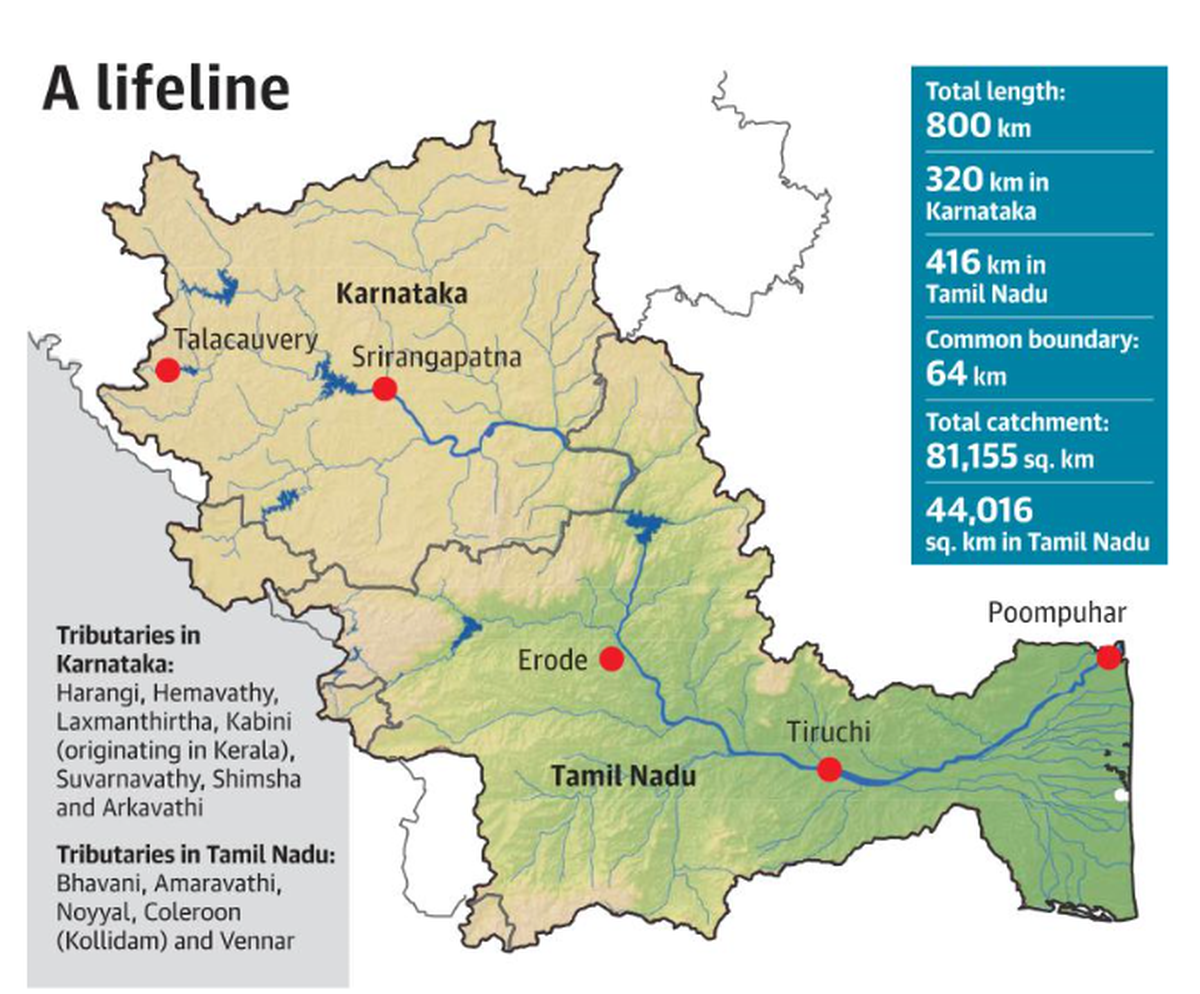
About 100 km away from the hustle and bustle of Bengaluru, the Cauvery sashays down the picturesque rocky terrain of Mekedatu. Broadly meant in Kannada as goat’s leap, Mekedatu, part of the Cauvery Wildlife Sanctuary, is hardly three km downstream of the point of confluence of the Arkavathy and the Cauvery river, called Sangama. The sanctuary is home to grizzled giant squirrel, considered endemic to Sri Lanka and south India and classified by the International Union for Conservation of Nature as near threatened.

Endangered fish species, Deccan Mahsheer, and vulnerable species such as oriental small clawed otter are among those which have found a haven in the Cauvery. The popular tourist spot has also been at the centre of intense and heated discussion between Karnataka and Tamil Nadu, the two southern States through which the Cauvery flows mostly. Of late, the former has been pursuing, with renewed interest, the project of building a reservoir to cater to the drinking water requirements of Bengaluru, as it has allocated ₹1,000 crore in this year’s Budget.
The Karnataka Cabinet on Monday (May 30) approved the resolution of the Karnataka Legislative Assembly and Legislative Council that urged the Centre to provide clearance to the Mekedatu project.
The Cabinet was also said to have approved the resolution passed by both the Houses that the DPR for Godavari-Krishna-Pennar-Cauvery-Vaiagai-Gundar project taken up by Tamil Nadu should not be cleared till the decision on the distribution of the rightful share of all the basin states were established.

“I have not shifted from my place - Yelahanka - because my area is covered under the Cauvery water supply scheme, even though it is not part of what is called the core city,” says B. Kumar, a middle-aged senior IT professional. Invariably, all residents of the metropolis, including those in added or extended areas, want the Cauvery water, because the quality of groundwater is not that good. This creates the need for a project such as Mekedatu, he feels. As the city is still expanding and able to draw more and more IT companies, the demand for clean water does not seem to end.
The Bangalore Water Supply and Sewerage Board supplies 1,450 million litres a day (MLD), using the Cauvery as the source, as per the information available on its website. Another project, envisaging the supply of 775 MLD, is under way. But, it looks like even this project may not quench the thirst of burgeoning Bengaluru. As per an estimate, the population of Bengaluru, which is now 13 million, is expected to touch the 20-million mark by 2031, when the city will need 4,000 MLD.
It is not just the IT professionals but several villagers in and around Mekedatu are also eagerly looking forward to the proposed reservoir project.
Heeramma, a homemaker of Maralebekuppe village, about 20 km from Mekedatu, says her village gets water supply for one to two hours a day. Sitting beside a poster with the slogan “Namma Neeru Namma Hakku” (Our water, Our right), she believes that if the project fructifies, this will benefit villages like hers, through which the pipelines will have to be laid for Bengaluru. The slogan was the theme of the 150-km-long march of the Congress, the principal Opposition party, in support of the Mekedatu project.
Like Heeramma, Raju, a vegetable vendor, and two other senior citizens, who are all residents of Aralalu village, near Kanakapura town, are so excited about the project that they tend to link the laying of water distribution lines in their place a few weeks ago to it, even though they are not oblivious to the fact that the Mekedatu project still remains on paper.
At present, the needs of Heerammas and Rajus, who live in villages along the Kanakapura-Mekedatu road, are met largely through groundwater. In addition, reverse osmosis plants have been put up en route, providing 25 litres of treated water at ₹5.
Besides addressing the drinking water problem, the project, people in the region hope, will solve several other problems. Shobha of Krishnayyanadoddi has a daughter who suffers from fluorosis. She is longing for a project that provides fresh water to her place. Fluorosis is not just confined to that village in Karnataka. On the other side of the Cauvery, fluoride contamination has been a major issue in Dharmapuri and Krishnagiri districts of Tamil Nadu. The Tamil Nadu government, which had implemented the first phase of Hogenakkal Water Supply and Fluorosis Mitigation Project about 10 years ago, has now proposed the next phase of the project.
Notwithstanding high expectations among sections of people of Karnataka, the Mekedatu project has been a non-starter. It has always been a source of friction between the two States. Originally mooted in 1948, the project had undergone several changes in its scope and coverage over the years. After the re-organisation of States in 1956, it was talked about prominently, especially in the early 1960s. Around the same time, Tamil Nadu came up with the Hogenakkal project.
Subsequently, Mekedatu was almost forgotten after the two States were locked in an acrimonious dispute over sharing the Cauvery river water. At one stage, the proposed project at Mekedatu was viewed only as a hydroelectric project and the National Hydro Power Corporation (NHPC), a Central agency, had shown interest in taking it up as a package of four projects — two each in the two riparian States. According to the NHPC’s plan, in addition to having a power plant of 400 MW at Mekedatu, Karnataka would have one at Shivasamudram of 345 MW. In Tamil Nadu, plants were proposed in Rasimanal (360 MW) and Hogenakkal (120 MW).
Since the late 1990s, the Central government, for about 10 years, had made several attempts to work out a consensus between the two States on the execution of the projects. Now, Karnataka is back to implementing Mekedatu on its own.
As per the upper riparian State’s plan, a ₹9,000-crore balancing reservoir has been proposed at Mekedatu, seeking to impound 67.16 tmc ft (thousand million cubic ft.) of water. The project, which will submerge around 4,996 hectares of land, including about 4,800 hectares of forest and wildlife land, is expected to help Karnataka utilise an additional 4.75 tmc ft of water allotted by the Supreme Court in its judgement in February 2018 to meet the drinking water needs of Bengaluru and neighbouring areas.
It will have a 400 MW hydro power component too. More importantly, the proposed dam will regulate the release of required quantum of water to Tamil Nadu on a monthly basis as per the Cauvery Water Disputes Tribunal (CWDT)'s final award of February 2007, as modified by the Supreme Court, says the Karnataka government’s pre-feasibility report of June 2019. The CWDT emphasised that “whenever any such hydro-power project is constructed and Cauvery waters are stored in the reservoir, the pattern of downstream releases should be consistent with our order so that the irrigation requirements are not jeopardised”.

This position was not disturbed by the Supreme Court in its judgment in February 2018, while reducing the share of Tamil Nadu from 192 tmc ft to 177.25 tmc ft. Besides, the one constant refrain among proponents of the project in Karnataka is that a lot of Cauvery water goes waste to the sea, after it reaches Tamil Nadu. At least, the proposed reservoir will reduce the waste.
But, the history of the dispute over sharing of the Cauvery water has provided several unpleasant experiences to Tamil Nadu, leading to a serious trust deficit with Karnataka. “Generally, they [Karnataka] do not give our share of Cauvery water, as per the schedule drawn up by the Cauvery Water Disputes Tribunal or the Supreme Court,” says V. Ganapathy, a Tiruchi-based water activist.
Tamil Nadu’s grievance against Karnataka acquires more intensity as the track record of the latter in releasing water during the first four months of the water year (June to May) is seen as far from being satisfactory. These four months, which mark southwest monsoon too, yield much less rain for Tamil Nadu than many other States in the country because the State falls in the rain shadow region. This is one of the major reasons for the Tribunal and the Supreme Court to have ensured that Tamil Nadu gets approximately two-thirds (123.14 tmc ft) of its annual quota (177.25 tmc ft) of Cauvery water during the four months.

Crowd at the public meeting in Bengaluru after Congress leaders’ padayatra from Mekedatu. File | Photo Credit: K. Bhagya Prakash
But, the Central Water Commission data on Cauvery water realisation at Billigundlu shows that ever since the Tribunal's final order was published in the Centre’s gazette in 2013, Tamil Nadu got its due or more than its quota during the period only in four out of nine years, even though its overall realisation exceeded the annual quota in six out of nine years.
It is because of the trust deficit factor that Tamil Nadu has been opposing any discussion to be taken up by the Cauvery Water Management Authority (CWMA), a body created to ensure the implementation of the CWDT’s final order and the Supreme Court’s judgment of 2018, on the Mekedatu matter, despite repeated attempts by Karnataka to have the issue discussed. In fact, on many occasions, the CWMA had even included Mekedatu as an item on the agenda for its meetings including its last on February 11, 2022.

After Tamil Nadu’s strong objections on a number of grounds such as the non-coverage of Mekedatu in the CWMA’s brief, the Authority did not proceed further but its chairman, S.K. Haldar, told this writer after the meeting that the Authority would seek legal opinion whether it could discuss the matter or not.
In the last few years, Karnataka has been knocking the doors of various institutions of the Central government to see to it that Mekedatu becomes a reality. In October 2018, the State, which had earlier submitted the feasibility report to Central Water Commission (CWC), got a glimmer of hope about the project when it received "in principle" clearance from the CWC’s screening committee for the preparation of Detailed Project Report (DPR) of the project.
The panel had provided a rider, saying that the CWMA’s approval would be a pre-requisite for consideration of the DPR by the Advisory Committee of the Union Ministry of Jal Shakti. An agitated Tamil Nadu had approached the Supreme Court with an application to restrain Karnataka from preparing the DPR. It had also filed a contempt petition against officials concerned. The cases are still pending with the Court.
Unmoved over the developments, the Karnataka government, in January 2019, submitted the DPR on the Mekedatu Balancing Reservoir cum Drinking Water Project to the CWC, which, in turn, had forwarded it to the Authority. Five months later, the upper riparian State moved the Union Ministry of Environment, Forest and Climate Change with a proposal for getting its proposal cleared for the Terms of Reference (ToR) to conduct the Environmental Impact Assessment (EIA) study regarding the project. But, it suffered a setback there as the Ministry’s Expert Appraisal Committee, in July 2019, took the stand that in view of the inter-State issues, an “amicable solution” needed to be arrived at between the two States. The Ministry had also decided that it would consider the proposal for ToR only after getting the clearances of the Union Ministry of Jal Shakti and the CWMA on the DPR. The Authority is expected to hold its meeting in June after the onset of southwest monsoon.
As for the criticism that Tamil Nadu allows a large quantum of water to drain into the sea, Mr. Ganapathy dismisses it and says that when excess water flows, it happens only in the last 10 km stretch of the river, that too during the northeast monsoon (October-December). “After all, some amount of water should go to the sea for ecological considerations,” he adds.

A senior official, explaining why Tamil Nadu government is opposed to the Mekedatu project, emphasises that there is no need for the proposed reservoir as the neighbouring State has created enough infrastructure to address the requirements of Bengaluru. Neither the Tribunal’s final order nor the Supreme Court’s judgment mentions the project or talks of anyone having the right to hold surplus water. Also, Tamil Nadu, apart from Krishnaraja Sagar and Kabini dams in Karnataka, has to get water from “uncontrolled catchments,” which are downstream of the two dams. If a reservoir comes up at Mekedatu, which is about 4 km from the inter-State border, Karnataka will only impound and divert the flows, which are otherwise due to the lower riparian State.

Farmers condemning Karnataka over the proposed Mekedatu dam project. File | Photo Credit: Bashkaran N.
The opposition to Mekedatu is not just from Tamil Nadu. A section of residents of Muthathi village in Mandya district of Karnataka is against the project as their village will get submerged if the reservoir becomes a reality. Four other villages — Sangama, Kongedoddi, Madavala and Bommasandra — will also go under the water. There is a temple in Muthathi for Anjaneya which has a Ramayana legend, and villagers talk animatedly about how the family of a towering Kannada film actor, Raj Kumar, is attached to the temple.
Srinivas, who studied up to higher secondary, is now assisting his father Muthiah, the owner of a bunk shop. He is completely against the project, which, he says, will take away the “soul” of the villagers. Both the father and the son, like many others in the village, say that government officials have held preliminary discussions with them and assured them that alternative lands will be provided to them, in case the project is implemented. They hasten to point out that they have not been served with any notice.
A senior official in the Karnataka government says that the project is still in “conceptual stage” with many key clearances yet to be obtained from different agencies.
The opposition to the project is also from other sections of society too. Pointing out that there are 193 lakes in and around the city, T.V. Ramachandra, who heads the Energy & Wetlands Research Group, Centre for Ecological Sciences, Indian Institute of Science, Bengaluru, says the best option to meet the local water demand is to rejuvenate the water bodies; enhance storage capacity, and improve groundwater recharge. This assumes critical importance as a substantial portion of the city’s water needs are met through groundwater. Removal of silt from the lakes, re-establishing interconnection among the lakes and getting rid of the encroachments are among the measures suggested by him.
Keeping Bengaluru’s requirement as 18 tmc ft annually, the academician says the city, having a spatial extent of 740 sq km, gets annual rainfall of 700-850 mm, which, in turn, yields about 15 tmc ft. Also, wastewater, if properly treated, will give about 16 tmc ft. Optimal treatment of wastewater is possible through the integration of constructed wetlands and algal ponds at the inlet with the secondary treatment plants.
The Karnataka government’s official, terming Dr. Ramachandra’s view as personal, says that the government examines pros and cons of various options and consults all stakeholders, before deciding on a particular course of action. He observes that “just because my option is different from yours, it does not lose the status of being the best.”

While echoing the sentiments of many others in Tamil Nadu on the Mekedatu, P.R. Pandian, a farmer leader from Mannargudi of Tamil Nadu, however concedes that Bengaluru requires more water and this can be met by reviving the reservoir project in Rasimanal. “You can have a drinking water-cum-hydro power project there. The two States can come to an understanding on how much water is to be supplied to Karnataka for Bengaluru. But, this project is possible only if all the three governments - Centre and the State governments in Tamil Nadu and Karnataka - agree,” Mr Pandian says.
Mekedatu connotes pristine and calm environs for nature lovers. Ironically, it also triggers strong currents of emotions on either side of the Cauvery.
此内容由惯性聚合(RSS阅读器)自动聚合整理,仅供阅读参考。 原文来自 — 版权归原作者所有。