





Sporting greying hair and a thin moustache, Hamdu Majhi, an unassuming member of the Kondh tribe in his 60s, is visibly agitated. His voice trembles, but his words are firm. He asserts that no matter what modern machinery is deployed, no road will be allowed to snake its way to the summit of the imposing 1,223-metre Sijimali hill, straddling Rayagada and Kalahandi districts of south Odisha.
Also Read : Questions over Gram Sabha records for Vedanta’s Sijimali Bauxite project in Odisha
Standing at Bichhapinda along State Highway 44, Hamdu, a resident of Uparamapadar village at the foothills of the Sijimali, speaks not just for himself but also for an entire community bracing for confrontation. He is far from alone. Under a punishing summer sun, the stillness of the forest is shattered whenever a vehicle approaches. Elderly women, lactating mothers holding infants, children, and men carrying axes rush out almost in unison upon seeing vehicles halt on the highway, the very point from which a 2.98-km access road is proposed to begin its ascent to the hill they call home and a lifeline.

The proposed road, requiring 11.314 hectares of land, is no ordinary infrastructure project. Its urgency is underscored by an extraordinary official response: the Rayagada district administration has imposed prohibitory orders under Section 163 of the Bharatiya Nyaya Sanhita, banning the assembly of four or more persons in villages surrounding the hill for nearly a month starting April 4. Such a move is rare in these remote villages and signals the tension simmering beneath the surface.
At the heart of this conflict lies mining of bauxite. The Vedanta Group’s alumina refinery at Lanjigarh in Kalahandi district currently operates at a capacity of 2 million tonnes per annum (MTPA), requiring approximately 6 million tonnes of bauxite each year.
Earlier, plans to source this raw material from the nearby Niyamgiri hills collapsed in 2013 after several gram sabhas rejected the proposal, an event widely regarded as India’s first environmental referendum and landmark assertion of tribal rights.
Now, the Sijimali hill, estimated to hold 311 million tonnes of bauxite, has emerged as the new frontier. The Sijimali bauxite block was allocated to the Vedanta Group in March 2023. It promises to bridge the raw material gap, especially as the firm eyes an expansion of its refinery capacity from 2 MTPA to 6 MTPA, which will require mining up to 18 million tonnes of bauxite annually.
For policymakers and industry stakeholders, the project represents continuity, efficiency, and growth. Yet on the ground, amid rising heat and anxiety, the story transcends numbers and projections. It is about a hill, its people, and a line they refuse to let anyone cross.
Hamdu walks nearly 10 km, often scaling one or two hillocks, to join villagers from around 40 settlements at the foothills of the Sijimali who have formed a resistance against any attempt to build the road. The journeys are long and physically demanding, but participation remains consistent among the tribal communities.

For months now, villagers have lived in makeshift shelters atop the hill, maintaining round-the-clock vigil to stop any construction activity. What began as scattered opposition has evolved into an organised and unyielding presence along the ridge of the hill, even amid heavy police deployment. Rotational shifts ensure that the vigil never weakens.
Villagers allege that regulatory clearances for the proposed mining project were granted by officials on December 31, 2025 despite procedural violations and without genuine informed consent. With formal channels of resistance exhausted, physically stopping the road has become, in their words, the last line of defence. For many, it is not just resistance but an act of preservation of land, culture, and a way of life intricately tied to the forest.
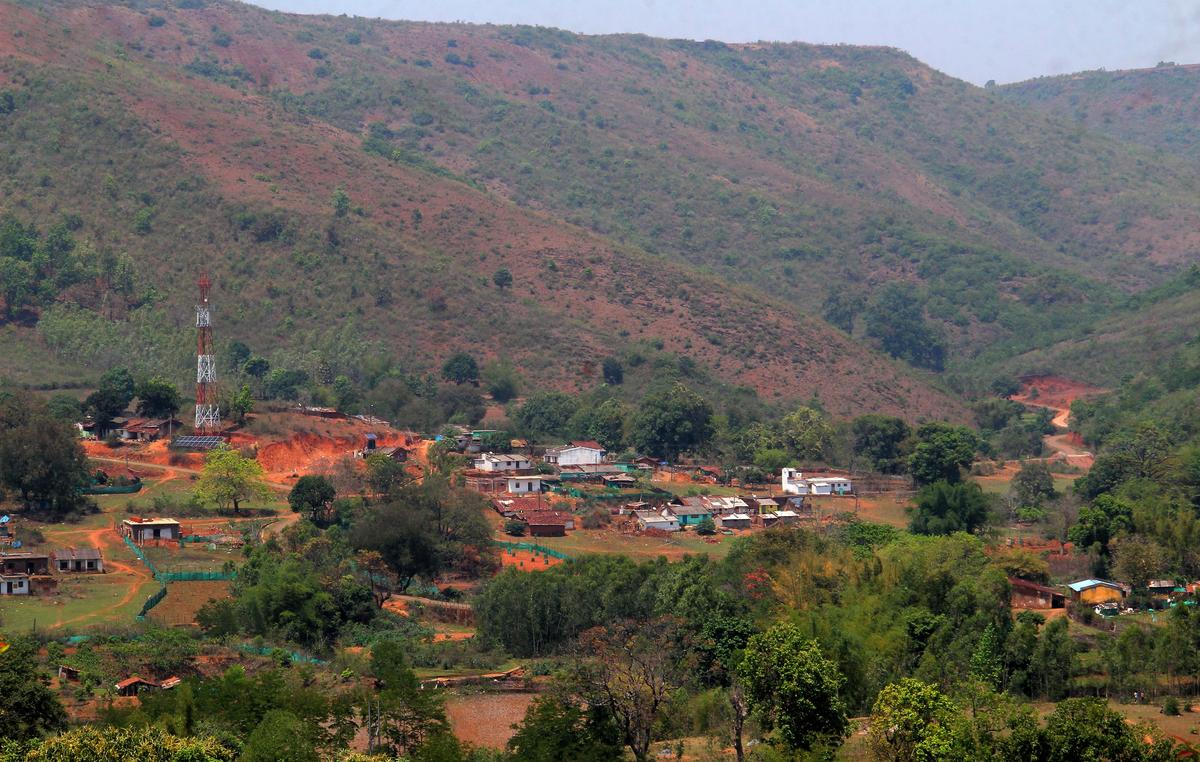
A tribal village at the foothills of the Sijimali in Odisha’s Rayagada district. | Photo Credit: Biswaranjan Rout
Each family in the village contributes to the resistance, says Hamdu. “We have 150 families in Uparamapadar. Each one takes turns guarding the hill. Where will we go from here? Sijimali sustained us long before outsiders came into this neglected region. They may offer compensation worth crores, but we will never leave our homeland,” he says.
This arrangement ensures both participation and sustainability, allowing villagers to balance daily survival needs with collective action. For them, the hill is not merely a geographical feature but a source of water, food, medicine, and spiritual identity.
Clash and crackdown
Tensions escalated sharply following a pre-dawn police operation on April 7. Residents of Kantamal village reported a sudden raid, alleging that the police used force and injured several villagers. Videos of chaotic scenes, shouting, smoke, and confusion quickly circulated on social media, drawing attention to a conflict that had largely remained localised until then.
However, according to Rayagada Superintendent of Police Swathy S. Kumar, the personnel had gone to execute a non-bailable warrant. “Anticipating resistance, a large contingent was deployed. When villagers began pelting stones, 58 police personnel were injured, six critically, and required urgent medical help,” she says.
Subash Singh Majhi, president of the Maa Mati Mali Surakhya Mancha, which is spearheading the anti-mining movement in Kashipur block, claims he was the intended target of the operation. “They came looking for me. I have neither murdered anyone nor looted property. What prompted the police action is for everyone to see. It was a clear signal that anyone who dares to oppose the mining of bauxite will be dealt with severely,” he says.
Villagers show spent tear gas shells allegedly fired by the police and point to the injuries they sustained. Laxman Naik, a resident of Kantamal, questions the growing criminalisation of protests. “In the eyes of the police, all villagers opposing the Sijimali bauxite mining project are criminals who must be put behind bars.”

Tribal villagers displaying tear gas shells fired by the Odisha police. | Photo Credit: Biswaranjan Rout
In Talaamapadar in Kalahandi district, residents say the police entered the village on March 10 and arrested 21 people, including 10 women. Weeks later, many remain in custody. Families recount sudden detentions, limited communication, and prolonged uncertainty.
Some villagers term the arrests “indiscriminate”. “My sister, a Class 9 student, was picked up, so was another girl in Class 8. Two couples were arrested, leaving their children uncared for,” says Champa Majhi.
Ranjana Padhi, an activist tracking cases lodged against villagers, says arrests have intensified since 2023. “At present, 24 people, including 21 from Talaamapadar, are in jail. More than 50 villagers have been arrested and hundreds have been named in different cases. Even pregnant women have not been spared,” she says.
Despite this, the resistance has not weakened. In Kantamal, villagers point to thriving paddy fields that remain waterlogged even during peak summer, a phenomenon they attribute to the water-retaining properties of the bauxite-rich hills. “Where does all this water come from? It is the Sijimali and the surrounding bauxite-bearing hills that sustain us. Do you think we will be better off if mining happens here?” says Shila Dei Majhi, a villager.
While the resistance has drawn support from activists and civil society groups, political responses have been relatively restrained. Delegations from Opposition parties have visited the area and called for a “high-level impartial inquiry” into the April 7 incident and demanded the withdrawal of cases against the villagers.
‘Manufactured consent’
Activists have expressed deep concern over the Odisha government’s “blind” support for the project, alleging that it has overlooked serious objections raised by villagers. For over two and a half years, a heavy police presence has been maintained in villages around the Sijimali.
Activists attempting to visit the region claim they have been chased, intercepted, and subjected to repeated questioning. Many allege that, without clear justification, they are being prevented from interacting with villagers.
Prominent environmental activists such as Medha Patkar and Prafulla Samantara, winner of the 2017 Goldman Environmental Prize, have been allegedly detained by police personnel in plain clothes. An official order last year barring 25 individuals from entering Rayagada district for two months was later struck down by the Orissa High Court.
Activists say gram sabha resolutions approving the project contain serious irregularities, duplicate signatures, forged entries, and even names of deceased individuals appearing in official records. They also allege that individuals listed as present were recorded as attending multiple gram sabha meetings simultaneously.
“There are hundreds of forged entries. Educated individuals are marked with thumb impressions while signatures of migrant workers appear to have been fabricated,” claims activist Sharanya Nayak, adding that once villagers became aware of these discrepancies, anger spread rapidly, strengthening resistance.
“At the heart of the resistance to the Sijimali bauxite mining project lies the manufacturing of consent, be it for roads, mining sites, or any related activity,” she says.
The Forest Rights Act, 2006 and the Panchayats (Extension to Scheduled Areas) Act, 1996 state that each village’s gram sabha must approve projects affecting their land. Following the protests, several gram sabhas have reportedly passed resolutions rejecting mining and demanding strict adherence to these laws.

A villager levels his agricultural field before cultivation at the foothills of the proposed Sijimali bauxite mining in Rayagada district. | Photo Credit: Biswaranjan Rout
Environmental concerns complicate the debate. “The bauxite-bearing region lies at the heart of the ecologically sensitive Eastern Ghats, which is our own Aravalis. Besides the Vedanta Group, the Adani Group, the Aditya Birla conglomerate, and the State-run Odisha Mining Corporation and the National Aluminium Company, several other entities are keen on extracting bauxite here. If large-scale mining is allowed, little of this fragile ecosystem will remain,” says Samantara.
Proponents of the mining project highlight its economic potential. In its Environmental Impact Assessment report, the Vedanta Group states that the project could generate approximately 600 direct jobs and contribute over ₹2,511 crore annually in revenue to the Central and State governments.
According to the Indian Minerals Yearbook 2023, Odisha holds 51% of India’s bauxite reserves and accounts for nearly 75% of the total production, making it central to the country’s aluminium industry. The Eastern Ghats stretch across Kalahandi, Rayagada, and Koraput districts and contain a substantial share of these reserves. For policymakers, tapping these resources is seen as essential for industrial growth and economic competitiveness. Nayak says if these sources are destroyed, the lives of people will be irreversibly impacted.
Studies examining earlier mining projects in the region, including those linked to public sector undertakings, have documented challenges in rehabilitation. Displacement often leads to fragmented communities, loss of traditional livelihoods, and increased dependence on migratory labour. Despite compensation packages, many affected families struggle to achieve long-term economic stability.
“Vedanta can throw statistics at us showing potential benefits to the tune of thousands of crores of rupees. However, has anyone studied the environmental cost that bauxite mining would cause? Who will evaluate the value of forest, water, and wildlife resources that undergo degeneration due to mining over the years?” says Samantara.
Meanwhile, the mining project in the nearby Kutrumali bauxite reserve is scheduled to begin in the second week of May. Kalinga Alumina Limited, a subsidiary of the Adani Group, proposes to start mining of bauxite on 701.792 hectares. Shankar Pani, an environmental lawyer, says the impact of mining on people’s livelihoods and the environment must be assessed across the entire region and not merely through the prism of a single project.
此内容由惯性聚合(RSS阅读器)自动聚合整理,仅供阅读参考。 原文来自 — 版权归原作者所有。