


On the morning of April 6, 1942, residents of Visakhapatnam witnessed unfamiliar aircraft circling above the city before sirens shattered the stillness. Japanese warplanes launched from the Imperial Japanese Navy light-aircraft carrier Ryūjō descended on strategic installations near the harbour, marking one of the most dramatic wartime episodes on India’s eastern coast.
The bombing lasted only a few hours. Yet its impact transformed the city permanently.
More than eight decades later, remnants of that turbulent period remained to be seen across Visakhapatnam. Some lie hidden beneath overgrown vegetation and expanding neighbourhoods. Others emerge unexpectedly along the shoreline after monsoon erosion and low tide. Together, they tell the story of a port city that briefly found itself on the frontline of World War II.
Historian and chronicler Edward Paul, who has documented Visakhapatnam’s wartime past extensively, says fears of a Japanese occupation deeply affected both the administration and residents of the city. “There was an apprehension of a Japanese occupation of Visakhapatnam Port city, in the minds of authorities vested with the responsibility of protecting the city as well as in the minds of people living in the city,” he says.
That fear shaped the city through the early 1940s.
When war came to Vizag
World War II began in Europe in 1939, but by early 1942 the conflict had spread deep into Asia after the Japanese advanced through Malaya, Singapore and Burma. British authorities feared that India’s eastern coastline could become vulnerable to Japanese attack.
Visakhapatnam, with its harbour and strategic location midway along the eastern coast, quickly assumed military importance.
According to Edward Paul, Army, Navy and Air Force contingents began arriving in the city from 1940 onwards. Air Raid Precaution systems were introduced, trenches were dug, bunkers were constructed, and civilian evacuation drills were conducted. A Coastal Defence Flight was established in the city in February 1942, one of six such units set up along the Indian coastline, the others being located at Madras, Bombay, Calcutta, Karachi, and Cochin. The unit came into existence barely weeks before the attack.
The fears became reality on April 6, 1942.
Vizag’s concrete bulwarks bring back memories of threats from World War
That morning, Cocanada, to the south, was bombed by a lone single-engine aircraft, becoming the first town in India to be raided from the air, as journalist-author and former Editor of The Hindu Mukund Padmanabhan recorded in his book The Great Flap of 1942: How the Raj Panicked Over a Japanese Non-invasion, published in 2024. Visakhapatnam was struck thrice on the same day and suffered considerably more.
Aircraft from Ryūjō, operating as part of Vice Admiral Jisaburo Ozawa’s carrier force in the Bay of Bengal, attacked in three distinct waves. The morning strikes were directed at ships entering the city’s harbour. In the early afternoon, the first wave of five Type 97 bombers from Ryūjō hit the port. A further attack followed at dusk. The raids narrowly missed a ship berthed in the harbour carrying approximately 350 kg of explosives, a near-catastrophe that went largely unrecorded in popular memory.
The human cost was significant. One bomb fell squarely on a shelter at the shipyard, killing five and injuring at least 40, among a total of at least eight killed across the day’s raids. Edward Paul says panic spread rapidly through the city in the aftermath. “Before the next sunrise, two-thirds of the people fled to the suburbs in bullock carts, bicycles, or whatever mode of transport that was available to them,” he notes.
In his book, Mukund Padmanabhan also records that the exodus from Visakhapatnam had begun months before the bombing and that the raids of April 6, 1942, caused the town to be emptied.
Rumours, evacuation plans and fear gripped several towns and cities as the British administration struggled to respond to the potential attacks by the Japanese.
Comment | Forgotten in India after fighting from world trenches
Pillboxes along the coast
Among the least documented wartime remnants in the city are pillboxes scattered along portions of the coastline.
These small reinforced concrete defensive structures were built as part of British coastal defence preparations during World War II. Several remain partially buried beneath sand deposits and coastal vegetation.
One such pillbox on the Beach Road seldom surfaces after the monsoon season, when soil erodes. Residents say the remains become more visible during low tide, offering glimpses of wartime defences that have otherwise disappeared beneath the city’s transforming coastline.
Attention has also been drawn in recent years to the neglect of these wartime bunkers and pillboxes, many of which remain unconserved and unprotected.
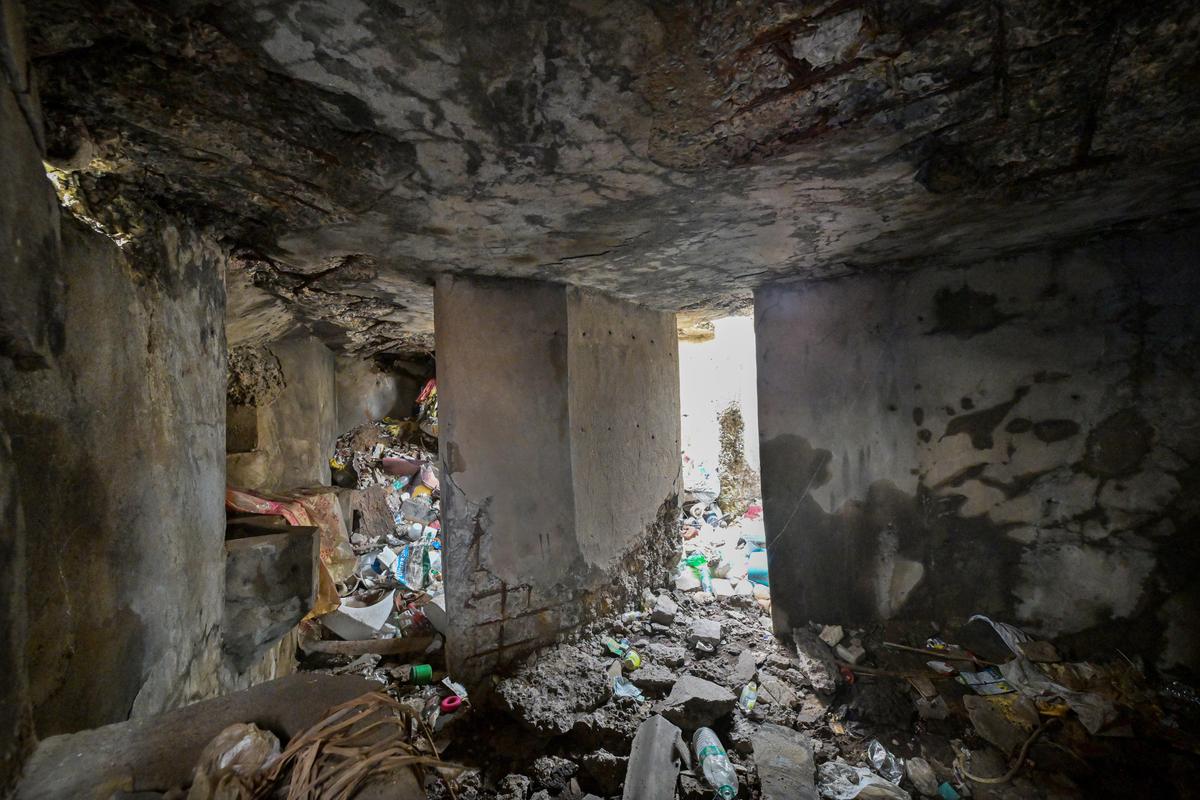
An inside view of the World War-II pillbox seen at Jalaripeta, which is burried under heaps of debris and garbage in Visakhapatnam. | Photo Credit: K.R. Deepak
The Naval Coast Battery
One of the most visible surviving wartime institutions is the Naval Coast Battery under the Eastern Naval Command.
Its origins date back to 1940, when British military authorities sought to establish coastal artillery positions to defend Visakhapatnam against possible Japanese aggression.
Edward Paul says the Army required a clear seafront location for heavy guns and eventually identified a coastal stretch occupied by fishermen’s settlements. Residents were relocated under wartime emergency regulations and resettled nearby in what came to be known as Kotha Jalaripeta.
The site became home to the 5th Indian Heavy Battery equipped with six-inch guns. Historical accounts trace the evolution of the installation from a wartime coastal defence unit into the present Naval Coast Battery functioning under the Eastern Naval Command. Though access to the operational premises remains restricted, the battery continues to stand as a direct institutional link to the wartime history of the city.
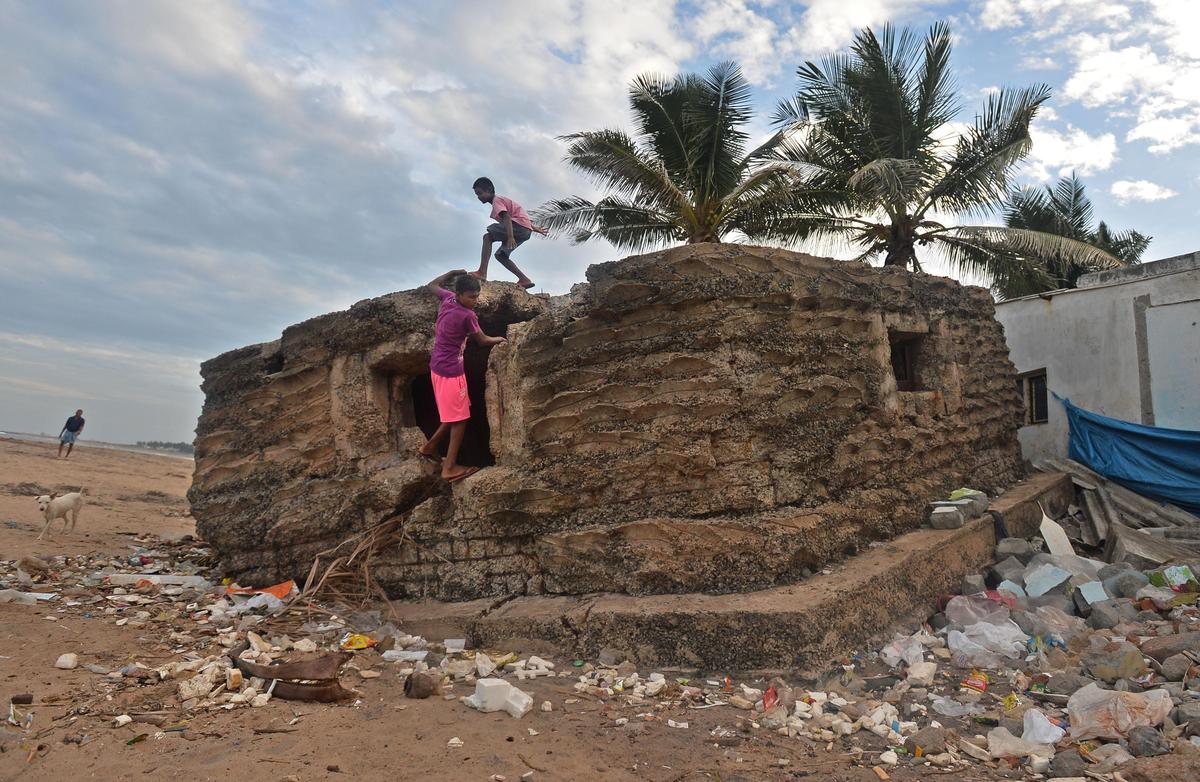
Children playing on the World War-II pill box in Visakhapatnam on July 12, 2016, which was revealed after heavy tidal waves cleared the sands at Peda Jalaripeta during Cyclone Hudhud that hit the coast on October 12, 2014. | Photo Credit: K.R. Deepak
Forgotten fortifications
The city’s wartime remnants are not confined to the coastline alone.
In recent years, reinforced concrete structures discovered near Daspalla Hills attracted attention from historians and heritage enthusiasts. The structures are believed to have served as wartime defence fortifications or gun emplacements overlooking the Bay of Bengal.
Researchers studying the site noted similarities between the structures and military observation or artillery positions used during World War II.
Visakhapatnam once contained a wider network of trenches, bunkers and defence positions constructed during the war years. Most of them disappeared as the city expanded into a major urban centre.
Some remnants survive quietly within institutional campuses, harbour precincts and inaccessible corners of the city.
AU and the war years
One of the consequences of the Japanese bombing involved Andhra University.
Within days of the air raid, military authorities requisitioned university buildings and lands for wartime purposes. The institution was compelled to relocate its academic activities outside the city.
The university shifted most of its departments to Guntur in April 1942, while the Chemistry Department was operated from Madras, Edward Paul says.
“For three years, the University was located outside Visakhapatnam and all their buildings were used by the Army,” he added. The university returned to the city only after the war ended in 1945.
Comment | Remembering the war, reminiscing forgotten Indians
The submarine beneath the Bay
The coast off Visakhapatnam also carries memories of underwater warfare from World War II.
Besides the wreck of PNS Ghazi, the remains of the Imperial Japanese Navy submarine RO-110 are believed to lie in the Bay of Bengal off the coast near Rambilli. The submarine was sunk on or around February 11, 1944, by the Royal Australian Navy corvettes HMAS Launceston and HMAS Ipswich, and the Royal Indian Navy sloop HMIS Jumna, using depth charges during Allied anti-submarine operations in the region.
Laid down at the Kawasaki-Kobe Shipyard in August 1942 and launched in January 1943, RO-110 operated from Penang in Malaya, and it was deployed for patrol duties in the Indian Ocean and the Bay of Bengal. During its third and final war patrol, the submarine attacked Calcutta-bound Allied Convoy JC-36 and struck the British merchant vessel Asphalion with two torpedoes before being tracked and sunk by the escorting warships off the Visakhapatam coast. Japanese naval records later declared the submarine lost with all 47 personnel believed to have perished onboard.
The presence of the submarine wreck beneath the waters off the coast underlines the strategic significance of Visakhapatnam within the larger theatre of the Indian Ocean conflict during World War II.
Andhra Pradesh: Brave World War II pilot flies into oblivion
Harbour memories
The harbour itself remains central to Visakhapatnam’s wartime story.
During the war years, the port came under military administration due to its strategic importance to Allied operations in the Bay of Bengal. Edward Paul notes that the harbour, originally administered by the Bengal Nagpur Railway, was taken over by the War Department in 1942 and remained under military control for nearly four years.
Among the few surviving memorials to the April 1942 raids is a plaque commemorating those killed in the harbour shelter strike. Mukund Padmanabhan notes that the Visakha Museum also displays the casing of a 250 kg unexploded bomb recovered from the attack, an object that has become, in his words, “something of a tourist attraction”.
Modern Visakhapatnam is often defined by its ports, shipbuilding facilities, naval establishments, pharmaceutical industries and technology corridors. Yet beneath that rapidly changing urban landscape lie quieter reminders of a period when the city stood at the edge of global conflict.