








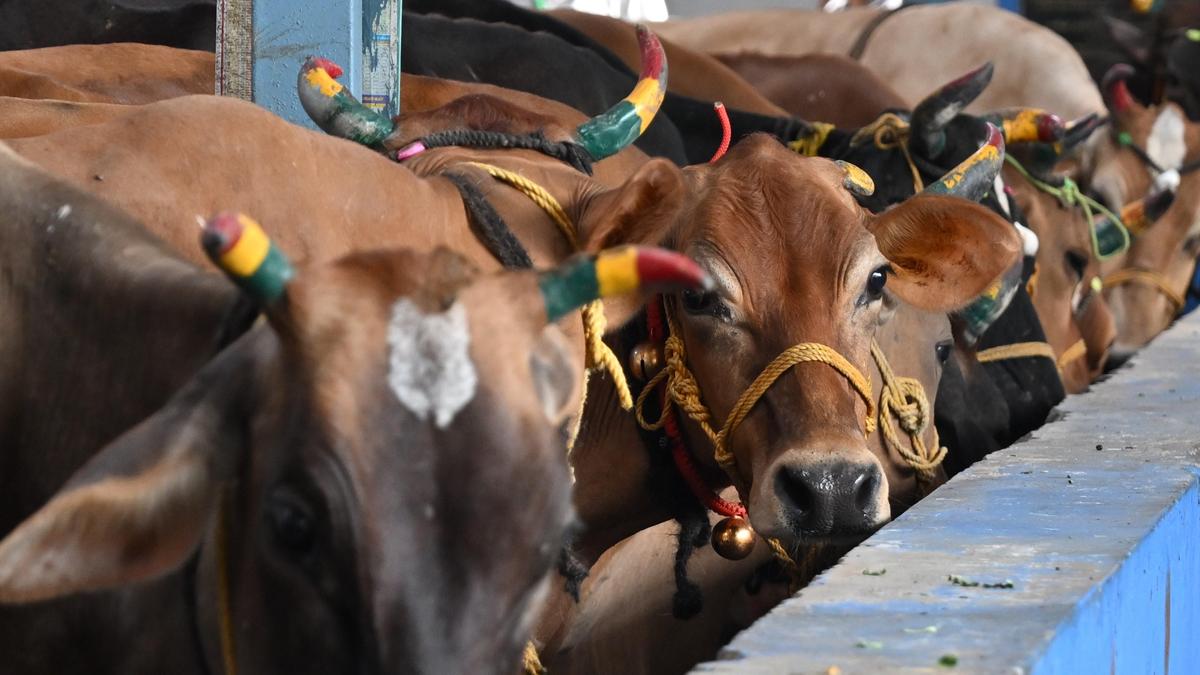
The Madras High Court on Wednesday (May 27, 2026) directed Tamil Nadu government to impose an immediate ban on cow slaughter across the State by implementing a Government Order (G.O.) issued on August 30, 1976 for prohibiting cow slaughter in the interest of milk production and improvement of rural economy.
A summer vacation Bench of Justices G.R. Swaminathan and V. Lakshminarayanan directed the Chief Secretary and Director General of Police/Head of Police Force (DGP/HoPF) to ensure that no cow or calf gets slaughtered anywhere in Tamil Nadu either on the eve of Bakrid on Thursday (May 28, 2026) or on any other day.

The two officers were ordered to issue suitable instructions to their subordinates across the State in order to ensure that there was no breach of the court order. The judges, further, directed the High Court Registry to list the matter once again on Friday (May 29, 2026) for the government to report compliance.
They also observed that a reading of the Tamil Nadu Urban Local Bodies Rules, 2023 makes it clear that the government officials concerned should not permit slaughtering of any other animal, such as goats and sheep, in a place other than a designated slaughter house that holds a valid licence.

The orders were passed while allowing a public interest litigation petition filed by K. Surya alias K. Surya Prasanth (29) the youth wing secretary of Indu Makkal Katchi. The petitioner had complained about temporary sheds having been put up in many places in Coimbatore to slaughter cows during Bakrid.
Authoring the verdict, Justice Swaminathan highlighted that Article 48 of the Constitution requires the State to take steps for prohibiting the slaughter of cows, calves and other milch as well as draught cattle. Even during the debates in the Constituent Assembly, it had been underlined that cow was a revered animal and that it had been associated with our civilisation from the time of Lord Krishna.

“Cow protection was an issue so dear to Mahatma Gandhiji. The eminent scholar Shri Dharampal pointed out that only to cater to the dietary requirements of the colonial Army, cows came to be slaughtered in very large numbers. After India attained independence, several States passed legislations and those legislations had also been upheld by the courts,” the judge said.
Further, stating that many Muslim Kings had abolished cow slaughter during their reign in the past, Justice Swaminathan quoted the Supreme Court too to have said that not all Muslims sacrifice cows on the day of Bakrid. Sacrifice of a cow on Bakrid was not an obligatory overt act for a person professing Islam to exhibit his/her religious belief and idea.
After referring to the top court’s verdicts on the issue and taking into consideration the 1976 G.O. issued for banning cow slaughter, the judge wrote: “Since the executive power is co-terminus with the legislative power, a Government Order issued by the Government banning cow slaughter is very much sustainable and has to be enforced, as it has the force of law.”
Who is Justice G.R. Swaminathan? | Focus Tamil Nadu | Video Credit: The Hindu
Published - May 27, 2026 10:11 pm IST