








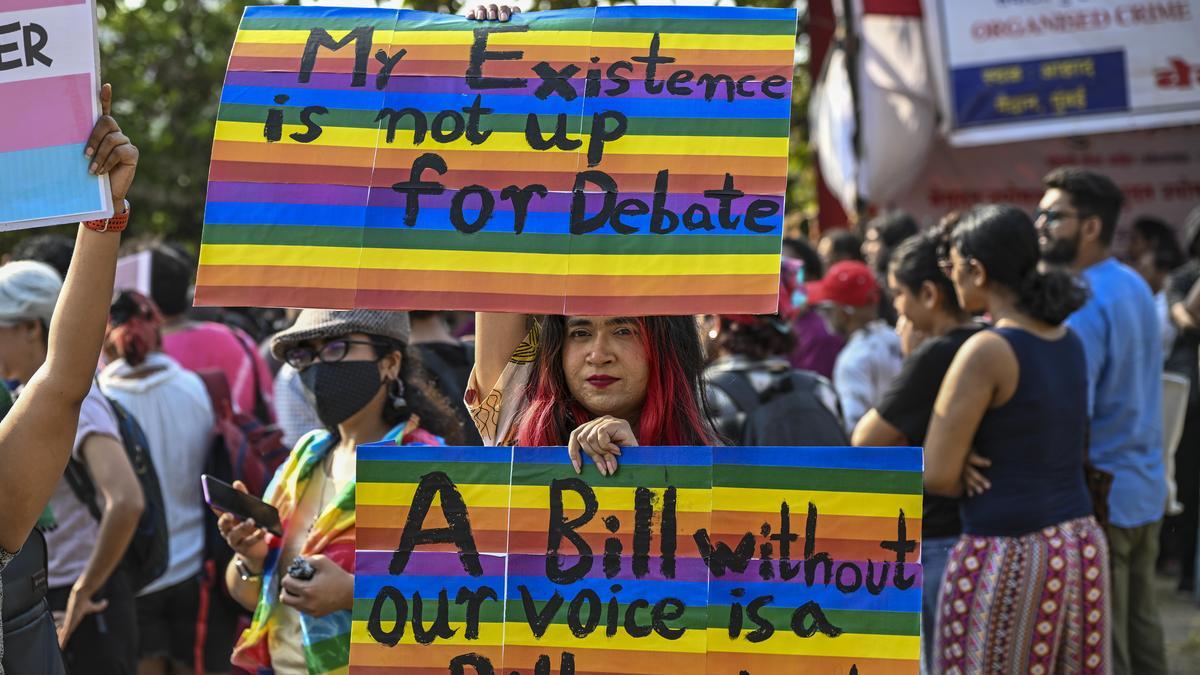
On March 30, 2026, the President of India gave assent to the Transgender Persons (Protection of Rights) Amendment Bill, 2026, converting it into law. The amendment has drawn considerable attention for what it does to the constitutional guarantees and legal standing of transgender communities in India. What it has drawn far less attention for is what it does to a transgender student trying to access a scholarship, request a hostel room, or file a harassment complaint at a government college. It does not modify a welfare framework alone. It restructures the terms on which the government recognises a transgender person and, few sites make that cost more concrete than the classroom.
(Sign up for THEdge, The Hindu’s weekly education newsletter.)
The legal foundation for transgender inclusion in Indian education was laid in April 2014, when the Supreme Court’s NALSA vs Union of India judgment established the right to self-determined gender identity as a fundamental right, and the Transgender Persons Act of 2019 gave it legislative form through Section 13, which prohibited government and government-aided institutions from discriminating against transgender students in admission, access to facilities, or participation in activities. The National Education Policy of 2020 classified transgender children among Socio-Economically Disadvantaged Groups and the Support for Marginalized Individuals for Livelihood and Enterprise (SMILE) scheme attached an annual post-matric scholarship of ₹13,500.
Political theorist Nancy Fraser argued that a just society must offer both recognition, meaning the state acknowledges who you are and redistribution, meaning it shares resources with you. The Indian government had, however imperfectly, committed to both for transgender persons, beginning with the NALSA judgment in 2014 and formalised through the Transgender Persons (Protection of Rights) Act in 2019 and its Rules in 2020, which together introduced the Transgender Certificate as the mandatory document for accessing government benefits. But every one of those commitments, the scholarships, the reservations, the welfare schemes, was made contingent on that single document. For any transgender person navigating this system, the certificate was the only proof the government would accept that they existed in it at all, however generously the system had been designed on paper.

The key, redesigned
The 2026 Amendment has redesigned that key. Under the 2019 Act, a certificate could be obtained through self-declaration by affidavit, a process that preserved the NALSA principle that gender identity is self-determined. The 2026 Amendment abolishes this, replacing it with a Medical Board headed by a Chief Medical Officer whose assessment must precede any certificate issued by the District Magistrate. It tells a person that their understanding of their own identity needs a clinical stamp before the government will accept it. For a student in a district where that Board has not yet been constituted, for which no district-wise constitution timeline has yet been published, the scholarship portal is accessible in name and unreachable in practice.
Also Read : A shade of dark: On the Transgender Persons (Protection of Rights) Amendment Bill, 2026
The amendment compounds this by narrowing the legal definition of who qualifies as transgender. Where the 2019 Act encompassed trans men, trans women, intersex persons and genderqueer individuals alongside named socio-cultural identities such as Hijra, Kinner, and Aravani, the 2026 version removes the broader categories and retains primarily the socio-cultural ones. A trans-masculine student who belongs to no named community and a non-binary student whose identity does not map onto any retained category are not denied a certificate through any explicit act. They are excluded from the definition entirely, a more thorough form of negation because it requires no act of individual discrimination to sustain itself.

This amendment does not arrive into a functioning educational system. It arrives into one that had already driven a community to build its own institutions in several instances. In 2016, Sahaj International in Kochi opened as an NIOS-affiliated centre for transgender dropouts completing secondary education outside institutions that had expelled or silenced them. In 2019, the Akhil Bhartiya Kinnar Siksha Seva Trust announced plans for India’s first dedicated transgender university in Kushinagar, Uttar Pradesh. Both emerged from the recognition that mainstream institutions had been hostile and the government indifferent, a pattern the Supreme Court described as recently as October 2025 as “gross apathy,” leaving communities to provide for themselves. The amendment does not address that failure. It simply makes the certificate harder to obtain and the category of those who qualify for it smaller, both changes deposited onto a system already in crisis.

What the student now faces
Think concretely of a student navigating a government college in 2026. She has secured admission and wishes to apply for the SMILE scholarship but finds that no Medical Board in her district has been formed. The hostel warden does not know what category to assign her room to, and most Student Information Systems continue to offer only Male or Female. The Statement of Objects and Reasons for the amendment states that the legislative policy is “not to protect each and every class of persons with various gender identities or gender fluidities.” The concern about accurate welfare targeting is not unreasonable in principle. But narrowing the eligible category without building the infrastructure to serve those who remain within it transfers the entire cost of that contraction onto students.

Three interim measures could limit the damage. The UGC, which issued transgender-inclusive guidelines in 2017, should issue a fresh circular extending provisional scholarship access to students whose Medical Board assessment is pending. The Ministry of Social Justice and Empowerment should publish a district-wise timeline for Medical Board constitution, because the 2019 Act carried a transition window for implementation and the 2026 Amendment carries none. And the National Scholarship Portal must be updated to ensure that students who qualified under the 2019 definition are not quietly excluded mid-application.
The students who disappear under this amendment will not disappear visibly. They will find that the scholarship portal asks for a certificate they cannot obtain, the hostel room has no category for their name and the admission form still offers only two boxes. They will stand at the threshold as the process moves on around them. Whether the government notices anyone is missing depends entirely on whether it chooses to look.
(Rahul Verma is an Independent Researcher and Sociology Educator.)
Published - April 16, 2026 08:00 am IST