







Who was Shivaji? It is a question rooted more in historical enquiry than heroic pride. A cluster of Marathi films made before have detailed the Maratha warrior king’s brainy conquests, whose strength lay in the innovative use of military tactics and a reliance on outsmarting the mighty opponent with limited resources. All of this makes Shivaji a great soldier, but what makes him a great king, whose fearless spirit is immortalised through folk songs and legendary tales passed through generations?

As Govind Pansare’s seminal book tells us, Shivaji’s greatness lay not just in his steely valour on the battlefield but in his multiple attempts to build a Swarajya or self-rule where empathy reigned high, justice sailed through, and fairness became the norm. The people, referred lovingly as Ryot and comprising mainly farmers and peasants, considered him their own because of his dedicated efforts to undo all wrongs meted out against them by an oppressive system. That’s why soldiers like Bajiprabhu Deshpande and Tanhaji Malusare were willing to sacrifice their lives for him, as his cause for Swarajya became their cause for liberation. Shivaji’s popularity among the common masses was due to the genuine concern he showed for bettering their living conditions. Popular culture, however, views him through a singular lens of a warlord, negating the expansive nature of his ideas and their rightful place in history.
Riteish Deshmukh’s Raja Shivaji tries to change that when we see a glimpse into the king’s humanity during a pivotal moment. A teenager Shivaji is moved to tears when an old lady dismisses his stature, complaining about the destruction caused by the Adil Shahi and Nizamshahi forces in Pune. The next day, Shivaji reclaims the city’s honour by moving a golden plough across the land, a symbolic gesture that creates a sense of reassurance among the masses. Later, in another scene, an enraged Shivaji cuts away the hands of an arrogant Patil for violating a woman.
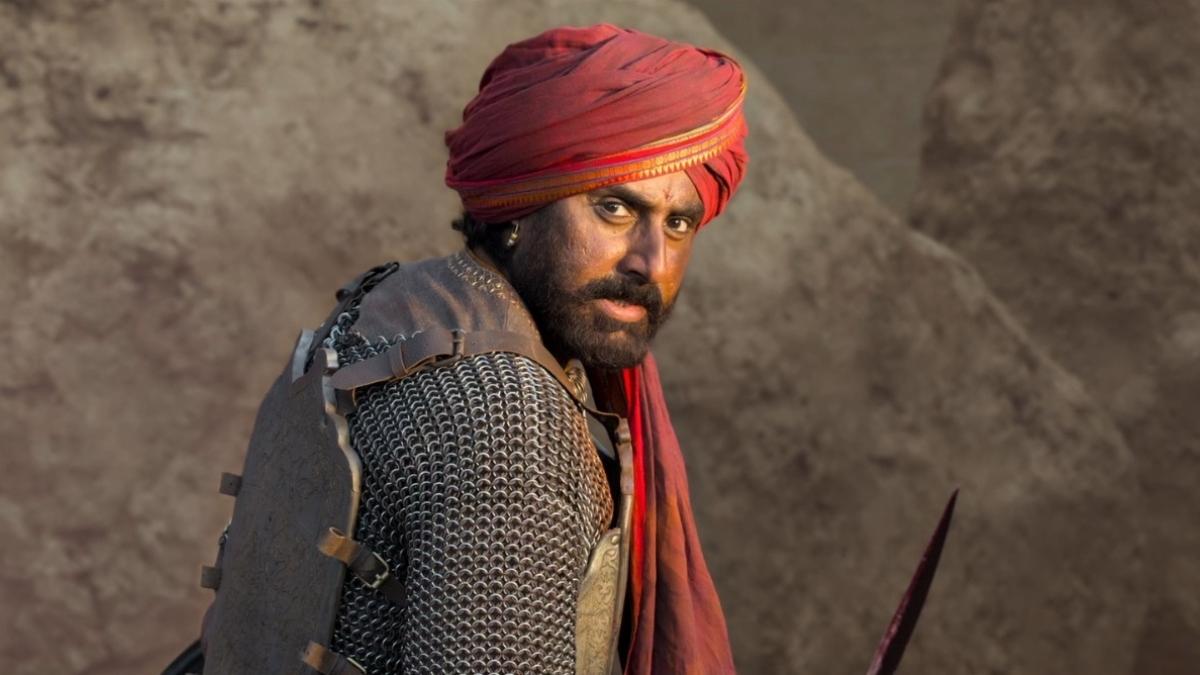
Abhishek Bachchan as Sambhaji Bhosle in a still from the film | Photo Credit: JioStudios
Deshmukh shows some willingness to understand the core of the Maratha king. However, these are still quicker moments whose effect doesn’t quite lend its soul to Shivaji’s persona. The filmmaking is ever more reverential towards him right from the moment of his birth, when a visual of his tiny limb rises against a charged background score. Shivaji (Riteish Deshmukh) is born at a time when his father, Shahji Bhosle (Sachin Khedekar), served the Adil Shahi dynasty. He shows signs of bravery as a kid, infused with ideas of self-rule by his brother, Sambhaji Bhosle (a sincere Abhishek Bachchan). Their relationship forms the core of the first-half, featuring lengthy action sequences and overdramatic dialogues underlining their rebellious nature.

Raja Shivaji (Marathi)
Director: Riteish Deshmukh
Cast: Riteish Deshmukh, Sanjay Dutt, Abhishek Bachchan, Sachin Khedekar, Genelia Deshmukh, Jitendra Joshi, Fardeen Khan and Vidya Balan
Runtime: 3 hours 15 minutes
Synopsis: In the mid sixteenth century, a young Shivaji rises up to conquer enemy territory and establish self-rule as he battles the Adil Shahi commander Afzal Khan
Deshmukh takes a long time to reveal the adult version of Shivaji as myth-making takes precedence over emotional resonance. When we first see him, Deshmukh’s Shivaji flies onto the battlefield to attack the incoming enemies, in a sequence that is steadily executed as Ajay-Atul’s operatic theme song reminds us of the legend of this warrior. The theatrics, however, don’t quite render much effect, for the essence of Shivaji’s ideals stays missing for the most part. It also becomes difficult to imagine Deshmukh as the Maratha chieftain even though the actor remains earnest in his portrayal. His screen presence doesn’t quite match the popular memory of the king. So, no amount of extreme slow-motion shots can convince us otherwise.
The film is otherwise mindfully shot by Santosh Sivan, with the flickering lighting and shadows adding a new dimensionality to the visuals. The cinematography also steers clear of excessively villainising the Muslim rulers, like Vicky Kaushal’s Chhaava, which added a distinctive tint to the scenes of Akshaye Khanna’s Aurangzeb. Deshmukh is not the kind to create a vile binary rift in history, but he is also not the one to delve into complexities, as we see the Mughal emperor Shah Jahan reduced to his worst caricature by Fardeen Khan and the other Adil Shahi rulers rendered as completely brainless buffoons. Sanjay Dutt gets his share of flair, though, as he instils his peak villainy ethos into Afzal Khan, a man epitomised as evil through popular folk ballads.
It is also the much mythologised confrontation between Afzal Khan and Shivaji that sets the film back into action after a series of lethargic sequences midway. The final act builds excitement for how tactfully Shivaji led the negotiations with Afzal, breaking him not with the blow of his sword but with the sharpness of his intellect. Deshmukh shows promise as a director in these portions, focusing on smaller details which are blended well with the editing to maintain the excitement, until the final moment of victory when he stabs Afzal Khan with his Bagh Nakh. It feels like a fitting conclusion, especially when Deshmukh and the writers layer the image of Afzal with that of an elephant wanting to conquer the forest, as his giant ego is attacked by Shiva, the lion.

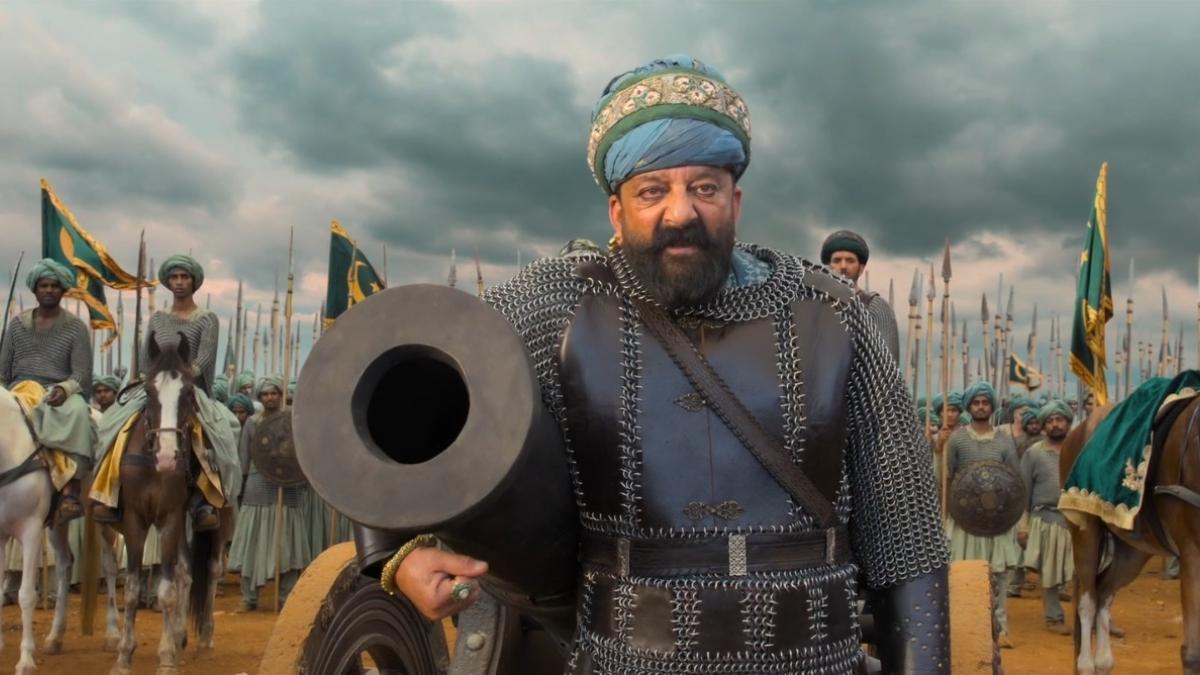
Sanjay Dutt in the film | Photo Credit: JioStudios
Beyond the metaphors, however, the portrayal of Shivaji barely scratches the surface. Deshmukh remains largely content with glorifying the king rather than inquiring into the nature of his glory. The efforts of making a conventional biopic convert the historical icon into a one-dimensional hero, fighting a generic good vs evil battle as the aesthetics genuflect in his honour. The other side of the king, far more relevant to contemporary times, which reflects in the stirring letter he wrote to Aurangzeb or the multi-cultural nature of his army, remains largely hidden beneath the outward shades of history. As the film ends with slogans in honour of Shivaji, the question still prevails: who really was Shivaji?
Raja Shivaji is currently running in theatres