




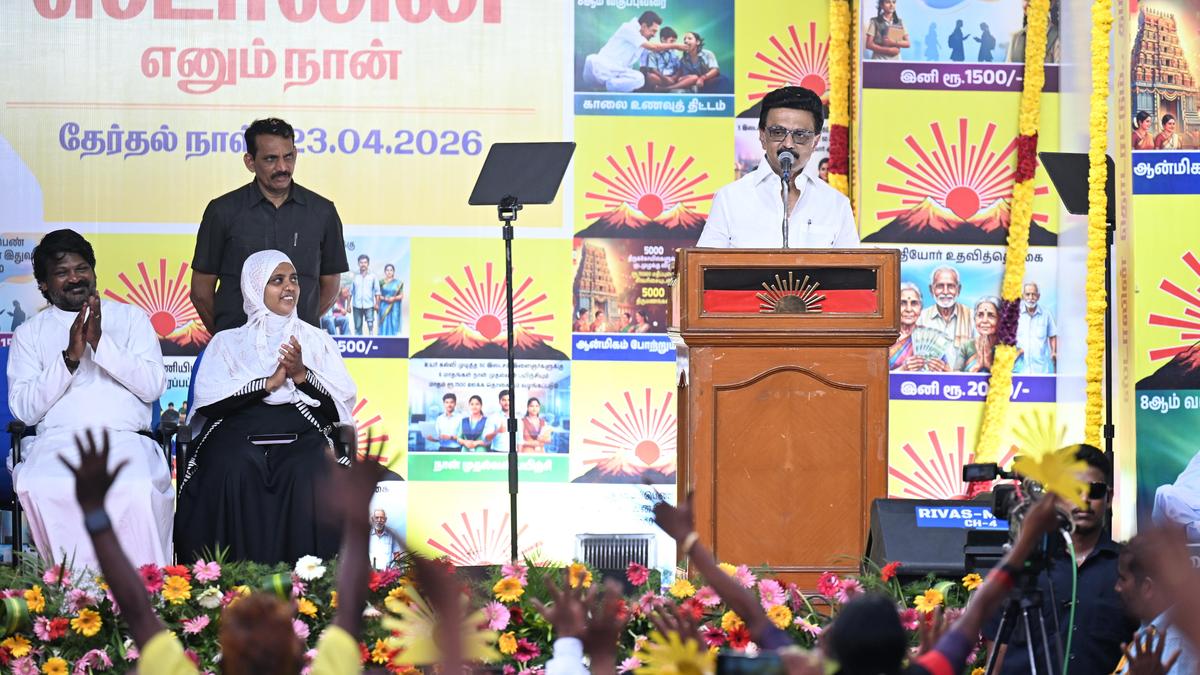
The sun was already unforgiving at 9 a.m. in Virudhunagar on April 5. Those who attended the election rally of Chief Minister M. K. Stalin, the star campaigner of the DMK-led Secular Progressive Alliance, were sweating profusely. Mr. Stalin delivered a tightly structured address, winding up in just about 30 minutes.
In a clear departure from the past—when local leaders and candidates would speak before the party leader addressed the gathering—this time, Mr. Stalin spoke alone, following only a brief introduction by the local minister or district secretary. He highlighted the overall achievements of the Dravida Munnetra Kazhagam (DMK) government and outlined schemes implemented in the district before introducing the candidates.

With the heat proving unbearable, he chose to restrict his campaign to the evenings, holding two meetings then instead of one in the morning and another later in the day. He compensated for the absence of morning meetings by interacting directly with people, shaking hands and posing for selfies—a practice he follows even outside the election season. This strategy helped establish a notion that the Chief Minister is accessible.
Mr. Stalin had already emerged as a star campaigner when his father, the late Chief Minister M. Karunanidhi, was alive but unable to tour due to age. He led the party’s campaign successfully in the 2019 Lok Sabha election, the 2021 Tamil Nadu Legislative Assembly election, the 2024 Lok Sabha election, as well as in by-elections and local body polls.
Besides highlighting the achievements of the DMK government, he targeted the BJP-led government at the Centre, accusing it of “betraying the interests of Tamil Nadu on every issue.” He also accused the All India Anna Dravida Munnetra Kazhagam (AIADMK), led by Edappadi K. Palaniswami, of playing second fiddle to the Bharatiya Janata Party (BJP). He often adopted an interactive style, eliciting responses from the crowd—an approach once used by the late Chief Minister J. Jayalalithaa.

However, he avoided engaging directly with actor Vijay, founder of Tamilaga Vettri Kazhagam (TVK), who has consistently maintained that the electoral contest is between his party and the DMK. Mr. Stalin also periodically released videos expressing his views on topical issues in strong language, often indicting the BJP-led Union government. His speech on delimitation, in which he declared a “black flag protest,” drew national attention. The defeat of the Bill in Parliament gave a fillip to the DMK’s campaign.
Though leaders of the DMK’s alliance partners shared the dais with Mr. Stalin, Congress leader Rahul Gandhi did not campaign alongside him. Differences over seat-sharing created a gap between the two parties, and the leaders spoke to each other only ahead of the introduction of the Constitutional amendment Bill on delimitation in Parliament. Mr. Gandhi campaigned separately.

Another leader who campaigned vigorously for the DMK combine is Deputy Chief Minister Udhayanidhi Stalin. Having acted in films, Mr. Udhayanidhi brings a different campaign style, successfully drawing attention to issues, as he did in the 2024 election. He notably carried a brick to highlight that the AIIMS promised by the Union government had not progressed beyond that stage. DMK Parliamentary party leader Kanimozhi Karunanidhi was another key campaigner.
Actor and MNM leader Kamal Haasan also joined the campaign, even though his party chose not to contest the election due to dissatisfaction over seat allocation. As a popular actor, he drew large crowds, and his campaign proved effective. He also released a video rendering a song, “Oru Thalaivan Irukkiran,” praising Mr. Stalin’s leadership.
DMDK leader Premallatha and Viduthalai Chiruthaikal Katchi (VCK) leader Thol. Thirumavalavan also campaigned vigorously for the DMK front.
Also read: Assembly elections LIVE
On the ground, the DMK continued to rely on its well-oiled party machinery —public meetings, door-to-door canvassing, and localised engagement led by functionaries and volunteers. Parallelly, it scaled up its digital operations, regularly releasing advertisements on social media highlighting the government’s achievements and promises. Former Union Minister P. Chidambaram and his son Karti Chidambaram campaigned, lending credibility to Mr. Stalin’s leadership and the DMK’s promises. Mr. Chidambaram, who had once described the DMK’s 2006 manifesto as the “hero” of that election, argued that the proposed ₹8,000 coupon for purchasing household appliances would stimulate the economy.
CPI(M) general secretary M.A. Baby, along with Polit Buro members Prakash Karat and Brinda Karat, also toured the State, vouching for the DMK’s governance. As an alliance of over 20 parties, the DMK front sought to reach almost every section of society, including various caste and religious groups. Bishops from several Christian denominations openly announced their support.
With actor Vijay’s TVK likely to absorb a share of anti-incumbency sentiment, the DMK appears confident of its prospects.
Published - April 22, 2026 01:00 am IST