


Imagine you’re strolling along the beach when you stumble upon a unique-looking creature washed ashore. Your first instinct might be to snap a picture and search online to identify the organism and find out how to safely return it to the water if it’s still alive. Once your walk is over, you might keep the photo as a memento of your day.
In our modern world, taking pictures is second nature. But before the invention of the camera, capturing such moments was not so simple. Long before photography, Japanese fishermen developed their own method to record their trophy catches, a technique known as Gyotaku.
What is Gyotaku?
The word Gyotaku is Japanese for ‘fish impression’ or ‘fish rubbing’. This practice began in the mid-1800s as a way for fishermen to document the size and species of their catch before selling it. Equipped with rice paper, sumi-e ink, and brushes, they would create prints of their prized catches. If they caught a particularly revered fish, they would make an impression before releasing it. They used non-toxic sumi-e ink, applied it to the fish, and pressed rice paper onto it to capture the impression. The fish would then be cleaned and either released or sold.
The evolution of an art form
Over time, Gyotaku evolved into a respected art form, with skilled artists creating detailed and beautiful prints of fish and other sea creatures. This art form reached its peak popularity towards the end of the Edo Period, which ended in 1868. Today, Gyotaku has resurfaced as a popular art form enjoyed by many, and the prints are believed to bring good luck.
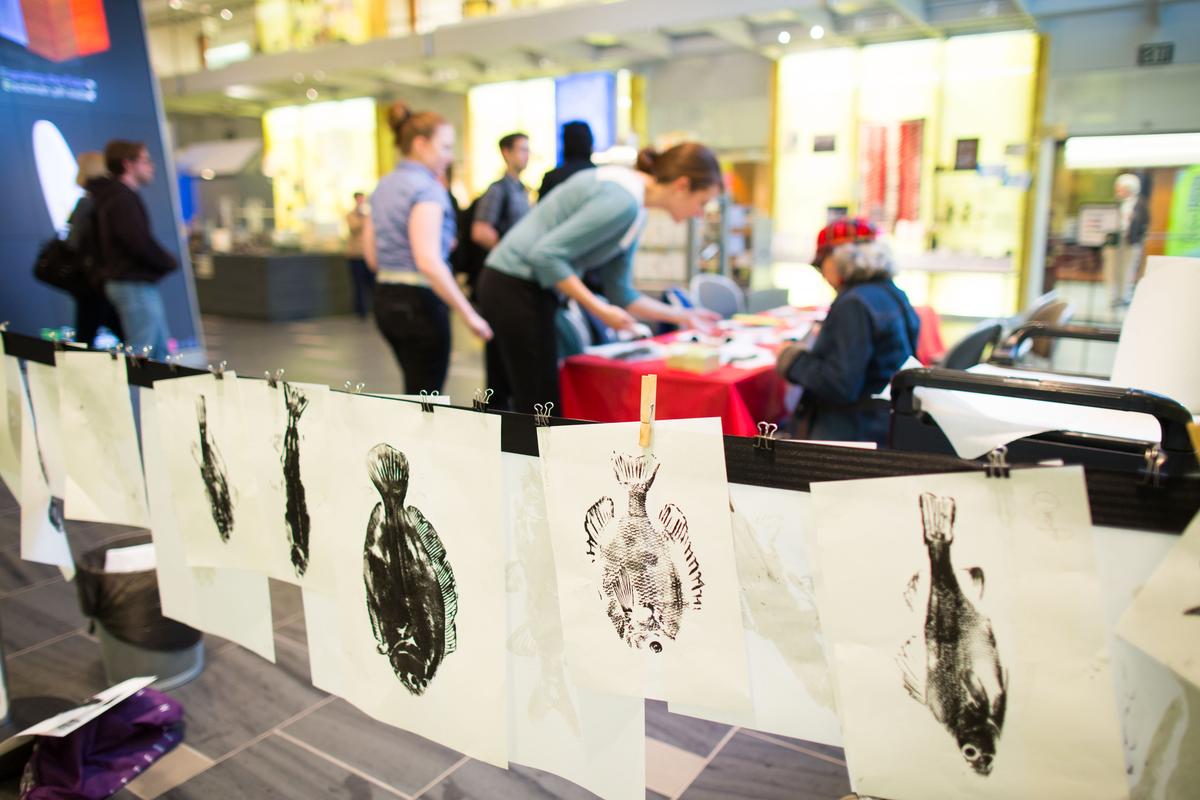
Photograph of Gyotaku, traditional Japanese fish printing, showing fish prints hanging to dry taken as part of the Philadelphia Science Festival April 2013 at the Chemical Heritage Foundation, Philadelphia, U.S. | Photo Credit: Conrad Erb/ WIKIMEDIA COMMONS
How to print a fish?
Creating a Gyotaku print involves a blend of artistry and technique. Artists today are mostly self-taught and often learn through trial and error, but the process begins with preparing the fish. The fish is placed on a hollowed-out surface with its fins spread and pinned to dry, then cleaned with water. There are two primary methods for printing:
1. Indirect Method: Involves placing moist fabric or paper onto the fish using rice paste. The artist then uses a cotton ball covered in silk to apply ink to the paper, creating the fish’s impression. This method requires more skill, as the paper must be carefully removed to avoid tearing.
2. Direct Method: Involves applying ink directly to the fish and then placing a moist sheet of paper or fabric onto it to produce a print.
A novel use for conservation
Today, Gyotaku has found a novel application in the field of conservation. Researchers use these historic prints to catalogue the biodiversity of fish in various regions over time. Scientific journals like Zookeys have published research on how Gyotaku prints help track the fulctuations in threatened and extinct fish populations in Japan’s past, filling in gaps where other data sets are lacking. There’s even speculation that these prints may harbour bits of DNA, aiding researchers in validating and tracking species present at the time.
As a fascinating blend of art and science, Gyotaku, has evolved from a practical recording technique to a respected art form and a valuable tool for conservation taht inspires and educates people around the world.