








Shanno Bai sits outside her kutcha house in Urdya Baida village, about 35 kilometres from Dhar town in Madhya Pradesh. One of her eight children works in the fields, while her grandchildren play nearby.
An unpaved road leading to her house has a small statue. It is of Shanno’s husband, Van Singh Araadi, who died in 2003 in police firing during communal clashes in Dhar district.
Recalling the events of that time, the family says that while there had been a clarion call from a local Hindu mystic to join a protest rally in neighbouring Amjhera town, Van Singh had only gone there to get his wheat ground.
“My father had gone to get atta from wheat,” says Shanno’s eldest son, Vikram. “There was a rally which ran into clashes with the police as a curfew was in place in Amjhera. My father got caught in between. After sometime, a neighbour who was also in town came and told us that he had been shot.” Vikram adds that the family had nothing to do with the communal dispute.
Van Singh and two others were declared martyrs by local Hindu groups. Their pictures have been displayed at the Bhojshala complex, an Archaeological Survey of India (ASI)-protected monument and the centre of communal tensions in Dhar for generations. Hindus believe the site to be a historical temple from the 11th century dedicated to goddess Vagdevi (Saraswati), while Muslims say it is the Kamal Maula mosque from the early 1300s.
With the Madhya Pradesh High Court recently declaring the disputed site to be a Hindu temple, there are celebrations in the Hindu community. Shanno’s household and village, however, are focused on making ends meet.
Shanno says that some local leaders came to offer condolences after Van Singh’s death, but nobody has checked on the family for 23 years.
“Two people came on Thursday [May 21] to invite us for a procession at the temple. We don’t have much to do with the whole thing but since they asked, we might go,” says Vikram.
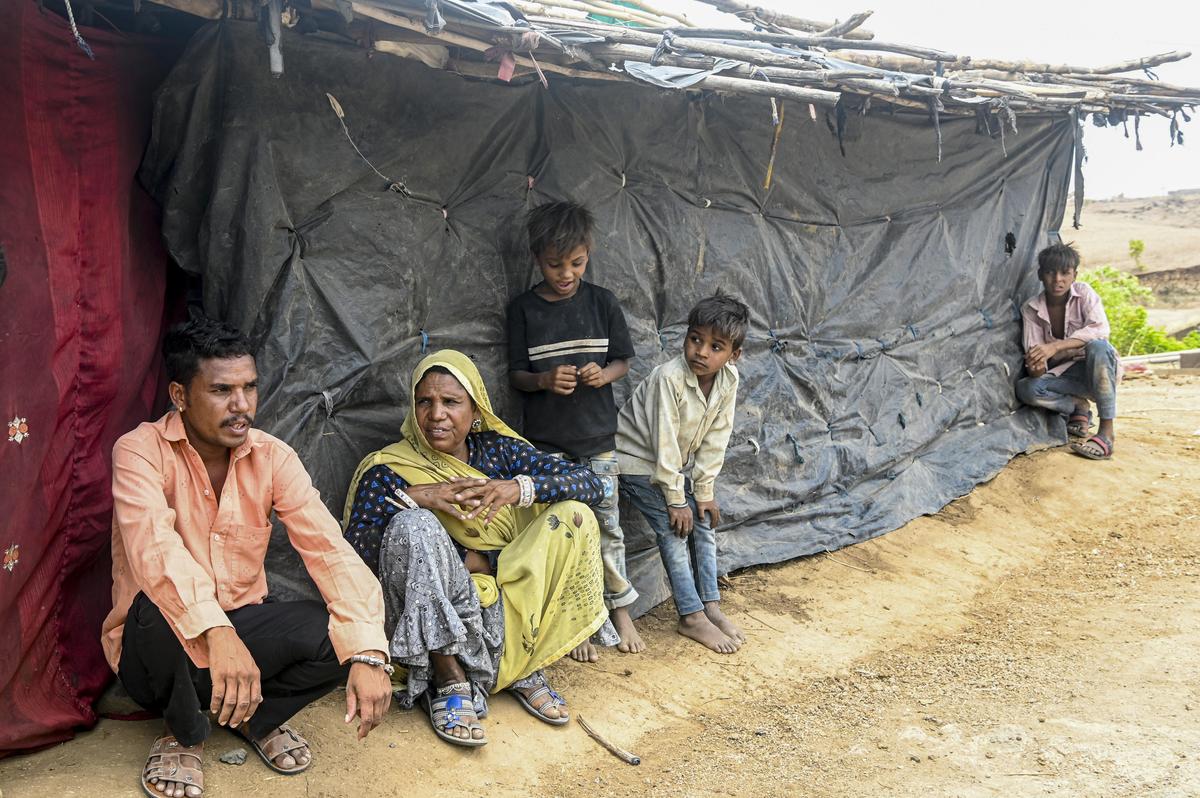
Shanno Bai, who lost her husband Van Singh Araadi in police firing during the 2003 communal clashes, with her son, Vikram (on the left), in Urdya Baida village. | Photo Credit: A.M. Faruqui
What the court ruled
Hindus believe the site to be a Saraswati temple and a learning centre with the name of Saraswati Kanthabharana, established by King Bhoja of the Parmar dynasty in 1034 CE. On the other hand, Muslims believe the site to be a mosque built between 1304 CE and 1331 CE by Maulana Kamaluddin Chishti, a Sufi saint during Alauddin Khilji’s rule at the Delhi Sultanate, who arrived in Dhar around 1292 CE.

Tensions at the disputed site escalated in the 1990s as competing claims by the two communities intensified. This prompted then Dhar Collector V.R. Subramaniam to issue a restraining order in 1997, allowing entry into the complex only to Hindus on Basant Panchami and to Muslims on Fridays for namaz. The order became the basis for the 2003 ASI order, which additionally allowed Hindus to enter on Tuesdays. The ASI also opened the site for general visitors barring Tuesdays and Fridays. However, tensions again flared on various occasions, especially when Basant Panchami fell on Fridays in 2006, 2013, and 2016, prompting the authorities to further intervene with specific schedules for such occasions.
On May 15, after hearing six writ petitions, a Division Bench of the Madhya Pradesh High Court in Indore delivered its judgment declaring the complex as a temple dedicated to goddess Vagdevi (Saraswati). The court also said that it was a Bhojshala, or a centre for Sanskrit learning.
The High Court quashed the April 7, 2003 order issued by the ASI stipulating that the Muslim community continue to offer Friday afternoon namaz at the site and Hindus conduct ceremonies on Basant Panchami and to visit every Tuesday with “a flower or two and a few granules of rice”. The court also gave the ASI complete control over the preservation and conservation of the site, and regulation of religious access to it.
The court also said that the Muslim community could approach the State government for an alternative piece of land to build a mosque within Dhar district, and that the authorities may consider such an application. However, representatives of the community have turned down the recommendation and filed a special leave petition in the Supreme Court to challenge the High Court judgment.
On May 16, the ASI issued an order saying that the Hindu community “shall have an unrestricted access to the Bhojshala complex in connection with the ancient practice of learning and the worship of Goddess Saraswati”.
The first Friday after the judgment
It is the first Friday since the May 15 verdict and Dhar town has been turned into a fortress. The markets are shut and security personnel patrol the lanes on foot and horseback. Anti-riot vehicles have been deployed across the town and bomb-detecting squads and sniffer dogs work in and around the site.
The Deputy Inspector General (DIG) of Police, Indore (Rural), Manoj Kumar Singh, says more than 1,800 personnel from the Rapid Action Force, Quick Response Force, Special Armed Force, and the local police have been deployed in and around Dhar.
The complex is heavily guarded with barricades and watch towers. Several Hindu devotees arrive at the complex for the morning aarti. Two dargahs adjacent to the complex have been obscured from public view after a barricaded corridor was erected along the path to Bhojshala, with sections near the dargahs and the graveyard covered by large white sheets. This marks the first Friday in decades that Muslims do not offer namaz at the site.
Until Thursday evening, some community leaders, including Abdul Samad, president of the Maulana Kamaluddin Welfare Society, which represented the community in the High Court, had said they planned to offer namaz at the site as they had for decades, arguing that the court order had “not restricted” them from doing so. In response, members of the Bhojshala Mukti Yajna, a local outfit, announced a maha aarti ceremony in the afternoon. The timings of both the events clashed, raising concerns among the authorities.
Senior officials of the district administration and police held meetings with both sides ahead of Friday, while Muslim leaders also held discussions with their lawyers. By Thursday night, both sides cancelled their plans, with Samad asking the Muslims to offer prayers at their homes or local mosques. Hindus have been holding their regular morning and evening aartis since the High Court’s verdict.
The ASI survey and objections
The High Court verdict relied largely on a 2,183-page report of a survey conducted in and around the complex by the ASI between March 22 and July 15, 2024, on the directions of the High Court.
The ASI said it followed various scientific and archaeological methods and its investigations indicated three distinct architectural phases at the site. It identified the existing structure as the third phase, built over an earlier structure that was damaged and later modified for reuse.
Among other findings, the ASI survey also said that the remains of the earliest structures constructed at the site still exist in-situ and are covered under the thick and heavy slabs of basalt used during the construction of the platform. “Based on the artefacts found during the investigations, these brick structures can be dated to the Paramara period, i.e. 10th-11th century CE,” the survey said.

The ASI also found 1,610 artefacts or remains of artefacts at the site, recovered from various locations, including walls and underground. The artefacts include 94 sculptures and sculptural fragments, coins of silver, copper, aluminium, and steel. These span multiple periods, including the Indo-Sassanian (10th–11th century), Delhi Sultanate (13th–14th century), Malwa Sultanate (15th–16th century), Mughal (16th–18th century), Dhar princely state (19th century), British era (19th–20th century), and independent India.
“Sculptures of four-armed deities were carved on windows, pillars, and beam used in the existing structure. Images carved on these included [Hindu deities] Ganesh, Brahma with his consorts, Nrasimha, Bhairava, gods and goddesses, human and animal figures,” the report said, adding that various carvings also included images of animals and birds as well as mythical figures. “As human and animal figures are not permitted in mosques at many places, such images have been chiselled out or defaced,” it added.
The ASI also said that the mihrab (a semicircular niche built into the wall of a mosque) “is a new construction and therefore it is beautifully decorated. It is made of different material than the entire structure.”
The ASI report also mentioned several Sanskrit and Prakrit inscriptions on damaged and reused stone slabs in the floor and walls, with the written surfaces altered through chiselling. It also recorded 56 inscriptions in Persian and Arabic.

The Muslim petitioners and lawyers, however, allege several irregularities in the survey exercise and report. They say that the court verdict was “solely based on the ASI report”, which in turn they say did not mention carbon dating to determine the age of artefacts that were recovered. They also said that their arguments were “not heard properly” in court.
Samad, who accompanied the survey team as a Muslim representative, alleges that while various items recovered during the excavations were “not disclosed” in the report, some items were also “planted” over the years.
“An idol of Buddha was found during the digging of the complex but the report does not mention it anywhere as it complicates the results,” he claims. “A skeleton, largely intact, was recovered from the backyard. It hints at the presence of a graveyard, but it was excluded from the report.”
He also alleges, “There is a room that was in the possession of the Muslim community and that was used to store mats and other items for namaz. The ASI took over its control in 1997 and used it as a CCTV surveillance and storage room. When that room was opened during the survey, its floor was already broken. During the excavation, many artefacts, including an idol, were recovered from there. If they were ancient they should have had thick layers of soil, but they appeared fresh.”
Samad also alleges that liquor bottles, disposable cups, wrappers of tobacco and plastic waste were found during the digging. “Were any of these things used 700-800 years ago,” he asks.
Senior advocate Salman Khurshid, who led the Muslim side’s arguments towards the later stages of the case, argued in court that such materials cast “serious doubt on the authenticity of the alleged recoveries”. He said that certain artefacts appeared to have been “implanted”.
The court said that the ASI had explained that such materials were found only in the uppermost heterogeneous debris layers, which already consisted of conservation debris, ceramic pieces, wrappers, and assorted waste.

During regular hearings in April, the Muslim side demanded videographic and colour photographic records of the survey proceedings and approached the Supreme Court for access. The Supreme Court directed the Madhya Pradesh High Court to consider all objections raised by the Muslim side. Following this, the High Court instructed the ASI to share the videography with all the parties involved in the case.
Samad alleges that only video clips of 45 seconds to a few minutes from each day were shared with them despite the survey being conducted for at least 10 hours per day.
Two streams of history
Zulfikar Pathan, president of the Kamal Maula Mosque Intezamia Committee, which was responsible for namaz arrangements at the site, alleges that the survey results and the court verdict are “predetermined” and that the findings were “conveniently presented to reach the desired outcome”. He says, “This is what we are challenging in the Supreme Court. We were not given a chance to cross-examine the ASI experts on the findings. We kept making our objections, but they were not properly addressed.”
He adds, “We had records that show that this site has been a mosque for about 800 years, but none of them were considered.”
Ashish Goyal, State vice-president of the Hindu Front for Justice, which was the primary petitioner from the Hindu side, says the site was damaged several times in attacks by Muslim invaders, including for the first time by Alauddin Khilji in 1305 CE and later by Mahmood Shah Khilji in 1514 CE. “The Bhojshala was damaged many times. And every time new structures like tombs, dargahs, and graves were added to the complex as well as in its premises,” he says.
Goyal claims that the offering of namaz in modern history only started in 1935 after the Muslim community sought a place from the then Diwan of the Dhar state, K. Nadkar.
An ailaan (official proclamation) issued by Nadkar on August 24, 1935, seen by The Hindu, reads that the “starting term of Bhojshala must not confuse anyone that this protected royal structure will be converted into any other form. The way namaz is offered now, there shall be no restriction upon that in future. Thus, the mosque shall remain a mosque”.
The ailaan, which was among the most prominent tools of the Muslim argument, was not considered by the High Court while questioning its legality as it was issued before the enforcement of the Government of India Act, 1935, in 1937.
Precedent for future
Hindu petitioners say that the inspiration to file the petition came after the 2019 Ayodhya verdict of the Supreme Court, in the Babri masjid-Ram janmabhoomi dispute case, that awarded the disputed 2.77-acre site to the Hindu litigants for the construction of the Ram Mandir.
The petition in the Bhojshala case was filed by the Hindu Front for Justice in May, 2022, challenging the 2003 ASI order. A similar petition of the Kamaluddin Welfare Society, that had been pending since 2019, was added to the case with the Society as a respondent.
The Madhya Pradesh High Court order on the Dhar dispute also refers to the Ayodhya verdict in 10 principles while saying that it was not deciding the property title of the disputed area.
The chain of inspiration that may lead to further disputes of a similar nature does not appear to stop with the Bhojshala verdict, as several other cases — such as the Gyanvapi mosque in Varanasi, the Shahi Idgah mosque in Mathura, and the Shahi Jama Masjid in Sambhal, all in Uttar Pradesh — are already sub judice.
The Bhojshala verdict could lead to more disputes within Dhar itself as Gopal Sharma, convener of Bhojshala Mukti Yajna, says that the outfit has already pinpointed three Islamic sites that he claimed were originally temples.
mehul.malpani@thehindu.co.in