







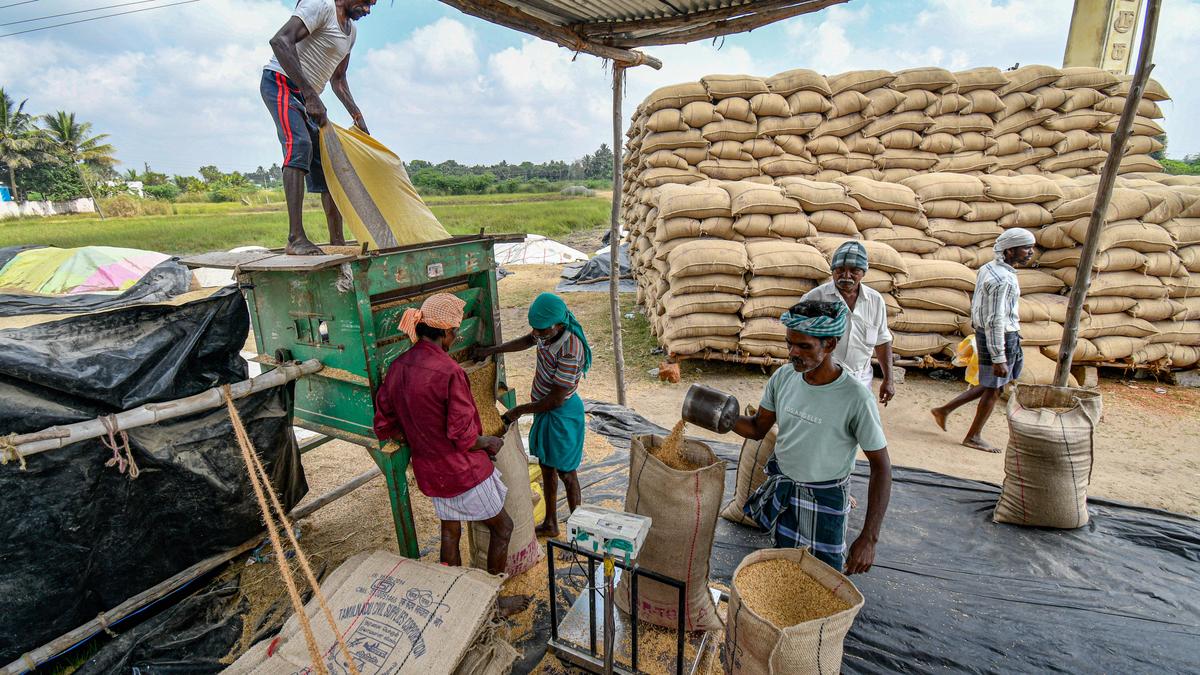
Almost two decades since the National Commission on Farmers, headed by renowned agricultural scientist M.S. Swaminathan, recommended providing 50% profit for farm produce to make farming viable, farmers’ incomes remain a debatable issue.
The issue crops up every election season, with political parties promising better procurement prices by increasing the incentive given by the State, over and above the minimum support price (MSP) fixed by the Centre, mainly for paddy and sugarcane.
Though farmers’ organisations are divided on various issues this election, with quite a few of them taking a political stand openly — some against the DMK government in the State, and others against the BJP government at the Centre — most of them agree that farm gate prices remain the primary concern of the average farmer, both in the Cauvery delta and in non-delta regions.
“Agriculture is increasingly non-remunerative and not a rewarding profession. The price factor is one of the main issues here,” observes Arupathy P. Kalyanam, general secretary of the Federation of Farmers’ Associations in the Cauvery Delta Districts.
The M.S. Swaminathan Commission had recommended a formula for calculating the minimum support price — C2 + 50% (50% more than the weighted average cost of production, classified as C2 by the Commission for Agricultural Costs and Prices). “The Commission gave its recommendations in 2006; we are yet to reap the benefits,” rues P. Ayyakannu, president, Desiya Thennindiya Nadigal Innaippu Vivasayigal Sangam.
As far as paddy is concerned, both the DMK and the AIADMK have promised to provide ₹3,500 a quintal. “This would work out close to the formula recommended by the Swaminathan Commission. Both the parties have announced ₹4,500 per tonne of sugar cane. But implementation is the key here – the DMK implemented its previous election promise [of providing ₹2,500 a quintal] after four years. Farmers expect the price to be offered soon after a new regime takes over,” Mr. Kalyanam says.
Taking a critical view of the DMK government’s policies, P.R. Pandian, president, Coordination Committee of All Farmers’ Associations of Tamil Nadu, contends that even the ₹2,500 for paddy came about due to the annual increase of about ₹100 in the MSP by the Centre. “The DMK promised to procure and fix the price of horticulture crops by forming district-level committees; they have not fulfilled this and several other promises. Farmers in several districts, including mango and tomato growers, continue to be severely affected by the crash in the farm gate prices of their produce,” he says.
Legal guarantee for MSP and the implementation of the M.S. Swaminathan Commission’s recommendations in full were the top two demands raised at a meeting of leaders of various farmers’ associations, chaired by Mr. Pandian in Tiruchi recently.
The Tamil Nadu Vivasaya Sangankalin Kootamaippu, a federation of a group of associations led by Cauvery Dhanapalan, too has demanded legal protection for the prices of 23 varieties of farm produce, including paddy, sugar cane, copra and milk.
Crash in prices
In recent months, farmers in rain-fed areas in Perambalur and Tiruchi were hit hard by the crash in the price of maize to well below the MSP fixed by the Commission for Agricultural Costs and Prices (CACP).
“There is no mechanism to enforce the MSP in the absence of government procurement. While the CACP’s MSP for maize was ₹2,400 a quintal for the 2025-26 kharif season, traders were offering less than ₹1,800. The previous year’s good prices had enticed more farmers to raise the crop during the season,” says R. Raja Chidambaram, State Secretary, Tamizhaga Vivasayigal Sangam.
Price fluctuations are a perennial problem faced by small onion growers too. “Often, the farm gate price is ₹10 a kg while the shallots are sold at ₹40 a kg at the markets. Farmers are not able to fix the price of their produce; but traders and intermediaries make profits at their expense,” he contends.
However, a veteran farmers’ leader from Karur district and president of Cauvery Irrigation Farmers’ Welfare Association, Mahadhanapuram V. Rajaram, feels that reducing the crises in the agriculture sector to the price factor alone would be a “simplistic approach”.
“We should move towards making agriculture an industry through mechanisation and value-addition. Marketing should be done professionally. The sector should be able to provide white-collar jobs to attract educated youth, and for this, we need mechanisation, food processing and value-addition units and active farmers-producers groups at the village level,” he says.
Published - April 09, 2026 10:40 pm IST