





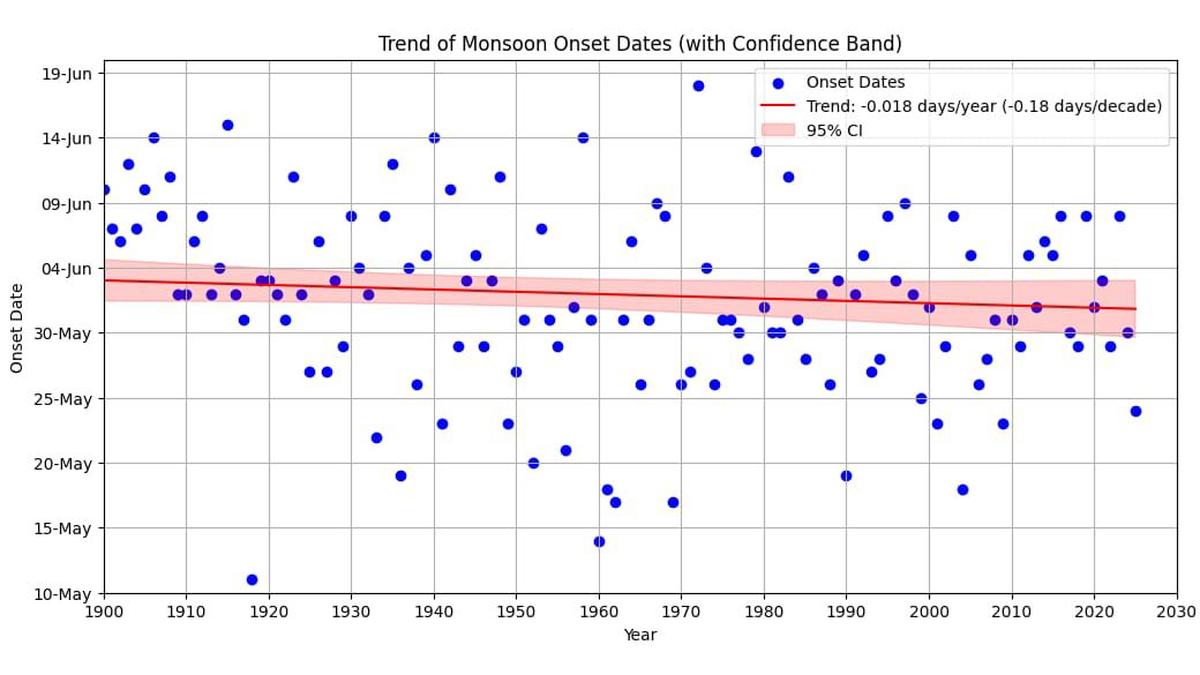
Although June 1 is traditionally considered the beginning of the rainy season in Kerala, an analysis of southwest monsoon onset data from 1901 to 2025 reveals that the monsoon has predominantly advanced to May in recent decades due to various factors, including global warming. Furthermore, Kerala is experiencing a paradox: while overall rainfall is declining, isolated extreme downpours are becoming more intense, especially in parts of central and northern Kerala adjacent to the Western Ghats, increasing the risk of floods.
A paper titled ‘Analysis of Temporal and Spatial Variations in Extreme Precipitation over Kerala,’ published in the Journal of Agrometeorology by a group of researchers headed by P.S. Biju, a senior scientist at the India Meteorology Department (IMD), Thiruvananthapuram, along with Raji Pushpalatha of Amrita Vishwa Vidyapeetham and researchers from the National Institute of Technology, Patna, and the Indian Institute of Space Science and Technology, sheds light on how rainfall patterns, monsoon behaviour, and extreme precipitation events have changed across Kerala over a 124-year period using high-resolution daily rainfall data from the IMD.
According to the study, the southwest monsoon onset occurs on average around June 1, with a standard deviation of roughly six days. However, the onset has predominantly advanced to May, especially in recent decades. According to IMD data, from 1901 to 2025, the onset occurred in May 57 times, while it occurred in June 68 times. Considering all available data from 1870 to 2025 (156 years), the onset occurred in May 70 times, while in the remaining 86 years it occurred in June.
Monsoon rain down
After the year 2000, the onset occurred in May 14 times, indicating that early onset of the southwest monsoon may become more common due to climate change. Southwest monsoon rainfall is also witnessing a decreasing trend in Kerala at a rate of 26 cm per decade, although the total number of rainfall days is increasing and severe weather events are rising across central Kerala and the Western Ghats regions of northern Kerala. However, coastal Kerala is showing a decrease in severe weather events like extreme rainfall, according to the study.

The highly exposed regions in Kerala to extreme rainfall events
According to Mr. Biju, the onset is gradually shifting towards May due to global warming associated with climate change. Summer temperatures may rise in future, potentially causing the early development of low-pressure systems over land. The monsoon winds, which blow from high-pressure cells near Madagascar, move towards low-pressure systems over land after crossing the equator. Global warming causes the earlier development of low-pressure systems over land, along with changes in the monsoon trough and heat lows. This is one of the main reasons for the earlier onset of monsoon, Mr. Biju said.
Summer rain up
Average annual rainfall across the State was reported at around 2,920 mm, with substantial spatial variation. The northeast monsoon also exhibited decreasing trends. However, summer rainfall showed a slight increase. Variations in rainfall across Kerala are mainly due to its topography, especially the influence of the Western Ghats. Northern Kerala receives the highest southwest monsoon rainfall, around 2,300–3,000 mm, while rainfall decreases towards central and southern districts. Some southern regions record less than 1,500 mm during the southwest monsoon. On the other hand, northeast monsoon rainfall is more concentrated in southern Kerala.
The changing trends also point to an urgent need for district-specific climate adaptation strategies in Kerala, improved flood management, better water storage systems, and climate-resilient agricultural planning to help cope with the State’s changing rainfall patterns, according to the paper.
Published - May 25, 2026 08:17 pm IST