









Sperm whales communicate using short sequences of clicks known as codas, which they exchange while coordinating within their groups. Scientists have long classified these sequences using the number of clicks and the timing between them.
Scientists document remarkable sperm whale ‘phonetic alphabet’
A study published on April 15 in Proceedings of the Royal Society B has however reported that there’s more to it than meets the ears: the codas also vary in their acoustic structure in ways that resemble patterns found in human speech.
“Before this work, sperm whale vocalisations were often treated as a kind of Morse code — simply patterns defined mainly by timing,” Gasper Beguš, associate professor of linguistics at University of California, Berkeley, and senior author of the study, said. “What we’re showing here is that there’s another layer of structure within the clicks themselves.”
Also Read | Latest environment news
Until now, classification relied on two measurable features: the number of clicks in a sequence and the spacing between them, known as inter-click intervals. These patterns produce distinct coda types. For example, a 1+1+3 coda consists of two clicks separated by pauses, followed by three clicks in rapid succession, while a 5R coda contains five evenly spaced clicks. Because different whale groups use different sets of these patterns, the system is unlikely to be entirely inborn. Instead, scientists think at least part of it is learnt within groups.
When the researchers broke each click down into its frequency components, they found that the sounds fall into two distinct categories: some have a single dominant frequency peak, while others have two. In human linguistics, such peaks are known as formants—the resonant frequencies that allow us to distinguish an “ah” sound from an “ee.” Consequently, the authors label these whale categories “a” and “i.” These two types are clearly distinct, and the same pattern of clicks—for example, a 1+1+3 coda—can be produced using either the “a” click or “i” click.
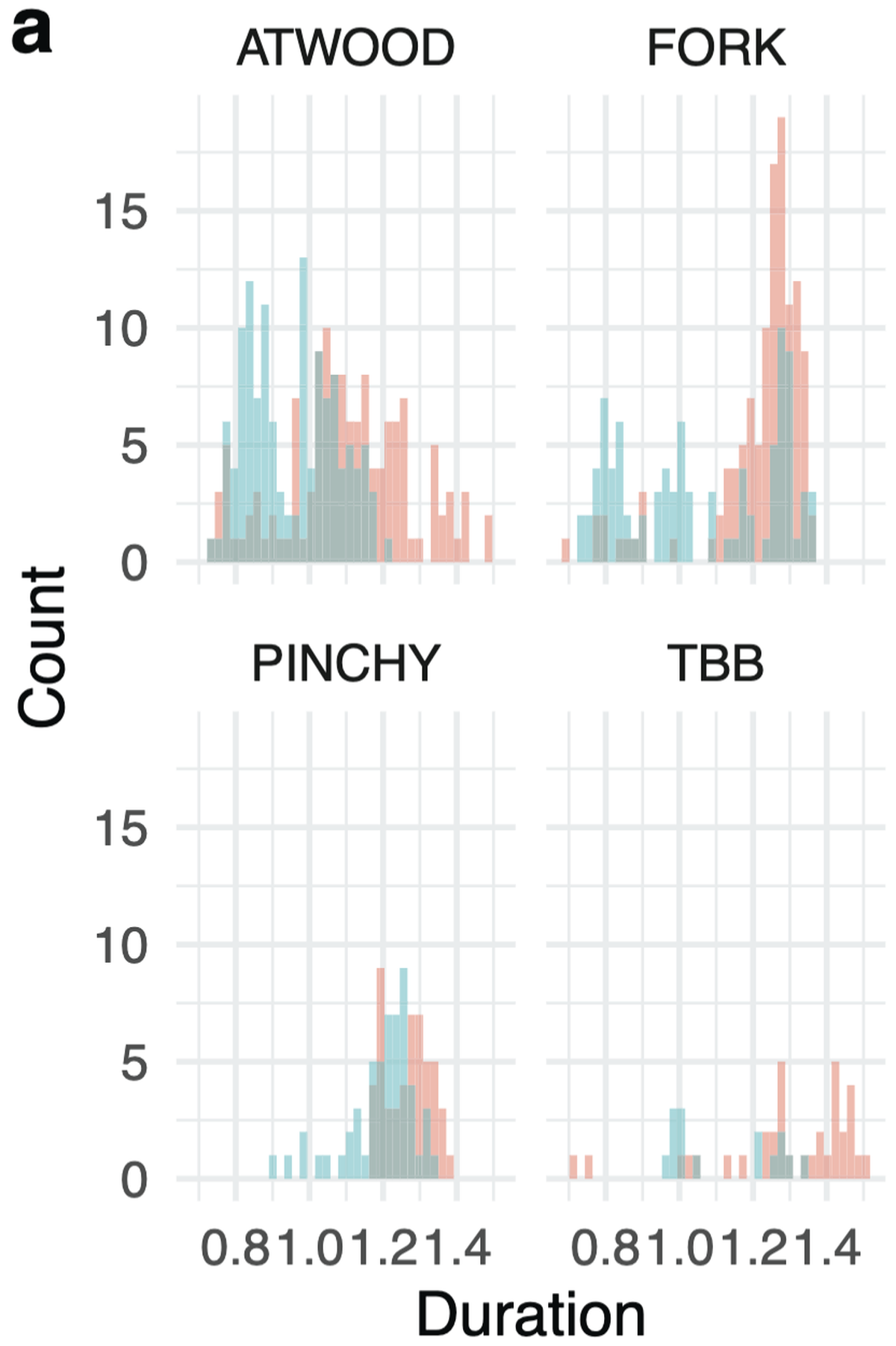
A histogram of the raw coda durations (in seconds) of 1+1+3 coda for four whales named ‘Atwood’, ‘Ford’, ‘Pinchy’, and ‘TBB’. | Photo Credit: Beguš et al. 2026 The phonology of sperm whale coda vowels. Proc. R. Soc. B 293: 20252994
Calling it a “fascinating finding,” Mason Youngblood, a behavioural scientist at Stony Brook University, said the study shows that sperm whale communication “varies not just in timing but also in tonal quality,” in ways similar to human vowels, suggesting the “signals may be able to convey more information than previously thought.”
The two click types are not used in the same way across all codas. In some, such as the 1+1+3 pattern, both appear in roughly equal numbers. In others, one dominates, and in a few it is almost absent. If click type were simply a side effect of sound production, this variation would be random. Instead, the patterns are consistent, suggesting that sperm whales control not just when they click, but also what kind of click they produce—treating timing and type as two separate features of their signals.
The researchers also identified several additional layers of variation in how codas are produced.
Codas in the two click types differ in length. Even when the pattern of spacing between clicks is the same, “a” codas are typically longer than “i” codas. In addition, the “i” category splits into two groups—some codas are short, while others are long—whereas the “a” category does not. This is similar to how the length of a sound can matter in human speech, where longer and shorter vowels can serve different functions.
They also found consistent differences between individual sperm whales. Even within the same coda pattern and click type, some whales produce longer sequences than others. For example, the length of an “a” coda can differ by about 170 milliseconds between individuals. Despite this, “a” codas are still longer than “i” codas across all sperm whales, showing that while whales may sound different from one another, they follow the same underlying patterns.
Finally, they found that one coda can influence the next. Most codas consist of a single click type, but in a few cases, the first click is different from the rest—for example, a coda made up of “i”-type clicks may begin with a single “a”-type click. These mismatches occur most often when whales switch from one type of coda to another. This suggests that the first click of a coda is affected by the coda that came before it, showing that codas aren’t produced in isolation—the previous one can shape how the next begins.
The results show that sperm whale vocalisations show clear parallels with human phonology—the system of rules that organises sound patterns in human language through combinations of discrete sound categories, timing, and position. Prof. Beguš, provides a hypothesis of convergent evolution playing out over grand timescales to explain the observations. “Humans and whales diverged tens of millions of years ago, but both evolved complex vocal systems that show striking structural parallels.”
Dr. Youngblood added that the rich social and cultural lives of sperm whales relies heavily on communication withing their family and clan groups. He believes this might support such a complexity in whale phonology. At the same time, he cautioned that one must not be quick to call it a language just yet.
“There are clear similarities, but also important differences,” Dr. Youngblood said. “The fundamentally rhythmic nature of sperm whale codas, for example, sets them apart from human speech.”
What these patterns mean remains unknown. The study does not identify what information codas convey or whether different patterns correspond to specific contexts. What it does show is that sperm whale communication is built from multiple features that can vary independently and in relation to one another—a level of organisation that is uncommon in animal communication systems.
“Determining whether these patterns map onto specific meanings will require much more work,” said Dr. Youngblood. “I know these are the goals of Project CETI, and I’m really looking forward to seeing what comes next.”
Anirban Mukhopadhyay is a geneticist by training and science communicator from New Delhi.
此内容由惯性聚合(RSS阅读器)自动聚合整理,仅供阅读参考。 原文来自 — 版权归原作者所有。