



惯性聚合 高效追踪和阅读你感兴趣的博客、新闻、科技资讯
阅读原文 在惯性聚合中打开

推荐订阅源

S
Secure Thoughts
Recent Commits to openclaw:main
H
Heimdal Security Blog
SecWiki News
SecWiki News
H
Hacker News: Front Page
N
News | PayPal Newsroom
L
LINUX DO - 最新话题
N
News and Events Feed by Topic
TaoSecurity Blog
TaoSecurity Blog
AI
AI
C
Cybersecurity and Infrastructure Security Agency CISA
Scott Helme
Scott Helme
PCI Perspectives
PCI Perspectives
S
Securelist
Exploit-DB.com RSS Feed
Cyberwarzone
Cyberwarzone
A
Arctic Wolf
Forbes - Security
Forbes - Security
T
Tor Project blog
Spread Privacy
Spread Privacy
WordPress大学
WordPress大学
I
Intezer
Martin Fowler
Martin Fowler
Help Net Security
Help Net Security
P
Proofpoint News Feed
让小产品的独立变现更简单 - ezindie.com
Cisco Talos Blog
Cisco Talos Blog
Latest news
Latest news
博客园 - 司徒正美
W
WeLiveSecurity
奇客Solidot–传递最新科技情报
奇客Solidot–传递最新科技情报
V
V2EX
P
Palo Alto Networks Blog
Google DeepMind News
IT之家
IT之家
阮一峰的网络日志
阮一峰的网络日志
V
Vulnerabilities – Threatpost
Jina AI
Jina AI
S
Security Affairs
Hacker News - Newest:
Hacker News - Newest: "LLM"
Simon Willison's Weblog
Project Zero
Project Zero
T
Threatpost
P
Privacy International News Feed
人人都是产品经理
人人都是产品经理
cs.CL updates on arXiv.org
Application and Cybersecurity Blog
博客园 - Franky
Hugging Face - Blog
Hugging Face - Blog
Apple Machine Learning Research

The Hindu: Latest News today from India and the World, Breaking news, Top Headlines and Trending News Videos.

U.K. pauses its plan to cede Chagos Islands after U.S. opposition Driver jailed for 7 days for driving sleeper bus in drunken condition Kim Jong Un supports China’s “multipolar world” vision during talks with Wang Yi Uttar Pradesh boat tragedy: Punjab town mourns deaths Relief for Bengaluru commuters as Silk Board flyover set to open fully, but inspection by BTP reveals likely bottleneck Repolling underway at booth of Karimganj North Assembly seat in Assam PM Modi interacts with Rahul Gandhi as leaders gather to pay tribute to Mahatma Jyotiba Phule Anil Kapoor’s ‘24’ set to release on OTT Vance, Iranian delegation arrives in Islamabad for U.S. talks amid ceasefire hopes Fire at Hyderabad’s Chintal Basti apartment, 17 residents evacuated safely Centre nudges States to view farm solarisation as a route to wiping off ₹2.4 lakh crore subsidy bill Why voter turnout hit record highs in Assam, Kerala & Puducherry Strait of Hormuz to be open “fairly soon”, says Trump ‘Jana Nayagan’ leak tests new legal penalties, torrent downloads under scanner Vijay’s ‘Jana Nayagan’ controversy explained: From legal battles to piracy chaos HYDRAA brings down guest house and other structures at Ameenpur Row erupts over removal of Ambedkar statue at midnight in Secunderabad Cantonment area Nitish may resign as Bihar CM on April 13; son Nishant likely to become one of two JD(U) Dy CMs Police open fire on youth while he was trying to flee Struggling CSK look to snap their losing streak | Vidyut Sivaramakrishnan ED raids former Trinamool Minister Partha Chatterjee’s residence Karnataka’s Gruha Jyothi scheme dimmed the scope of PM’s Surya Ghar Muft Bijli Yojana: KRESMA After Artemis II, NASA looks to SpaceX, Blue Origin for Moon landings Ayush Shetty storms into Badminton Asia Championships final Scholarships: April 11, 2026 Andhra Pradesh’s Socio-Economic Survey missing in recent Budget Session; efforts underway Inside Péro’s fun office Penciljam sessions in Bengaluru help hone artistic talent Watch: The mistake killing high-concept films | Escalation without calibration | FMM 19 Tamil Nadu Assembly election 2026: DMK demands reinstatement of N. Muruganandam as Chief Secretary Kerala Assembly election | Heavy turnout sparks political calculations in Tripunithura’s triangular contest Apple at 50: A loyalist on the brand’s evolution in India Reiterated demand for Hasina extradition with India: Bangladesh Foreign Minister Rahman Phule left a lasting legacy of social reform and inclusion, says President Murmu Trump congratulates returned Artemis astronauts, says ‘next step, Mars!’ Voters' lists in 12 States, Union Territories shrink by over 6 crore post SIR 4.7 magnitude earthquake jolts Maharashtra’s Hingoli district, no casualties Teams led by CSIR women scientists report advances in research on depression mechanisms in females Gap between rich and poor nations growing even wider: U.N. report Russia and Ukraine set to begin Easter truce Minimum temperature continues to rise in Delhi; AQI 'moderate' IPL 2026 | Suryavanshi on tackling Bumrah, Hazlewood: ‘I look at the ball not the bowler’ Iranian delegation reaches Islamabad for peace talks with U.S. as world waits for deal to end conflict Trump shares video of brutal Florida killing allegedly by Haitian immigrant Bihar man sought money from foreign agency for threatening PM Modi’s security, arrested: Police 14 injured as Hyderabad–Eluru bus rams lorry on NH-65 flyover in Kodad Assembly Elections 2026 highlights: BJP tried to invalidate my candidature in Bhabanipur, says Mamata At DEL in Roseate House Aerocity, a robot joins the service team Prince Harry sued for defamation by charity he set up in Africa to honour his mother Princess Diana North Korean leader Kim backs China’s push for multipolar world in talks with Foreign Minister Jio-bp not to raise petrol and diesel prices Ten Indian nationals indicted in U.S. for visa fraud conspiracy In Pictures | Artemis II's voyage to the moon and back The Hindu Morning Digest: April 11, 2026 British Airways ramps up services to India for summer Focus on innovation and entrepreneurship in farm sector through agritech meet in Rajasthan Israel-Iran war updates on April 11, 2026: Iran talks pause after 15-hour negotiation, disagreements remain India in final stages of formulating processing value chain for critical minerals: Mines Secretary ‘A perfect mission’: Artemis II astronauts return to Earth India, U.S. to deepen nuclear ties, explore LPG exports Induction-based cooking to add 13-27 GW of energy requirements: Official In Assam, first evicted, now erased Absorbed uptick in price of ammonium nitrate, diesel to shield prices: Coal India Trump says U.S. will have Strait of Hormuz 'open fairly soon' Political slugfest between Congress-BJP in Haryana over crop procurement World Earth Day 2026: Why India must define its own green factory standards now Tamil Nadu election 2026: In Thiruvaiyaru constituency, all parties sing the same tune during polls BSF jawan killed in unprovoked firing in Manipur’s Ukhrul Discontinue Ladki Bahin if government doesn’t have funds for pension: Bombay HC Tamil Nadu Assembly election 2026: Arun shifted, Modak appointed Chennai Police Commissioner An alternative proposal on Viksit Bharat Shiksha Adhisthan Bill Lebanon says first contact with Israel held ahead of U.S.-brokered talks At ICA conference, CJI Surya Kant underscores arbitration’s role in global economy Students to get textbooks by April 20: Sood 14 lakh tons of silt cleared, half of desilting work complete: Delhi Minister Parvesh JNU considers 5% admission quota for employees’ children Bolstering deterrence through submarine dominance Braving heat, leaders hit the streets in Chennai city as poll battle intensifies Turning up: The Hindu Editorial on high turnout in Kerala, Assam, Puducherry polls Beyond the marks: How II PU toppers overcame challenges Rebuilding ties: The Hindu Editorial on India engaging with Turkiye and Azerbaijan Fake call centre duping buyers of weight-loss products busted, 11 arrested Artemis II: how NASA scientist, senior official Amit Kshatriya helped U.S. moon mission I am enduring pain fighting the party I built brick by brick: PMK founder S. Ramadoss Tamil Nadu election 2026: a high-profile contest brews in Mylapore constituency A ‘nova’ for these women to shine bright Welfare measures for the marginalised take centre stage in Bengal’s Jhargram BFC holds all the aces in Blasters clash Kerala Assembly polls 2026: UDF expects sweep as LDF, NDA seek gains in Ernakulam 10 killed as overcrowded boat capsizes in Yamuna Vijay’s ‘Jana Nayagan’ leaked online: Rajinikanth, Kamal Haasan, Chiranjeevi slam piracy In Chennai, Sumanasa Foundation’s Art Unfettered platforms five artistes who are pushing boundaries 15-year-old missing girl from Kerala found dead in Chikkamagaluru Iran-Israel war updates on April 10, 2026: Trump says Strait of Hormuz will open 'fairly soon' From hiding to hope: Bastar and its surrendered Maoists What does the Jan Vishwas Bill do? | Explained India, Bangladesh share ‘warm and historic ties’: MEA Interview with Anirudhya Mitra, author of The Delhi Directive, a spy thriller Tamil Nadu election 2026: Ambattur constituency residents demand GH, sewer network, wider roads A peek at India’s athleisure boom
The discoverers of radio emissions from Jupiter
2026-04-17 · via The Hindu: Latest News today from India and the World, Breaking news, Top Headlines and Trending News Videos.

Does Jupiter have a “voice”?

When we say discovery of Jupiter’s “voice”, it corresponds to the discovery that the planet Jupiter is a strong source of radio waves. This discovery was made in the 1950s by two scientists at the Carnegie Institution in Washington D.C. – Bernard F. Burke and Kenneth Linn Franklin – when the idea of using radio for astronomical research was still relatively new. 

By the time Burke and Franklin got together for their work, astronomers were privy to the fact that several sources in the sky emitted radio waves. With receivers in the rural 96-acre Mills Cross field near Washington, the duo set out to map the northern sky using their radio antenna array. 

In order to test how their array was working, they picked Crab Nebula – a supernova remnant and pulsar wind nebula – in the constellation of Taurus. The tests went well and with the passing weeks, they progressively changed the pointing direction towards the south. 

When there were some aberrations that they couldn’t identify, they initially suspected terrestrial interference, probably from a passing vehicle. But by observing it more carefully over the nights that followed and noticing that it not only occurred around the same time period, but was also consistently occurring four minutes earlier each night, they realised it had to be a celestial object. 

Once they had a few more months of data, they could rule out stars as the source of the radio emissions didn’t move like those that come from stars. This not only eliminated stars, but also nebula or galaxy as they all move across the sky at about the same rate. 

Finding that the object that happened to be near Crab Nebula in the sky was Jupiter and checking its rate of movement to match with the data they had, the duo were able to zero in on Jupiter. On April 5-6, 1955, Burke and Franklin announced their discovery at a meeting of the American Astronomical Society. A lot of noise followed as it was the first ever noise to have been identified as coming from a specific planet.  

How has it helped?

The detection of the first non-thermal radio noise from a planet provided astronomers and scientists a new tool for exploring the solar system. Immediately after the announcement, in fact, astronomers went back to their own existing data, to see if they had a match as well. 

Australian radio astronomer Charles Alexander Shain was actually able to recognise Jovian radio bursts in his own data set. Looking back following the announcement in 1955, Shain found observations he had taken five years earlier to correspond to radio emissions from Jupiter. This meant that immediately after the discovery, there was already five years worth of data to begin work with. Another 70-plus years worth of data has since been added to this repository. 

As far as Jupiter is concerned, the bursts of radio emissions served as the first evidence for a Jovian magnetic field. Most radio waves from Jupiter are polarised, implying that wherever these waves were originating from, there’s a magnetic field present.

The radio emissions observed by Burke and Franklin were in the form of noise bursts with peak intensities so great that Jupiter is the most prominent source in the sky at this wavelength, behind only the sun. These emissions are called decametre radiation, based on the characteristic wavelength. 

Subsequent observations were at shorter wavelengths, revealing that the solar system’s biggest planet is also a source of steady radio emissions. These are called decimetre radiation, again, based on the characteristic wavelength.

Here’s more about the two men who made the discovery:

Burke’s baseline

Born in Brighton, Massachusetts, U.S. on June 7, 1928, Bernard F. Burke enjoyed maths from a rather young age. This didn’t surprise those around him as his mother Clare was a typist who worked with statistics and therefore came up with her own method to type complex maths formulae manually, and his father Vincent was the head of the maths department at a high school. 

Interest for what lay beyond was also evident from an early age as he purchased a large piece of glass along with a friend at the age of 16 with the objective of grinding it into a telescope’s lens. 

After graduating from high school, Burke received a full scholarship to study the violin. He turned it down and decided to study at the Massachusetts Institute of Technology (MIT). Studying physics and astrophysics, Burke received his PhD in 1953, 

Following his PhD, Burke joined the Carnegie Institution of Washington’s Department of Terrestrial Magnetism (DTM) and it was during his time here that he co-discovered radio noise from Jupiter in 1955. He was at DTM for another decade, before heading back to MIT in 1965 as a professor of physics. 
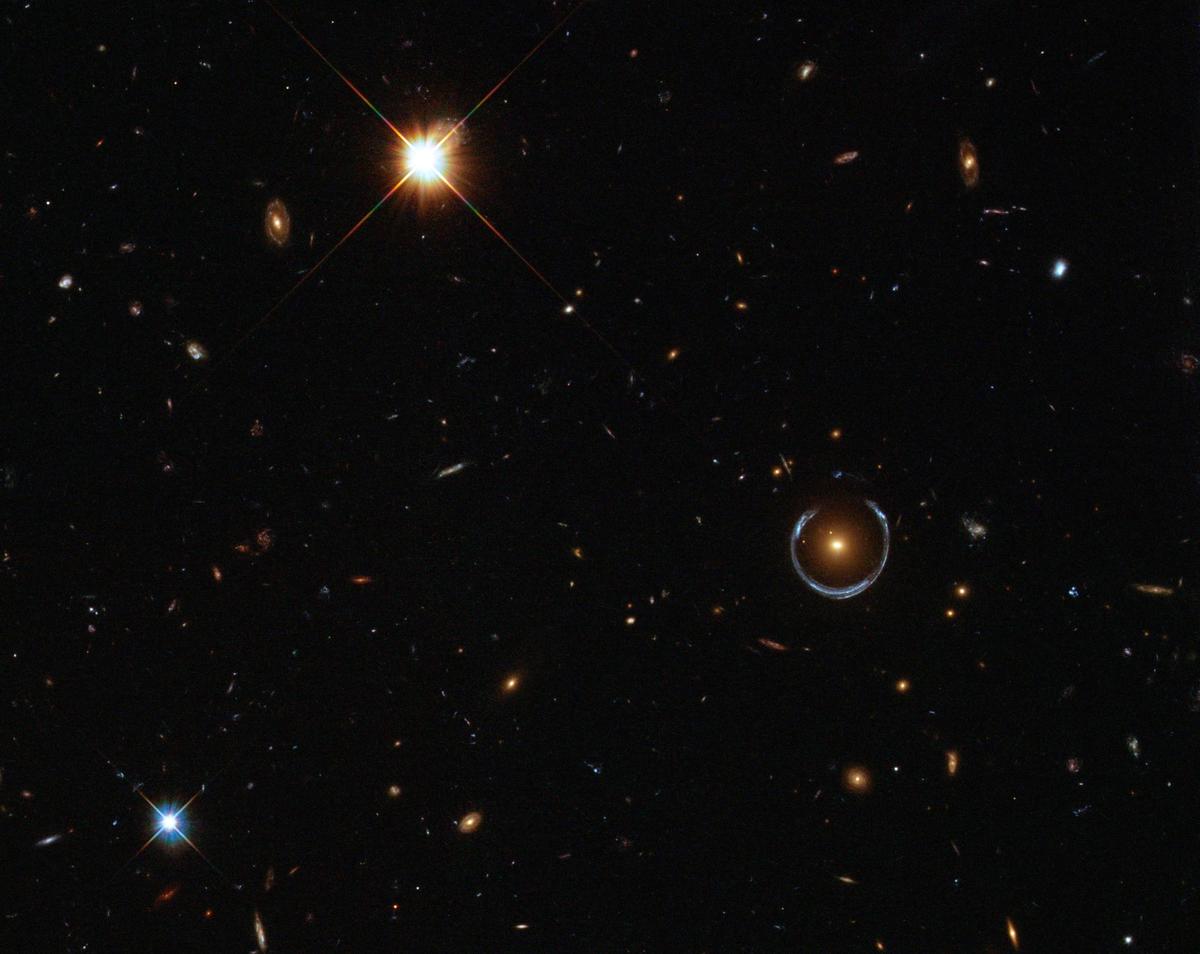
The blue horseshoe shape that circumscribes the red galaxy is the real prize in this image - an Einstein ring. This blue horseshoe is a distant galaxy that has been magnified and warped into a nearly complete ring by the strong gravitational pull of the massive foreground Luminous Red Galaxy.

The blue horseshoe shape that circumscribes the red galaxy is the real prize in this image - an Einstein ring. This blue horseshoe is a distant galaxy that has been magnified and warped into a nearly complete ring by the strong gravitational pull of the massive foreground Luminous Red Galaxy. | Photo Credit: ESA/HUBBLE & NASA

Once in MIT, his work shifted, focussing on the detection of gravitational lensing and in the development of Very Long Baseline Interferometry (VLBI). In 1988, he discovered what is considered the first Einstein ring. A rare astronomical phenomenon predicted by theoretical physicist Albert Einstein’s theory of relativity, Einstein ring is the deformation of light in the form of a ring due to gravitational lensing around a massive cosmic object. 

In addition to his own research, Burke was also well-respected as a professor, challenging students both on and off campus. He passed away on August 5, 2018, aged 90. 

Facts about Franklin

Kenneth Linn Franklin was born in Alameda, California, U.S. on March 25, 1923. Franklin set his sights at the distance much earlier than most as one of his earliest memories was looking up at the moon and asking his mother what it was. He never got his answer then as his mother was blind. It left him seeking answers and explaining astronomical phenomena as best he could for a lifetime. 

After earning his doctorate in astronomy from the University of California, Berkeley, Franklin joined DTM. Along with Burke, Franklin detected Jupiter’s “voice” in 1955 and went on to accept an astronomer’s position at the Hayden Planetarium the following year. 

In addition to studying astronomical phenomena, Franklin became an expert communicating these as he had a talent for putting the right things in focus. This helped not just those around him, but also the journalists, who often quoted him. He provided astronomical information to The New York Times for years, including the hour of sunrise and sunset, and served as a consultant for Scientific American, and television networks NBC and CBS.

It wasn’t just the times on Earth that he was good at, as is evident from the fact that he invented a watch for moon walkers in 1970. With moon missions on the rise then, Franklin’s watch measured time on the moon based on lunations – a lunar month of 29.53 Earth days during which the moon completes a full cycle of phases. While the watch never really caught on, his methodology for calculating time there is very close to the solutions thought off in the current decade when interest in moon missions is again on the rise.  

Apart from being a popular lecturer, Franklin also produced his own radio programme. He never missed a chance to encourage his students to analyse radio waves coming from Jupiter, striving to kindle curiosity as an educator. He passed away on June 18, 2007, aged 84.