









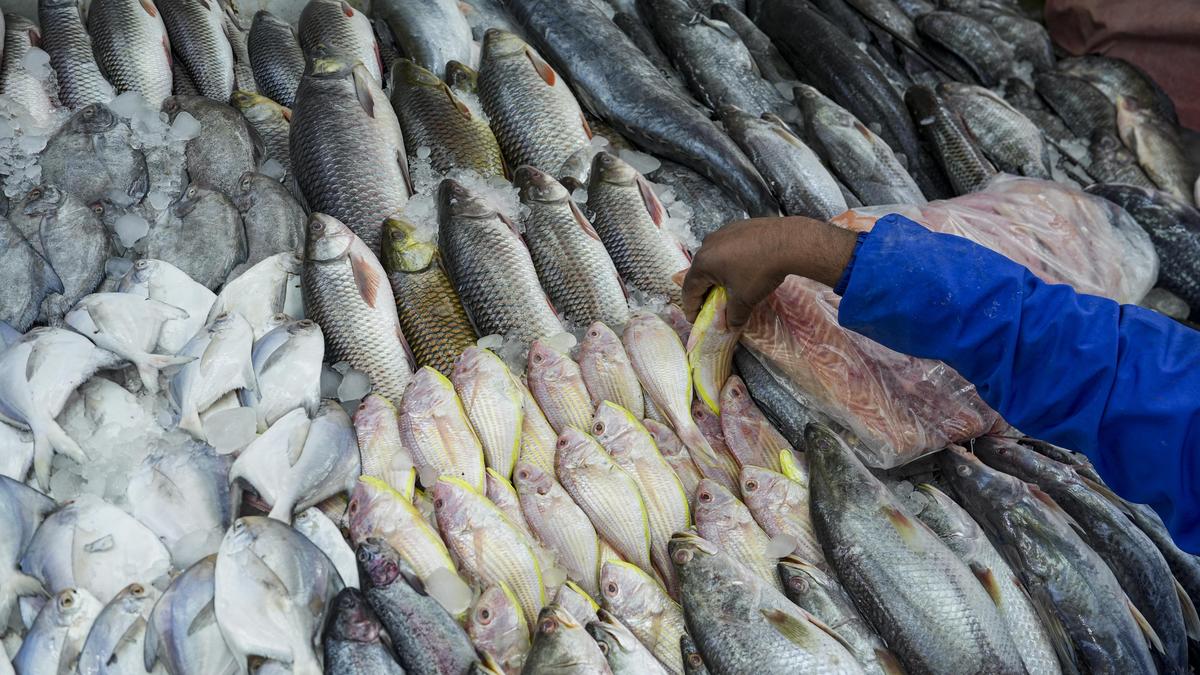
Budget 2026-27 highlights undertaking of initiatives for integrated development of fisheries in 500 reservoirs and Amrit Sarovars (ponds developed under Mission Amrit Sarovar) to enhance income of fish farmers. This will also involve strengthening market access by giving support to fish farmer-producer organisations and cooperatives.
India is the second largest fish producer in the world. Now, it is also the second largest globally in aquacultural production. The country has witnessed a 106% increase in the national fish production since 2013-14 that stands at a record 197.75 lakh tonnes in 2024-25. Interestingly, 75% of our fish production comes from inland fisheries that include freshwater, brackish, and saline water resources. Reservoirs, spread over an area of more than 31.50 lakh hectares, are a major source of freshwater fisheries and aquaculture. Fish production from these water bodies is approximately 18 lakh tonnes.
Located primarily in eastern, central and the peninsular regions, these reservoirs contribute to the livelihood of millions of fish farmers. This is especially true for economically backward and water-scarce regions where they play a crucial role in providing direct/indirect employment and food security through nutrition.
While Madhya Pradesh has the maximum area under reservoirs (approximately six lakh hectares), Tamil Nadu has the highest number of reservoirs at over 8,000. For the purpose of fisheries management, reservoirs are categorised as small (less than 1,000 hectares), medium (up to 5,000 hectares), and large (more than 5,000 hectares).
A key factor in the rise of the country’s fish production is the increase in fish productivity in reservoirs to 100 kg per hectare compared to 50 kg per hectare in 2006. This has been made possible by application of cage culture technology with sufficient stocking of quality seed backed by requisite budgetary support under flagship programmes such as Blue Revolution (BR) and the Pradhan Mantri Matsya Sampada Yojana (PMMSY). While the Indian major carps (Catla, Rohu, Mrigal) form the core species for stocking, need-based stocking of additional species (Tilapia, Pangasius, etc.) in consultation with beneficiaries is provided under the above programmes.
These reservoir cages, floating or stationary, are typically made of synthetic netting or mesh with a structure for support. The mesh allows for natural water flow, ensuring oxygen and nutrient exchange with the surrounding environment. Additionally, these cages are anchored to the bottom or suspended from buoys to maintain their position and depth. This facilitates easier feeding, monitoring, and disease management for the fish species cultured. Further, to promote species diversification, in addition to rectangular cages, circular cages are increasingly being deployed.
Bimal Chandra Oran is a fish farmer from Saraikela district in Jharkhand who has taken up aquaculture for his livelihood in the Chandil reservoir ecosystem. As a member of the Chandil Bandh Visthapit Matsyajibhi Swalambhi Sahkar Samiti (CBVMSS), he set up two cages and was provided subsidised seed and feed inputs. This was followed by a series of capacity-building trainings to upgrade his skills. Over the years, he has cultured Tilapia and Pangasius species through the reservoir cage technology. Backed by marketing support through cooperative society, he has been able to produce three tonnes of fish, thereby achieving an annual turnover of more than ₹3 lakh.
An Indian Council of Agricultural Research (ICAR)-Central Institute of Inland Fisheries (CIFRI) study envisions that aquaculture productivity can go up to 300 kg from the current 100 kg per hectare in such reservoirs. To achieve this potential, experts suggest adopting a value chain approach through the integrated development of these reservoirs. This includes converged setting up of hatcheries, feed mills, storage sheds, ice plants, berthing platforms, auction centres, and marketing retail outlets, and ensuring availability of boats and refrigerated trucks.
To ground the above value chain approach, a cluster-based strategy is being implemented by the National Fisheries Development Board (NFDB) to enhance the competitiveness of the reservoir ecosystem through end-to-end solutions. In line with this strategy, recently a reservoir cluster has been announced for the Halalai and Indra Sagar dams in Madhya Pradesh. The effort will be, first and foremost, to identify sectoral gaps in fisheries production, productivity, and processing capacities within this reservoir ecosystem. Critical, for instance, herein will be the assessment of multiplicity of agencies owning fishing rights, which sometimes poses challenges in data gathering. And without doubt, it will also entail enhancing economies of scale for local fish farmers by their aggregation through cooperatives and fish farmer-producer organisations. Such reservoir clusters will be replicated in other States and Union Territories as well.
In addition, Mission Amrit Sarovar is being implemented with the core vision of conserving surface and underground water in district ponds. A key innovation herein is mapping of user groups for pond management through community participation. Each Amrit Sarovar is designed to have a pondage area of minimum one acre with a holding capacity of 10,000 cubic metres. The Amrit Sarovar at Dine Dite Rijo in Upper Subansiri district of Arunachal Pradesh is a success story of a retention basin that has been successfully used for stocking and aquaculture of ornamental fishes. Tapping fisheries in reservoirs and Amrit Sarovars aligns with the Viksit Bharat@2047 vision to empower fishermen families to thrive and contribute to the nation’s Blue Revolution.
Abhilaksh Likhi is Secretary, Department of Fisheries, Ministry of Fisheries, Animal Husbandry & Dairying, Government of India. Views expressed are personal.
Published - April 13, 2026 02:13 am IST