


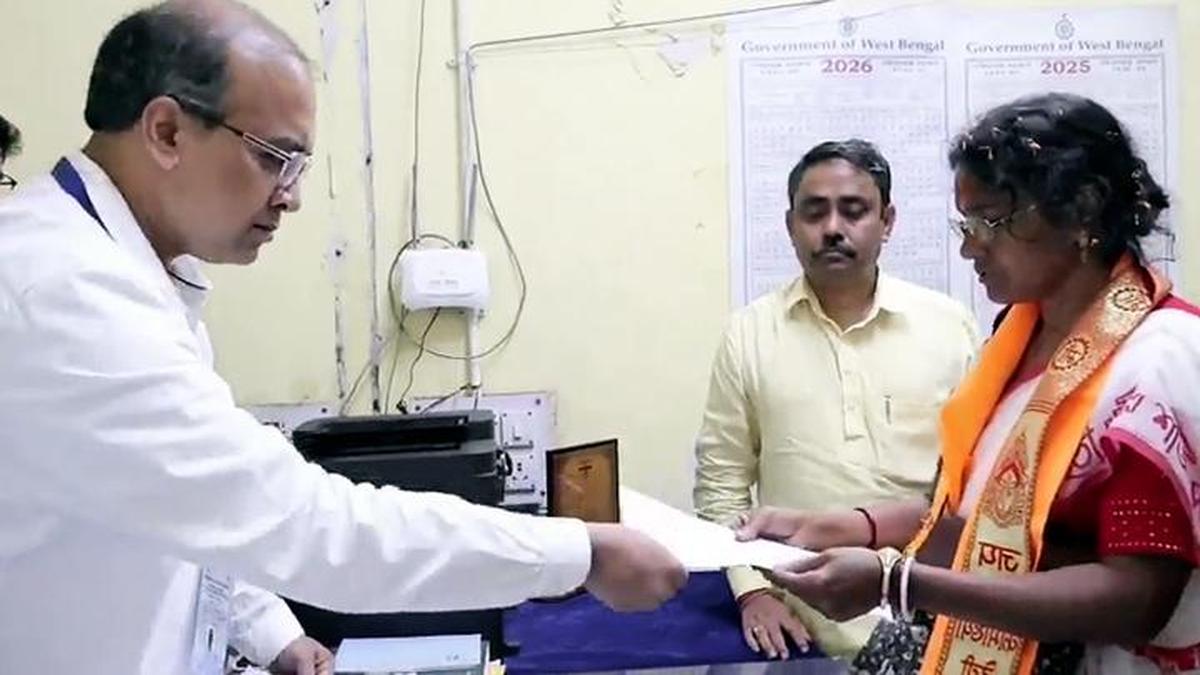
Almost 20 months after the R.G. Kar rape and murder victim, widely known as Abhaya, passed away, her mother, Ratna Debnath, stepped into the political arena to get justice for her daughter. She is fighting the upcoming Assembly elections in West Bengal on a Bharatiya Janata Party (BJP) ticket. Though her candidature has received massive support, especially from women, it has also invited criticism.
On Thursday (April 9, 2026), as she campaigned in the lanes of her Panihati neighbourhood with folded hands, Ms. Debnath, accompanied by her husband, appealed to voters to support her. She blamed the Trinamool Congress government for the R.G. Kar incident.

“The courage she has shown is unparalleled. We are all standing here for a mother to bring justice for her daughter,” senior BJP leader Smriti Irani, who too accompanied Ms. Debnath, said.
As Ms. Debnath made her way into the crowd, mothers hugged her, cried and wiped tears with their saaris. The crowd empathised with her, the sentiment of “it could have been our daughter” echoed through it.
“My first work will be to bring justice for my daughter and not let any other Abhaya happen in this State,” she said.

During one of her door-to-door campaigns, some locals attacked her. Though the protesters did not carry any political banners, they shouted “Joy Bangla” (a popular slogan used by the Trinamool Congress).
“They are very scared of my candidature. They are not happy after killing my daughter. They may think killing me will help because there will be no one left to seek justice for my daughter,” Ms. Debnath said in response.
Civil society reacts
The R.G. Kar movement saw a massive outpouring of support from the civil society with people taking to the streets to seek justice for who they called their ‘daughter’. Though most stood by Ms. Debnath in her journey then, they are wary about her candidature now.
“The R.G. Kar movement was a non-partisan moral assertion against systemic injustice, not an electoral project. The candidature of the victim’s mother from the BJP risks recasting a broad civil society movement into a partisan frame. This also raises serious concerns, given the BJP’s record in cases like the Hathras gang rape case, Unnao rape case, Kathua rape case, and the situation in Manipur, along with its protection of figures like Brij Bhushan Sharan Singh, Kuldeep Singh Sengar, Gurmeet Ram Rahim Singh, Asaram Bapu and those convicted in the Bilkis Bano case,” Subarna Goswami, a senior doctor who was at the forefront of the movement, said.

Though Dr. Goswami said that no one should judge the grieving mother’s choice to join politics, he insisted that the core values of the movement should not be lost to partisan politics and be made an election agenda. Justice, accountability, and systematic reform were the biggest demands of the protests, he said.
One of the regular participants of the many rallies and protests of the movement, Smritiparna Sengupta, said people who claim that Ms. Debnath joining the BJP has made a mockery of the movement do so out of arrogance.
“Even if Abhaya’s mother had been a BJP member that day, the protest wouldn’t become meaningless... We must remember that we did not do the movement as a favour to anyone. Whoever the crime happens to, it’s natural that civilised people will demand justice for it,” she said.
Ms. Sengupta said that though she personally does not endorse someone joining the BJP, no one has experienced Ms. Debnath’s pain and should not judge her choice.

Another active participant in the protests, Sumedha Dey, said a mother seeking justice for her daughter using any means is not wrong, be it politics or movements. However, she questioned if Ms. Debnath joined the party under any political pressure, a sentiment that has been echoed by many others.
“As a mother, she went through a lot. If she were not Abhaya’s mother, no one would have judged her for joining the BJP. It is her constitutional right. We should not be judging her,” Ms. Dey said.
She said that women’s safety and gender issues become part of poll manifestos during every election, with each offering social welfare schemes for women, but added that none of the promises brings real change after the elections.
Published - April 11, 2026 10:22 pm IST