








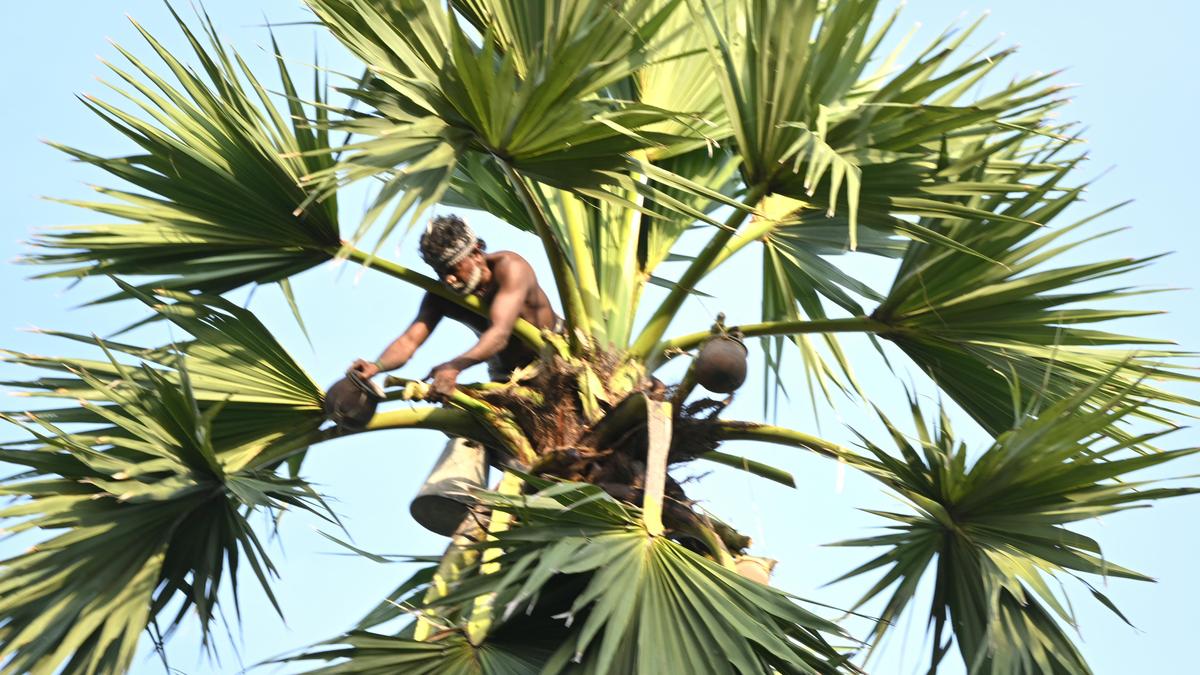
Traditional palm tree climbers and other palmyra based livelihoods in Thoothukudi district are under strain due to unpredictable weather conditions, lack of modernised storage and growing shift of workers to other occupations.
The district is known for its Udangudi ‘karuppatti’ (palm jaggery),which officially holds a GI tag as well as the widely recognised Vembar ‘karuppatti’. Several parts of the district especially Anthoniyarpuram, Vembar, Vilathikulam and Udangudi have comparatively higher proportion of palm tree climbers and people dependent on palmyra-based livelihoods. However the number of climbers and people depending on palm trees is steadily decreasing due to uncertain income and lack of assistance, both in terms of marketing facilities and financial assistances.
Paulraj, a palm tree climber from Vilathikulam said that he has been in the business for the past 40 years, but still struggles to maintain a stable livelihood. He added that the climbers have work only about six months, which covers peak summer season, while for the remaining months they depend on loans from traders often at an interest rate of two paise.
“When the season starts, traders purchase palm jaggery from us and deduct the amount we borrowed. This often leaves us with little profit and mostly no profit at all,” Mr. Paulraj claimed.
He noted that although there are few associations for palm tree climbers, they have not taken any major steps for the welfare of climbers.
Arasakumar, a private firm employee from Vembar said he had witnessed the struggles faced by his family members who worked as palm tree climbers. “I have seen my family members struggle to meet demands of daily life,” he stated.
He pointed out many climbers fall into the cycle of borrowing money and repaying it through the sale of palm jaggery. Mr. Arasakumar stressed that, similar to fishermen and salt pan workers, the palm tree climbers should be provided with relief assistance during off-season.
He also highlighted the need of immediate financial assistance to the climbers who suffer injuries after falling from a tree or experiencing long-term physical ailments caused by the nature of their work.
Mr. Arsakumar further emphasised that unpredictable weather conditions have significantly affected ‘padhanner’ and palm jaggery production.
“About 15 years ago a single tree would yield six to seven litres. Today the yield has fallen to just two-three liters because of changing weather patterns,” he said.
Francis Xavier, a palm jaggery trader from Vembar, echoed the similar concerns over the declining production of palm jaggery and palm candy (panagkarkandu). He added that there is no storage facility in the district to preserve palm jaggery, forcing producers to sell their stock within the season.
The absence of job security and the risks associated with palm climbing have also discouraged younger generations from entering the profession. Many youngsters in the region now prefer alternative occupations with stable income and less riskier jobs.
For a region deeply rooted in palmyra cultivation and palm-based livelihoods, many workers believe stronger associations and a proper welfare board are essential. These workers continue to play a significant role in the district’s rural economy and many are demanding better welfare measures, financial support and marketing infrastructure to sustain their traditional occupation.
Published - May 31, 2026 09:11 pm IST