








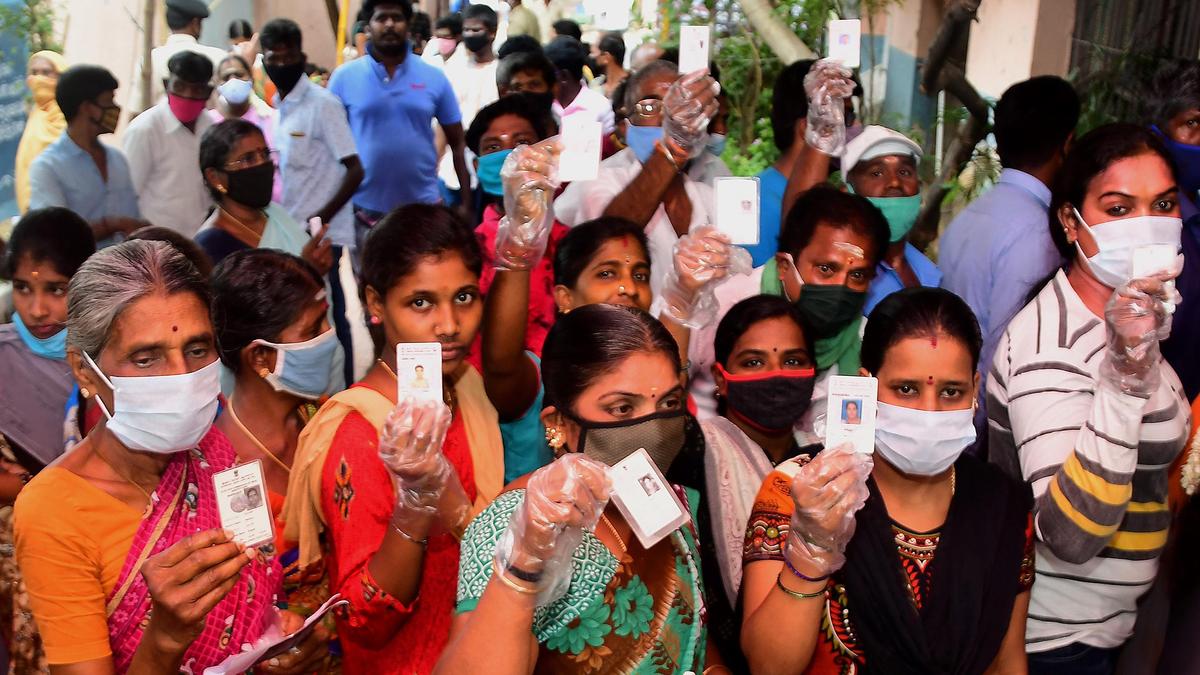
For over two decades, Chennai, the State capital, has trailed the rest of Tamil Nadu in voter turnout. In the 2021 Assembly election, about 61.48% of the city’s electorate turned out, while the State average was close to 74%. A similar gap was visible in 2016, when Chennai recorded 61.37%, even as Tamil Nadu crossed 74%.
In 2011, a year of higher participation across the State, the city recorded 67.47%, still some distance from the State average. However, that momentum did not carry forward. In the elections that followed, the turnout dropped, and has since remained largely unchanged, staying in the range of 61%-62%. Even as more people are added to the rolls, roughly the same number of voters turns up to vote.
Dip in the voter base
In 2001, Chennai’s Assembly constituencies recorded a low turnout of 44.88%, with 14.19 lakh voters out of an electorate of 31.62 lakh casting their votes. The Special Intensive Revision (SIR) carried out between the 2001 and 2006 elections led to a dip in Chennai’s voter base. Across 14 central constituencies, the electorate fell from 31.6 lakh to 27.71 lakh, a decline of about 12.37%. The verification exercise sought to remove duplicate entries, the names of the deceased, and voters who had moved away.
In 2006, the number of voters rose to 17.91 lakh, pushing the turnout to 64.66%, a jump of nearly 20 percentage points.
Professor Ramu Manivannan, sociopolitical analyst and former Head of the Department of Politics and Public Administration at the University of Madras, attributed the low turnout to what he described as a “metropolitan culture”, in which voting is not always seen as imperative. “Urban areas are dominated by middle- and upper-middle-class families whose general attitude is not to turn out, because they feel relatively secure. The same happens in cities like Bengaluru and Mumbai,” he said.
North Chennai votes more
Within the city, however, this average hides differences. In 2021, constituencies in North Chennai, such as Dr. Radhakrishnan Nagar, Perambur, Royapuram, and Thiru Vi Ka Nagar generally recorded a higher turnout, ranging from about 60% to just over 70%.
In contrast, much of Central and South Chennai — Thousand Lights, T. Nagar, Mylapore, Velachery, Anna Nagar, Virugambakkam, and Saidapet — remained in a tighter and lower band, mostly between 55% and 58%. This pattern is visible in the earlier elections too. In 2011, northern constituencies such as Dr. Radhakrishnan Nagar, Royapuram, Perambur, and Kolathur were largely in the high-60% to low-70% range. Central and southern constituencies — including Thousand Lights, T. Nagar, Mylapore, Anna Nagar, and Velachery — were slightly lower, mostly clustered between 65% and 69%.
Home to the working class
Professor Manivannan said the densely populated northern neighbourhoods, home to a larger working-class population, tend to see more consistent voter mobilisation. “When announcements are made on cash transfers or cash coupons for women, they do turn out to vote. After the election, they also come back and ask whether these schemes have been implemented,” he said.
The low voter turnout in urban segments is not limited to Chennai. Across cities such as Coimbatore, Madurai, and Tiruchi, core urban seats consistently underperform their districts. In 2021, Coimbatore’s urban constituencies hovered in the low-to-mid 60s against a district average of over 72%, while Madurai’s central segments slipped back to the low 60s after peaking in 2011, well below the district’s 73% range.
Published - April 12, 2026 11:22 pm IST