


Growing up amid the lush forests and tea plantations of Darjeeling, conservation scientist Barkha Subba often spent hours wandering the woods around her home, “endlessly curious” about the creatures she encountered — birds, insects, frogs and snakes. Among them was one animal that especially captured her interest and later inspired her to become a conservation biologist fighting for its cause: the Himalayan salamander.
Subba is one of two Indian women this year to have won the prestigious Whitley Award, popularly known as the ‘Green Oscars’. The award honours grassroots conservationists protecting landscapes and ecology in the Global South.

Subba and her fellow awardee, Parveen Shaikh, have been recognised for their work conserving two lesser-known species in India — the Himalayan salamander (Tylototriton himalayanus), a small ‘dragon-like’ amphibian endemic to the hills of Darjeeling and Eastern Nepal; and the Indian skimmer (Rynchops albicollis), a white, black-capped bird with a bright orange bill. While the salamander’s official conservation status is unknown, it is believed by wildlife experts to be in serious decline due to habitat loss. The skimmer, on the other hand, is endangered.
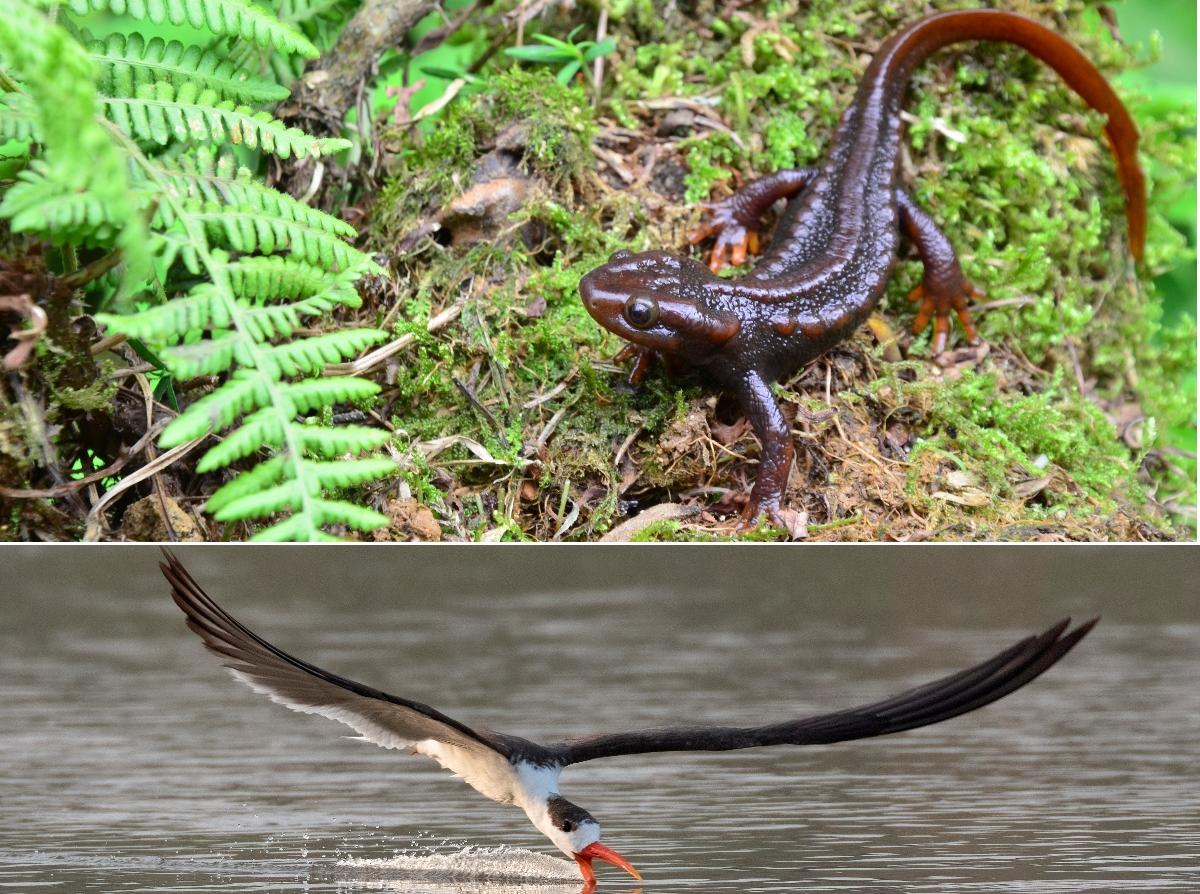
The Himalayan salamander (top), endemic to the hills of Darjeeling and Eastern Nepal; and the Indian skimmer, which nests primarily along the banks of the Chambal river in Central India.
Both species remain little known outside conservation circles, despite serving as important indicators of the health of the ecosystems they inhabit. “They may not be charismatic or widely celebrated, but they are deeply important to the ecosystems they inhabit. When we protect an indicator species, we are also protecting forests, wetlands, streams, soil health, and entire ecological processes that countless other species — including people — depend on,” says Subba.
Involving the local community
The salamander was once widely distributed across Darjeeling, but is now restricted to less than 50 hectares of its former habitat. “What drew me to the Himalayan salamander was that it represented everything fragile and overlooked about our mountain ecosystems. Here was a species that had survived for millions of years, yet very few people even knew it existed,” says Subba.

Tea plantation workers in Darjeeling. | Photo Credit: Courtesy Whitley Fund for Nature
“Their home is disappearing. Wetlands are being drained, disturbed, filled or polluted. Many breeding sites now dry earlier because the rainfall pattern has become erratic. The salamanders return to their natal site to breed and lay eggs — a process known as philopatry — which makes them highly vulnerable. So, when a wetland is lost, an entire future generation can vanish,” she adds.
A scientific advisor with the NGO Federation of Societies for Environmental Protection, Subba has been working on restoring the wetlands frequented by the salamanders, removing invasive species, and monitoring threats such as the deadly chytrid fungus that has affected amphibian species across the world. She also engages with local communities as a part of her work.
Where the Indian skimmer nests
A similar initiative is helping the Indian skimmer along the Chambal river where it nests every year. Shaikh, a scientist with the Bombay Natural History Society, has been working on conserving the bird species since 2016. She is the founder of the Guardians of the Skimmer initiative, which involves local communities in protecting and monitoring the nests of the bird. Numbering around 3,000 in India, the skimmer nests primarily along the banks of the Chambal (originating in Madhya Pradesh and flowing through Rajasthan and Uttar Pradesh to join the Yamuna) from March to June, and is highly susceptible to attacks from feral animals, including dogs.

Parveen Shaikh at work. | Photo Credit: Courtesy Whitley Awards
“The initiative not only provides seasonal employment opportunities for local riverine communities, but also, as a consequence, leads to them taking an active interest in the protection of all native aquatic fauna,” says Shaikh. As a result of these efforts over the last decade, the population of skimmers along the Chambal river has increased more than two-fold, from 400 individuals to over 1,000, while nest survival rates have also doubled in the same period.
Courtesy Whitley Fund for Nature
Shaikh says that with the Whitley Award funding, the initiative can be expanded to Prayagraj in Uttar Pradesh, where the Ganga and Yamuna converge. “Prayagraj represents one of the most culturally and spiritually significant cities in India. Conservation efforts here must navigate pressures from pilgrimage-related disturbance, boat traffic, fishing and pollution,” says a press release from the U.K. charity Whitley Fund for Nature, which gives out the Whitley Award. In addition to £50,000 (approx. ₹64.75 lakh) in project funding over one year, the awards provide profile and training.

Barkha Subba and and Parveen Shaikh (far right) with other winners at the Whitley Award ceremony in London.
Both Shaikh and Subba acknowledge the role of local communities in protecting keystone species such as the skimmer and the salamander. “The river communities that work with us show that they are indeed a part of the solution in conservation practice. Conservation is equally about human communities as it is about wildlife,” says Shaikh.
Parveen Shaikh at work.
Barkha Subba at work in Darjeeling. | Photo Credit: Bhaskar Chettri
With two women winning the award, Shaikh also hopes that more women find inspiration to become scientists and conservationists. “The scenario is definitely changing, with more women becoming involved in conservation. But it is important that even more come forward to do so.”
Neha Sinha, conservation biologist and author, says that the awards are an “important recognition” of lesser known species that are heavily dependent on conservation interventions in India. “Both species are nearly endemic to India yet do not have the popularity they should enjoy, in terms of policy or funding intervention,” she says. “It is amazing not just that these talented women have been awarded, but also that their focus is on species which have largely been overlooked. Their work also draws attention to places outside protected areas, and the importance of hydrology for conservation and not just for human use.”
rohan.prem@thehindu.co.in